The 1628 VOC ship reconstruction has been afloat for 31 years. Now engineers have to transfer her weight from the water onto a purpose-built steel cradle without damaging her.
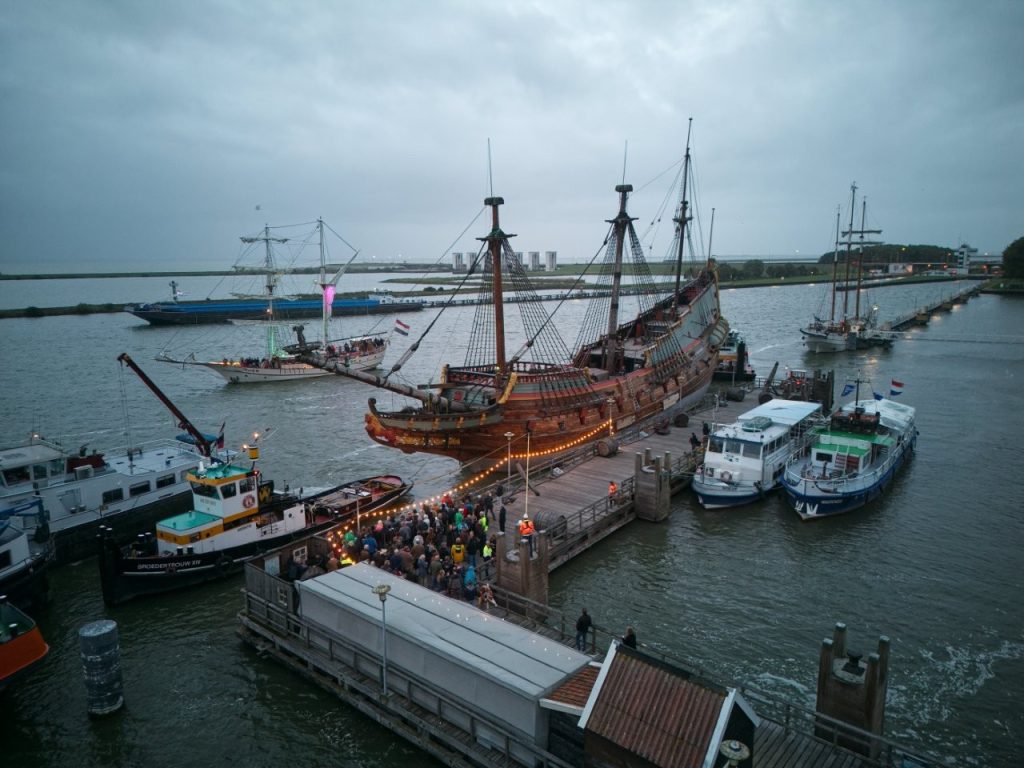
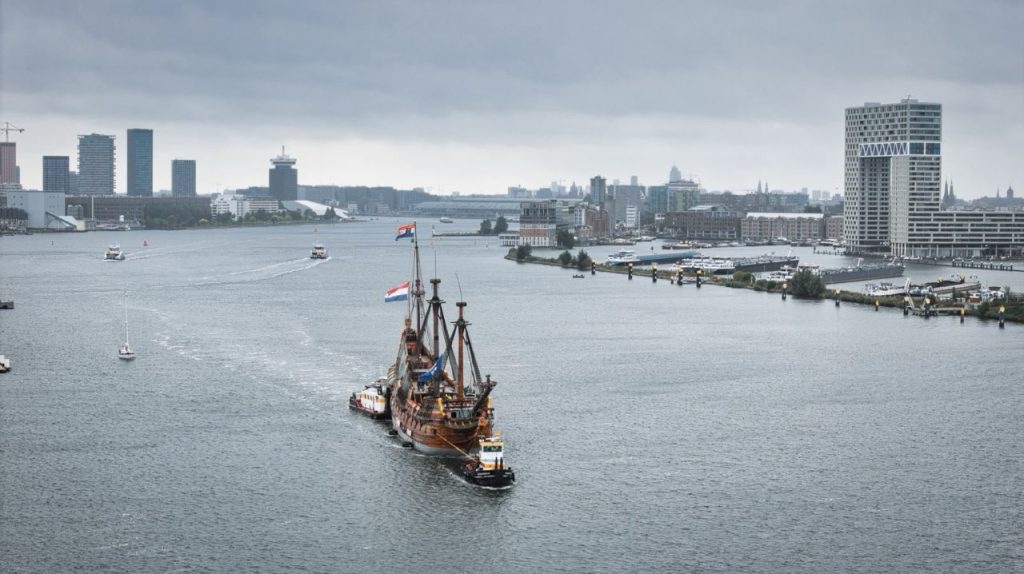
Batavia arrived at Damen Shiprepair Amsterdam on Saturday 19 September after a six-hour tow from Museum Batavialand in Lelystad, the start of an operation that will put the 56.6-metre reconstruction of the 1628 Dutch East India Company retourschip permanently ashore after 31 years afloat.
Batavia arrived at Damen Shiprepair Amsterdam on Saturday 19 September after a six-hour tow from Museum Batavialand in Lelystad, the start of an operation that will put the 56.6-metre reconstruction of the 1628 Dutch East India Company retourschip permanently ashore after 31 years afloat.
The move is about long-term preservation rather than a one-off repair. Museum Batavialand says being on land will let the hull dry out naturally, give it better protection from the weather, and make it possible to carry out more targeted maintenance than is practical while the ship sits permanently in the water.

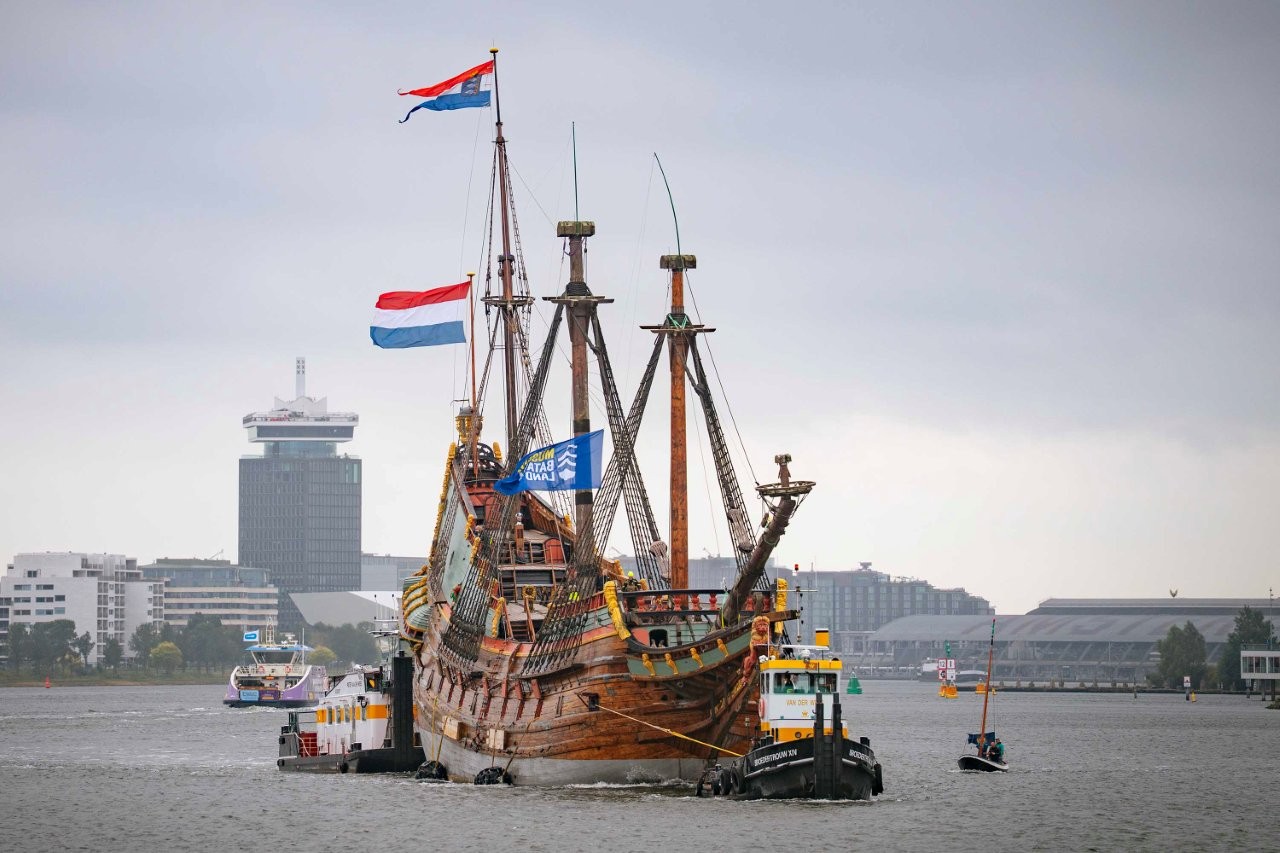
She travelled to Amsterdam under her own hull rather than on a barge or pontoon, masts standing, towed by two tugs from Koninklijke Van der Wees. Placing her on a pontoon for the passage would have introduced loads her hull was not built to carry, so she stayed in the water, with her full rig in place and a 30.5-metre air draught. Her guns and most of her ballast had already been removed, and temporary steel shoring fitted in the hold and on deck, to absorb the loads that arise once the supporting buoyancy falls away.
Rebuilding a ship lost in 1629
The ship being handled so carefully in Amsterdam is itself the product of an unusual piece of experimental shipbuilding. The original Batavia was built in Amsterdam in 1628 as flagship of that year’s Dutch East India Company fleet to the East Indies, and never completed her maiden voyage. She struck a reef in the Houtman Abrolhos, off Western Australia, on 4 June 1629. With the ship lost and senior officers away seeking help, VOC merchant Jeronimus Cornelisz took control of the survivors; he and his followers went on to kill more than 100 of them before a group led by soldier Wiebbe Hayes resisted, and commander Francisco Pelsaert returned with a rescue ship.
More than three centuries later, shipwright Willem Vos set out to build a reconstruction at Lelystad. No original timbers survive – the excavated remains of the wreck, now held by the Western Australian Museum, were studied as evidence rather than built into the new hull – and no complete 17th-century construction plans existed for a ship of this kind. Vos’s team worked instead from that archaeological evidence, historical accounts and comparable surviving vessels, including the Swedish warship Vasa. Construction began in 1985 and ran for ten years, doubling as a training project: more than 600 young people took part through vocational training and youth-employment placements before the ship was completed and christened by Queen Beatrix in 1995.
That history is back at work in the current operation. Jan Kuperus and Rienk Gardenier, who trained as apprentices under Vos during the build, returned through their firm Kuperus & Gardenier to verify Batavia‘s dimensions and weight and identify the hull’s vulnerable areas ahead of the move into dry dock. Vos himself, now in his mid-80s, was at Lelystad to watch the ship he built leave on the morning of 19 September.

Getting 650 tonnes onto a cradle
In dry dock 4 – the same dock Batavia was launched from in 1995 – she will be lowered onto a purpose-built cradle of steel and timber, 39.7 metres long and 15.5 metres wide, weighing 87.2 tonnes of steel and 14 tonnes of wood. Crane mats go down on a Van der Wees pontoon to spread the load and support pots are set on top, before the cradle is craned into place from the quay. The pontoon is then ballasted down and submerged in a dock bed Damen designed specifically for the job, and two small tugs manoeuvre Batavia over the cradle. Once the dock is pumped out and she settles into her supports, the remaining gaps between hull and cradle are packed with timber – a job expected to take two days while the structure beds in.
The load model took ten months to develop, and the wider dry-docking sequence has been engineered over 14 months. FaraFlash established Batavia‘s dimensions and weight and produced the basic cradle design, before Q3 Heavy Lift carried out the detailed engineering, including the support and jacking arrangement, and Niron Staal fabricated the cradle. Trans Global Projects handled project management, risk analysis and permitting.
Paul van de Craats, Commercial Manager at Damen Shiprepair Amsterdam, trained during the years Batavia was being built. “I followed the construction of this ship during my own training years, under Mr Vos, and what struck me was that they built her authentically and taught young people the carpentry trade while doing it,” he says. “We work the same way; we train our own people on the job to master ship repair. Dutch maritime history came into dock 4 in 1995 and it is back now.”
Once dry, the pontoon will be deballasted and the dock reflooded until it lifts pontoon and ship clear of the cradle’s supports, and Batavia will be towed to the quay for her remaining ballast to come off. With that ballast gone, she will weigh almost 650 tonnes for the return journey. She is scheduled to leave for Lelystad by pontoon on 1 October and come ashore at Museum Batavialand the following day, dates the museum says remain subject to weather and operational conditions.
Once back in Lelystad, Q3 Heavy Lift will use self-propelled modular transporters to move Batavia off the pontoon, jack her into position and place her on a new concrete foundation built by Anton Bouw- en Betontechniek.
“We normally move transformers and offshore structures for a living,” says Ard Suvaal, Project Manager at Trans Global Projects. “Nobody ever sees that work, except for the people who are inconvenienced by road closures. This project is different: it’s highly public and has enormous historical value.”
The move ashore is part of a larger redevelopment of Museum Batavialand, due to bring its shipyard, Batavia and its exhibitions onto one site by the end of 2028.