Kingfish are an enigma. One day they smash anything remotely edible, baits and lures alike, the next they seem to have their mouths sewn shut. Unfortunately, the second scenario is far more common than the first!
However, using a frisky live bait or an effectively manipulated dead bait can often unravel those ‘stitches’, especially when presented on a suitably-sized hook attached to a leader that’s not so thick it’s obvious.
Sounds simple enough, but kingfish are notorious for finding structure and breaking off, so you want the leader to be as strong as possible, and long as well, to protect against bust-offs – a Catch 22 situation.
Choosing the right leader is a balancing act with several factors to consider: the strength of your tackle; the leader material; the underwater topography of the area you are fishing; and the live-bait species.
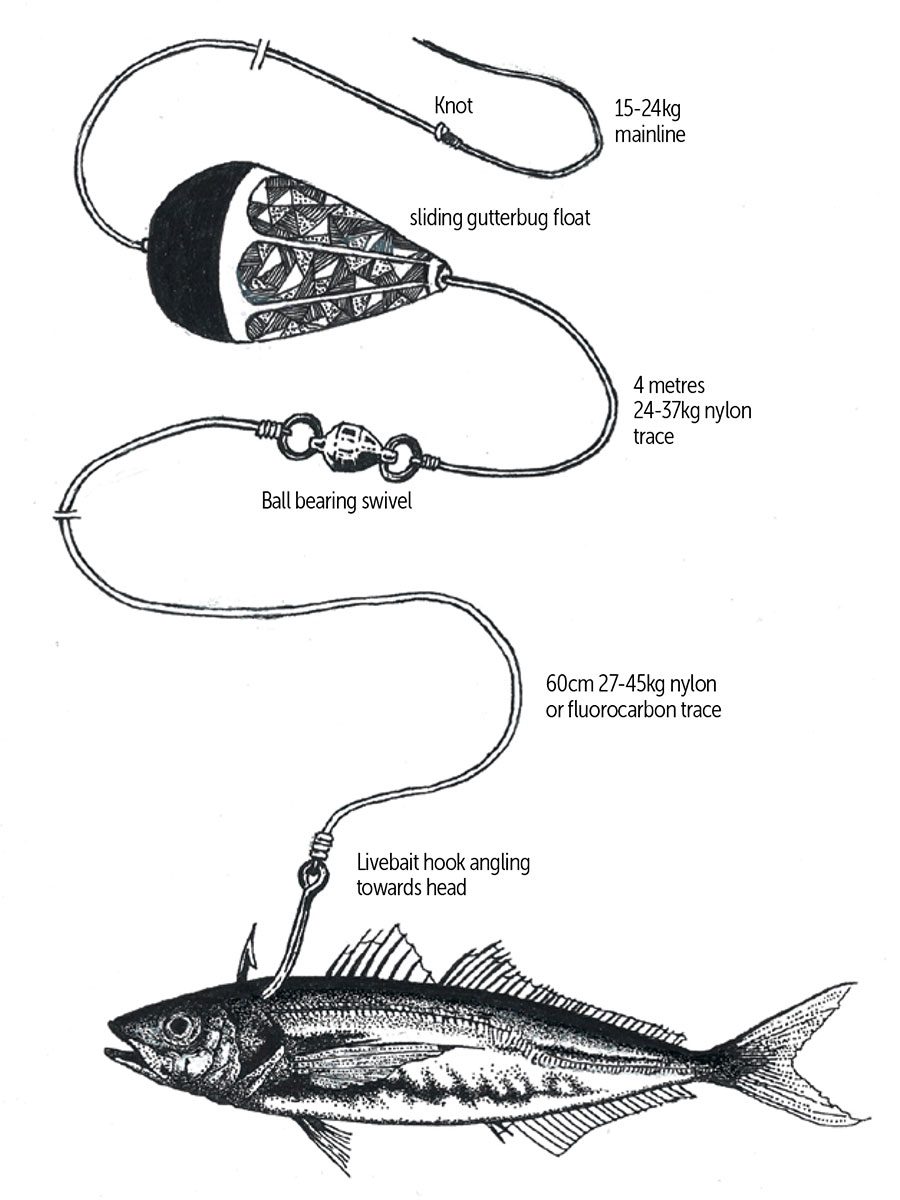
Kingfish tackle: Although I enjoy the challenge when accidentally hooking kingfish on light tackle, the word ‘challenge’ should be emphasised as kingfish often break off on light tackle for various reasons. So when specifically targeting them, do yourself and the kingfish a favour by using suitable robust tackle: while 15kg gives the angler a decent chance if the fish are of modest size and the area is relatively clear of obstacles, a 24kg or 37kg set-up is more appropriate when targeting large kingfish over foul ground.
Once you’ve selected your tackle, choose a leader that is at least as as strong as the reel’s mainline, but preferably stronger (thicker), for protection against abrasion damage. Leader material and length: Your choice is either monofilament nylon or fluorocarbon (wire trace is highly visible and puts kingfish off biting). Nylon trace material is engineered for toughness and abrasion resistance, is relatively easy to knot – especially using a uni knot – and is fairly supple. Compared to nylon leader, Fluorocarbon leader is harder to see (for fish) and more abrasion resistant (though often thinner), but harder to knot, less supple and considerably more expensive.
Whatever material you choose, make your leaders as long as is practical – I make mine to fall within the conventional IGFA sport-fishing rules (i.e. a maximum of 30 feet for lineclass weights to 15kg, and 40 feet for lines of 24kg and over). That’s because kingfish can drag quite a bit of line through jagged rocks and seaweed in their efforts to escape, so the more abrasion protection you have, the better the chances you and the fish stay connected.
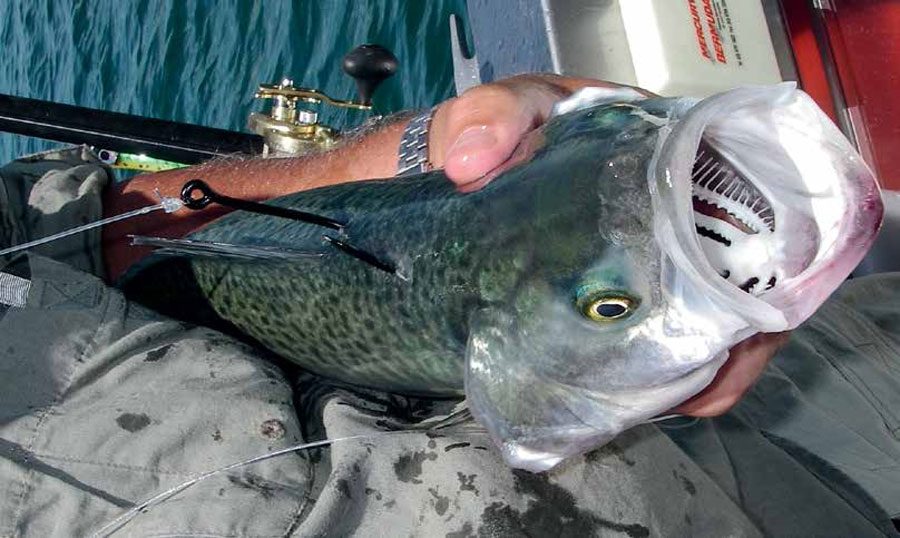
The other reason I like longer leaders is they allow the live bait more scope to charge around giving off stronger vibrations. Live baits on longer leaders attract kingfish from further away and often excite them enough to eat the bait. The area: The rockier and weedier the area, the stronger the gear and leader should be, as even modest kings are strong enough to wrap anglers up or break the line in foul ground. In such situations, the difference between success and failure often comes down to the thickness and length of the leader – and how well it has been connected to the mainline. Obviously, the thicker and tougher the trace material the more protection it affords, but just how thick the leader should be is largely determined by the size and type of bait.

The bait: To some degree it seems that the bigger and friskier the bait, the less the leader thickness (breaking strain) matters – provided the bait is small enough for kingfish to eat! So, while a big kahawai or trevally bait around 2-2.7kg should ideally used on a leader of 45-55kg, 70kg or even 90kg is not necessarily over the top, especially if marlin are also a possibility, as can be the case when fishing some of our more remote offshore grounds – the King and Middlesex Banks off the Three Kings Islands, for example.
At the other end of the scale, a large piper or medium-sized yellowtail mackerel is better deployed using a length of 24kg leader, although it may be necessary to go up to 27kg or even 37kg if the ground is particularly unforgiving, or down to 18kg if the kings are wary.
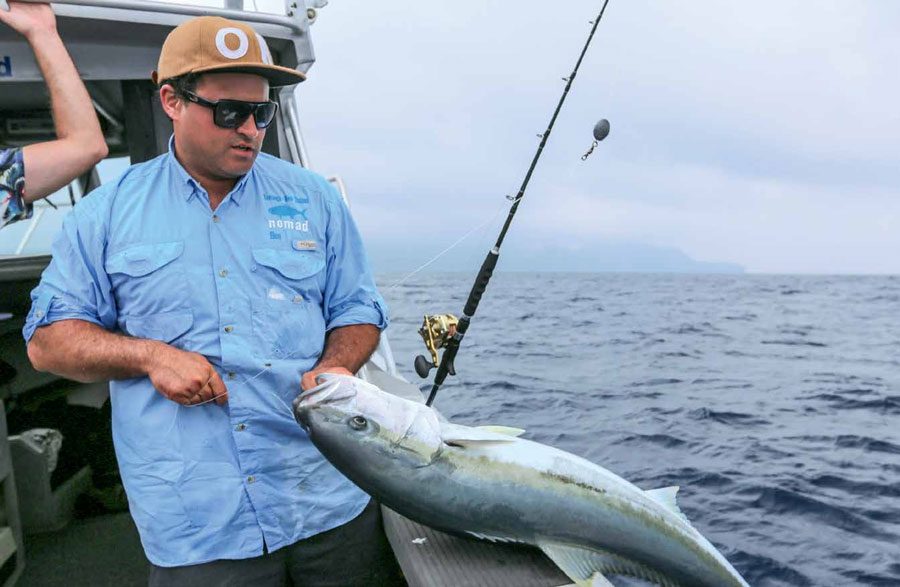
MATCHING LEADER LENGTH AND THICKNESS TO BAIT SIZE
• BAITS TO 20CM (i.e. small mackerel or mediumsized sprats and piper): three to six metres of 18-27kg trace, 5/0-6/0 hook.
• BAITS TO 30CM (i.e. small kahawai, medium-sized mackerel and trevally): three to six metres of 2737kg trace, 6/0-7/0 hook .
• BAITS TO 40CM (i.e. medium-sized kahawai or large koheru): three to six metres of 37-45kg, 8/0-9/0 hook.
• BAITS TO 50CM (i.e. large kahawai and trevally): four to six metres of 45-54kg, 10/0 hook.
OTHER USEFUL TIPS
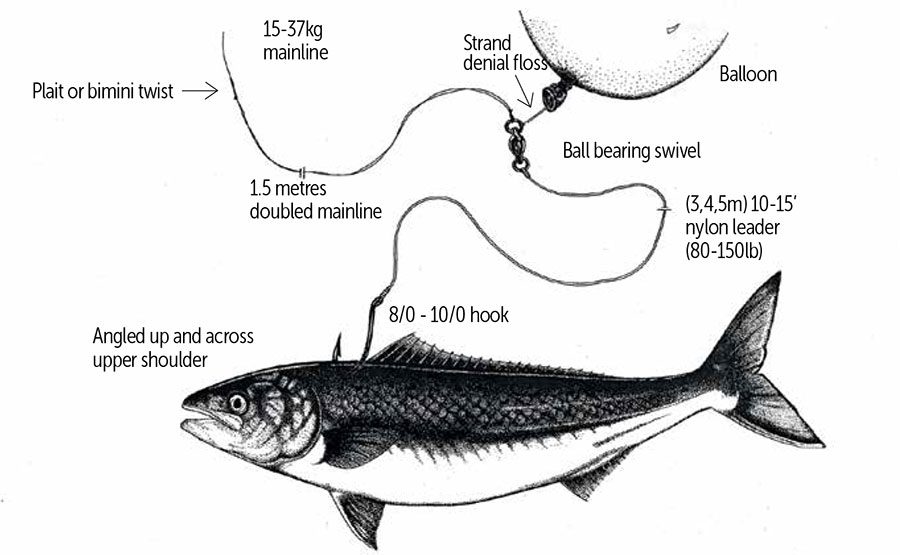
Incorporating a ball-bearing swivel into the terminal rig is always recommended as live baits often swim in circles, causing leader twist. Standard swivels bind up under pressure, so are not as good.
Use uni-knots to connect the swivel to both the mainline and leader – they are simple to tie and work with most line types and diameters.

If using a balloon, tie it to the rear (top) ring of the swivel using a doubled over length of cotton (you can also use dental floss), so the swivel is still able to rotate freely.
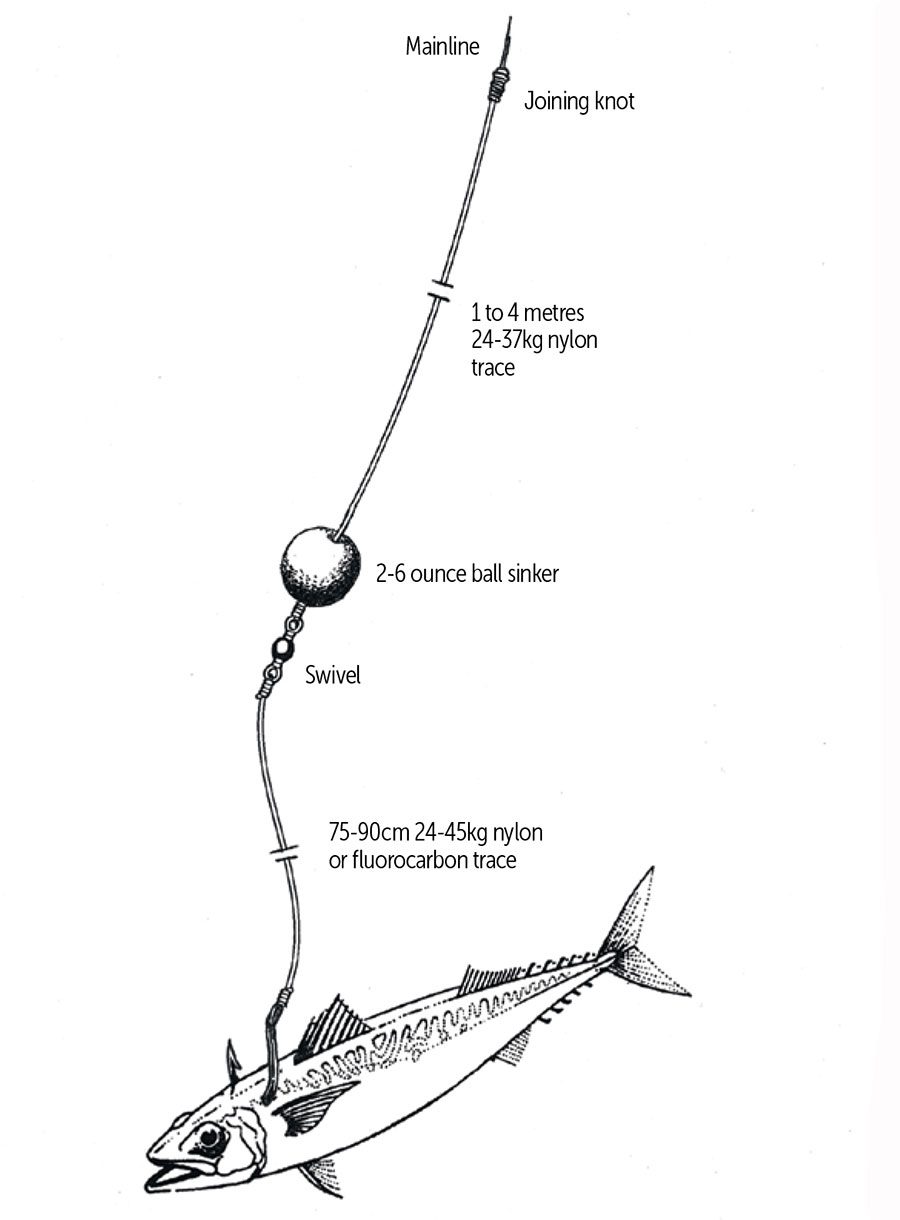
If gently casting out using a float, connect the mainline to the trace with an Albright (nylon) or an FG (braid) knot, and insert a ball-bearing swivel between the float and live bait about 50-60cm from the bait. The float can then slide freely on upper (longer) section of the trace the leader joining knot acting as a de facto stopper – or use a stopper knot.
When fishing a sinker, you can still employ a long leader, but knotted to the mainline with an FG (braid) or Albright knot (nylon) and dispensing with a swivel. Back-to-back uniknots are okay to use if re-rigging in a hurry, but less strong.
If using a swivel with your weighted rig, at least a metre of trace between the swivel and the hook allows the bait enough freedom of movement. BNZ