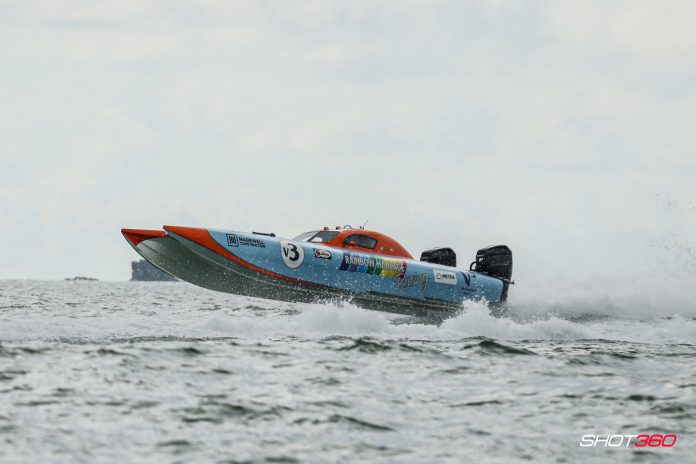
Probably one of the most hotly-discussed topics within the powerboat racing community is steering types – what’s good and what should be avoided.
Huge advancements in steering have been made in the last 5-10 years, with fly-by-wire, power and electric steering adopted by many manufacturers. But older and still very functional systems still compete successfully, including hydraulic steering and rack-and pinion. In the local market an overwhelming majority of racers prefer outrigger-styled wire-rope steering – and this has been the favoured system among powerboat racers for decades.
It should be stressed that all the steering options above get the job done, but some get it done better than others – it’s horses for courses.

It’s long been said that the way to set a ski hull up for racing is to install wire rope/pulley outrigger steering, and whilst it’s not incredibly difficult to do, there is much that needs to be done correctly to get the best from it. Firstly, there is an array of options available for outrigger steering setups, as well as attachment positions on the engine itself. What’s critical is ensuring that the pivot point of the outrigger (the eyelet at the end of it) is in line and at the same height as the pivot/swivel unit on the mid-section.

From there, the next critical piece is ensuring that the pulley’s shackle lines up with the trim/tilt tube to ensure the geometry is correct. Much of the finer detail will depend on the final position of through-hull pulleys on the transom, but this system is adaptable by adding and subtracting connecting shackles until the ideal result is achieved. There’s a fair bit of trial and error involved.
Why wire rope? Many drivers believe wire rope gives them a real time feel for the boat’s attitude and its response to steering tweaks. And the faster you react the faster you can run. The downside is the amount of maintenance: constant checking of shackle connections, yearly or biannual replacement of cables, and servicing the helm bushings themselves. However, it’s all straight forward, easy DIY, if somewhat time consuming.
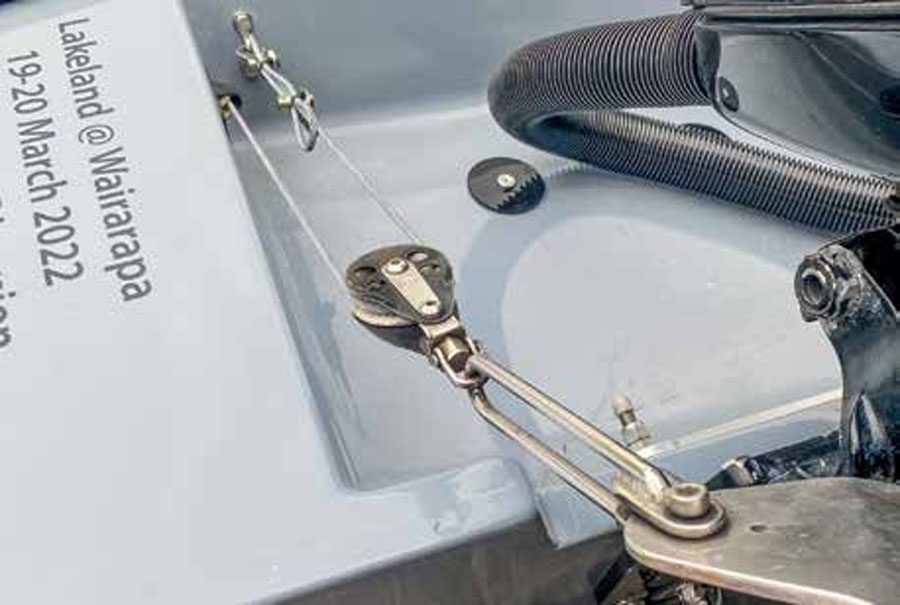
Another contentious point is what cable to use. Most racers tick with galvanised steel cable (it shows signs of wear more clearly than stainless steel cable) – just make sure it’s a 5mm diameter 7×19 strand wire to allow it to flex around the sheaves nicely.
Hydraulic steering is a go-to for many in the racing community, largely due to its ease of fitting, relative ease of maintenance, and tidy installation. However, hydraulic steering is known to suffer air bubbles and slow bleed/ creep if not maintained to the highest standard. And while steering wheel creep’s not a massive issue, it does lead to the top centre of the wheel slowly rotating around the clock face, meaning you no longer have an accurate visual prompt to centre the steering.



That said, hydraulic steering was a turning point in the social ski scene because steering became physically so much easier, and it eliminated the torque-steer of the motor, making it more comfortable to use with today’s higher horsepower (higher torque) engines.
However, many racers running new four-stroke outboards with electric/power steering have also opted to retrofit outrigger steering. Could it be the tried and true is still the way to go? BNZ