


A couple of years ago, our favourite anchorage around Waiheke was Putaki Bay; a calm, sheltered spot within easy walking distance of the local supermarket. Each trip ashore, we’d pass a row of small yachts standing neatly on their “legs” along the foreshore. At low tide they rested upright on the sand, connected to land by simple wooden planks that served as gangways. By high tide, those same boats were afloat again, the planks half-submerged and their sterns gently swinging in the water.
This sight isn’t unique to Waiheke. One day, a wrong turn in Auckland led us to Little Shoal Bay, where a handful of yachts stood in the same quiet defiance of gravity. You’ll find them dotted around New Zealand’s coast; small craft resting squarely on twin fins, poised and patient, waiting for the sea to come back.
These are bilge-keel boats; twin-keeled craft built to do something few yachts can manage: go aground in style.

Instead of a single deep fin, a bilge-keeler carries two shorter keels mounted either side of the hull. Under sail they act as stabilising fins, reducing roll and providing lateral grip; when the water drains away they become the boat’s legs, letting her rest upright without props or cradles.


The idea began in Britain, where five-metre tidal ranges demanded practicality. Yet it suits New Zealand just as well, where bays, estuaries, and river mouths dry daily. For hands-on Kiwi sailors, a bilge-keel boat offers freedom and self-reliance.
The twin-keel concept dates to the 1920s, when Lord Riversdale and then Yachting Monthly editor Maurice Griffiths designed the Bluebird of Thorne, a cruiser that could sit safely on the seabed between tides. Their outward-splayed keels kept the yacht upright when dried out and efficient under sail.
The idea soon spread through British yards such as Westerly and Moody, and by the 1970s it found a New Zealand champion in Ray (R.G.) Hart of Hart Brothers Marine.
Enter the aptly named Beachcomber 6.5, a true Kiwi original. A 1972 Beachcomber Bilge Keeler (early series) currently listed on Trade A Boat sparked my curiosity. Designed by Hart and built locally between 1970 and 1980, the Beachcomber 6.5 was a compact cruising yacht crafted for New Zealand waters. There’s even a surprisingly detailed Wikipedia entry dedicated to it. Around 89 hulls were launched, most carrying the now-classic bilge-keel configuration.

Come across one and you’ll find a compact little cruiser, 6.5-metres LOA (slightly less on the waterline) with a 2.45-metre beam, giving a length-to-beam ratio of about 2.65. That puts it toward the beamy end of small monohull cruisers, exactly what you’d expect from a bilge-keeler built to dry out, feel stable, and offer generous living space. With a 0.6-metre draft, the design reads as a shoal-draft coastal cruiser; beamy, steady underfoot, happy in shallow anchorages, and able to stand level when the tide runs out, trading a little windward edge for a lot of practicality.
Spar height is 8.53-metre (28-foot) carrying roughly 9.6-metre² of mainsail and 8-metre² of jib or genoa. The fibreglass hull uses a 12-mm end-grain balsa core, making it strong yet light for the era.
Early Beachcombers, including the 1972 models, carried square cast-steel bilge plates on each side of the hull; a simple, rugged design that reflected the boat’s practical Kiwi origins. These early keels gave the Beachcomber its signature shallow draft and the ability to sit level on sand or mud, perfectly suited to the tidal bays of the Hauraki Gulf.
A 1972 Beachcomber, listed on Trade A Boat as I write this, provided the inspiration to dig deeper into the fascinating world of bilge keels. https://www.tradeaboat.co.nz/detail/beachcomber-bilge-keeler-1049174
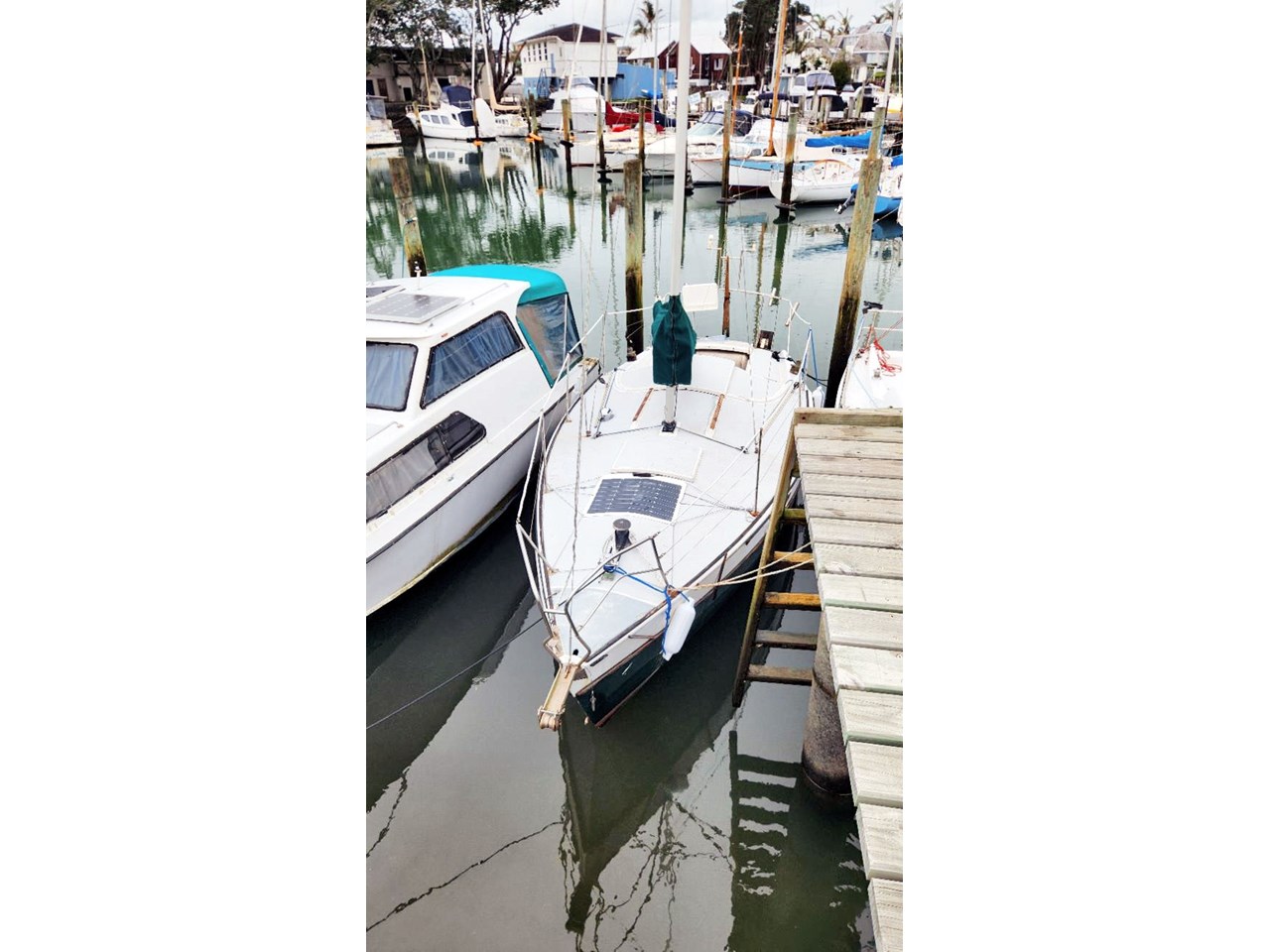
As production continued, designer Ray Hart refined the concept, introducing cast-iron swept fins with slim bulbs that added about 340 kg of ballast and a touch more stiffness under sail. Both versions share the same core appeal: a sturdy, go-anywhere coastal cruiser built to explore New Zealand’s shallows in comfort and confidence.
Bilge-keel geometry is carefully calculated rather than standardised. Naval architects place the keels at the turn of the bilge, where the hull curves from bottom to side, and adjust spacing according to the boat’s purpose:
- Hull beam and shape: Wider hulls allow keels to be set further apart, while rounder hulls bring them closer together.
- Stability when dried out: The distance between the outer edges of the keels, combined with the rudder, forms a tripod base that keeps the boat balanced on the ground.
- Hydrodynamic efficiency: As the yacht heels, the leeward keel becomes nearly vertical, producing lift and reducing sideways drift.
Hart’s Beachcomber struck that balance perfectly. Its twin keels were positioned for both firmness when grounded and steady performance under sail; ideal for cruising in shallow, sheltered waters.
For practical sailors, the bilge-keel’s virtues are many. A bilge-keeler can be beached deliberately on firm sand, allowing owners to step ashore or service the hull without a lift. In days past, antifouling can be applied between tides in gumboots and shorts, and a drying mooring costs a fraction of a marina berth. Today, of course, antifouling outside permitted hard-stand areas is frowned upon (at the very least).

Because the twin keels act as natural roll dampers, they make the boat steadier at anchor. And with a draft under a metre, they open up estuaries, lagoons, and tidal creeks unreachable to deeper-keeled yachts.
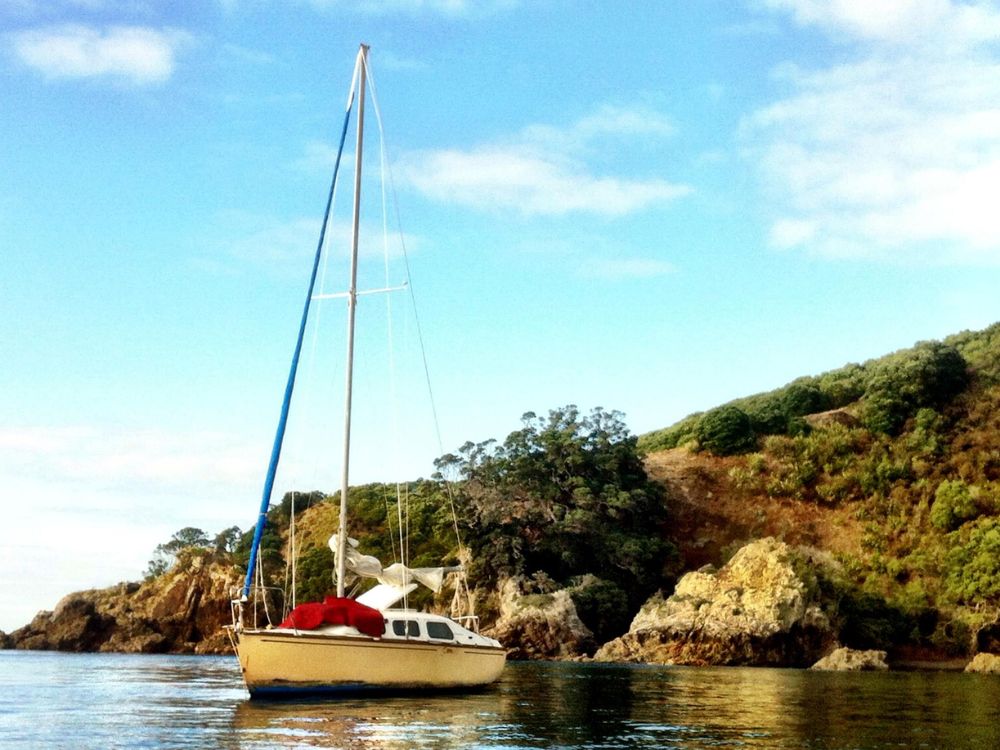
They’re not fast by racing standards; two keels create extra wetted surface and a touch more drag, but for cruising at six knots, the difference is negligible. As one Beachcomber owner quipped, “The fin-keel crowd might get to the pub first, but I’ll already be sitting upright when they arrive.”
Half a century after Hart Brothers built the first Beachcombers, many still grace New Zealand harbours. You’ll spot them resting level on their twin keels at low tide, a timber plank stretching to shore, the evening sun glinting off their masts.
They’re simple, tough, and self-reliant; traits that define Kiwi boating. In a country where tides shape every coast, the bilge-keel boat remains one of the smartest designs afloat.
And among them, the Beachcomber 6.5 endures as a true local classic, a small yacht with two legs to stand on.


Interesting article as I’ve always wondered about bilge keelers. I don’t believe antifoulingpermitted to is a permitted activity between the tides anywhere in the country. It’s certainly not in the Auckland region under the Unitary Plan as there is no way of managing contamination losses to the environment including heavy metals and biocides.
Perhaps best remove that “advantage” from the article. It is a real up hill battle to convince many in the marine sector that we can’t continue in the old ways now we understand the damage done.
Kind Regards
Mike
Hi Mike
Really good point, I have raised it with Kirsten, the author of the article, and she is going to make an update.
Best regards
Chris
Web Editor, Boating NZ