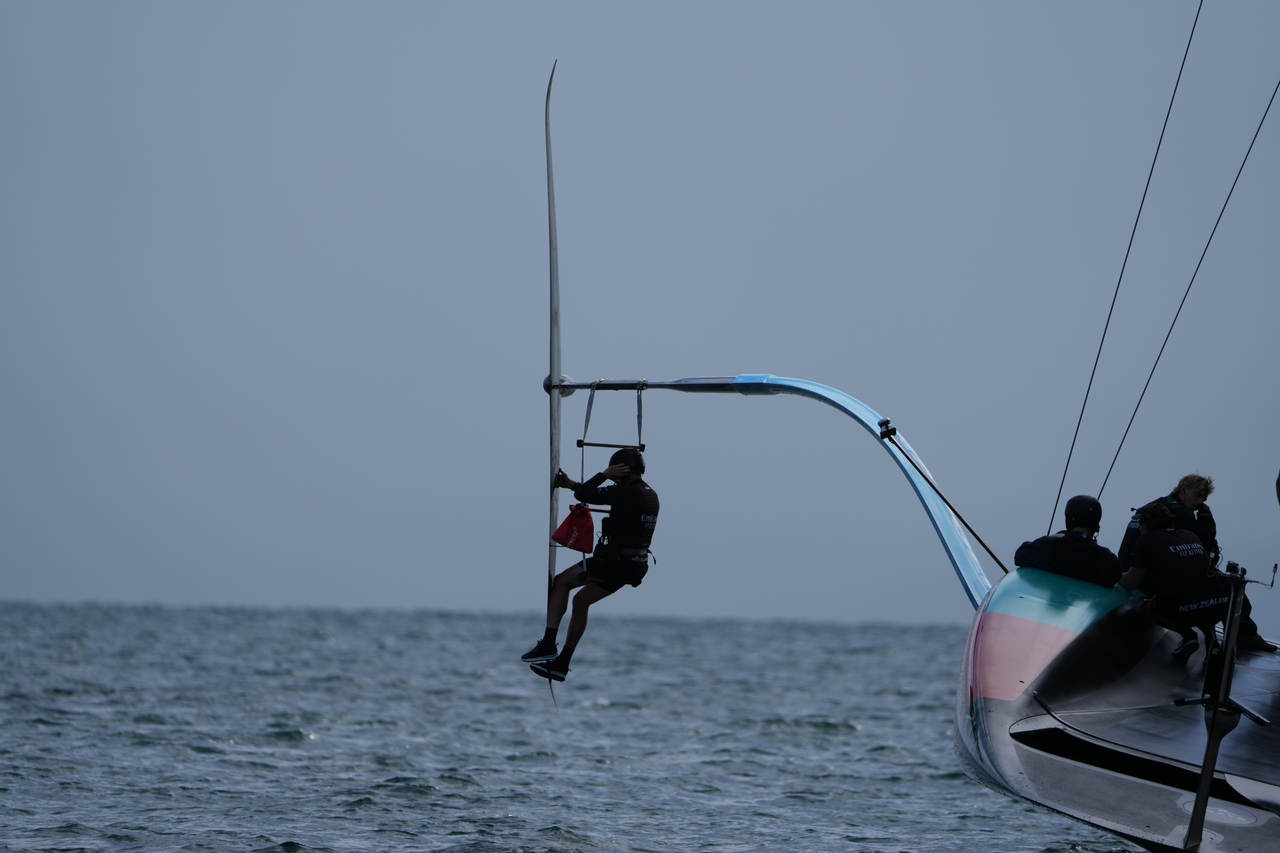
There is a certain logic to what happened on the Hauraki Gulf on Thursday. Emirates Team New Zealand spent the better part of four hours deliberately sailing their AC75 into uncomfortable territory, probing the low-speed edges of the foiling envelope, forcing stalls, testing rudder limits, and loading up sails in conditions that kept the breeze variable and the margins thin. When the tack of the Code J3.2 jib let go just after 1300hrs, sending the sail free of the forestay and rattling carbon battens against the mast, it was dramatic. It was also, in a sense, the session working exactly as intended.
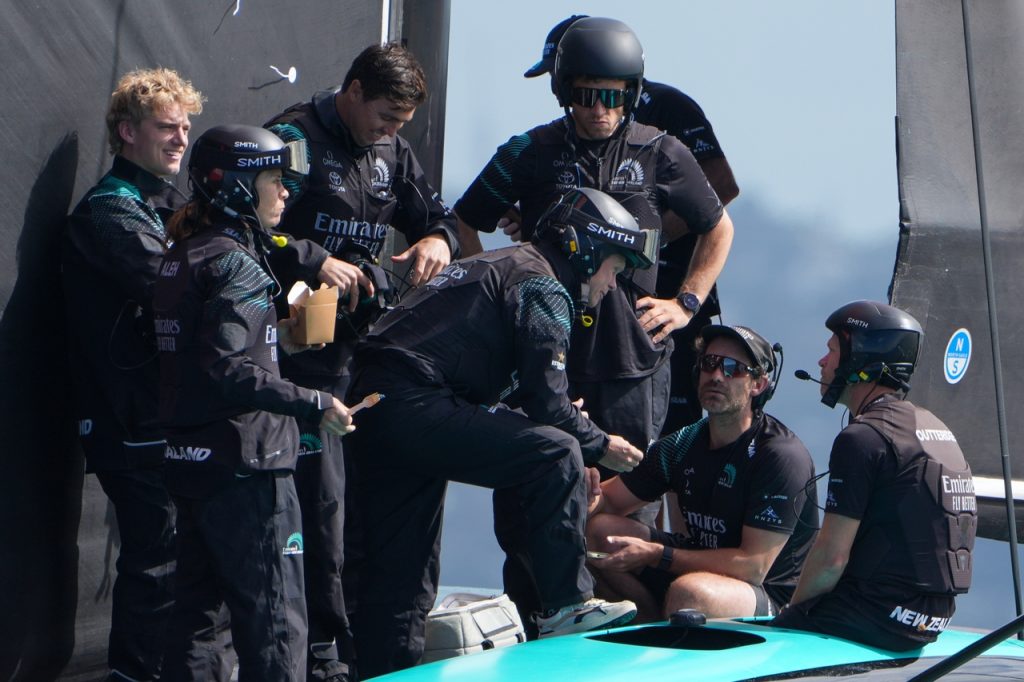
Co-helm Chris Draper, standing in for Seb Menzies while the regular helm competes at the 49er World Championships in Quiberon, France, was characteristically measured. “That’s part and parcel of pushing the structures on this boat and the sails,” he said. “One of those things.”
He is right, of course. But as Sail-World NZ’s Richard Gladwell noted in his recon report, there is a complicating factor sitting behind that pragmatism. The sails being pushed to those limits were legacy gear from the 2024 America’s Cup campaign, equipment originally designed to last a single Cup cycle that is now being asked to perform across a second. Gladwell observed that gear breakages, while rare for ETNZ, “may increase across all teams” as the Protocol’s requirement to use that legacy equipment begins to bite. What looks like a routine test failure may be an early signal of a wider constraint the whole fleet will be managing as AC38 preparations deepen.
The failure aside, the session itself painted a clear picture of where ETNZ’s development focus sits at this stage. The recon unit reported the team repeatedly entering what it described as a “high slow mode,” sailing at elevated ride heights and reduced speeds to map the boundaries of sustained flight. Takeoff speeds in the 14 to 15 knot range were logged, with the port foil’s stall limit sitting somewhere in the 16 to 18 knot band. Downwind speeds still reached into the mid-30s when the team opened up, but outright pace was not the point. Understanding exactly where control becomes difficult, and what happens at those margins, was.
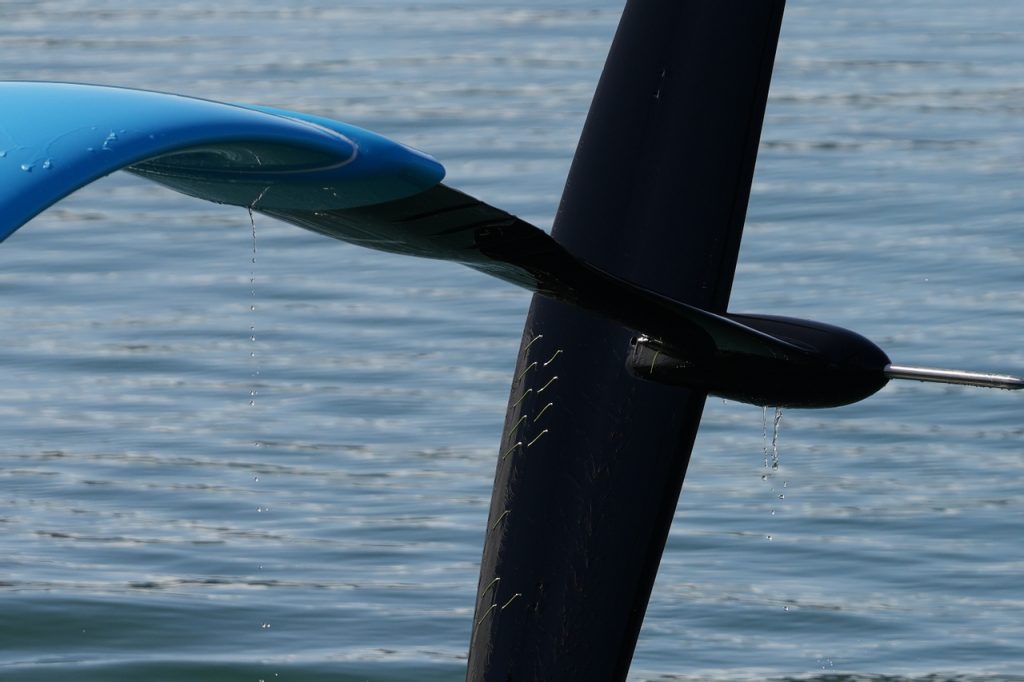
Tell-tales on the foil arm trailing edges and a camera focused on the junction between the foil arm and wing foil suggested the team were as interested in what the water was doing around the foils as they were in how fast the boat was going. An additional Starlink unit had been mounted on the communications pod since the last session, and battery changes were carried out at regular intervals throughout the day, underlining just how data-intensive these test campaigns have become.

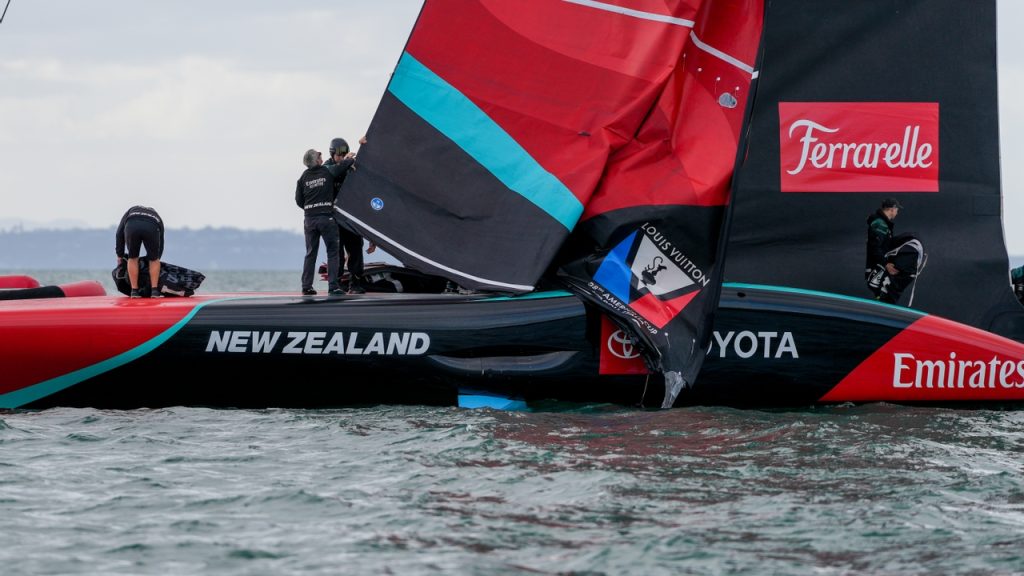
The breeze, ranging from 6 to 8 knots early and building into the 12 to 15 knot range through the afternoon, kept conditions variable enough that the team stayed on the J3.2 longer than they might otherwise have chosen. That decision, and the Cunningham load applied to keep the sail driving in the gusts, likely contributed to the eventual failure.
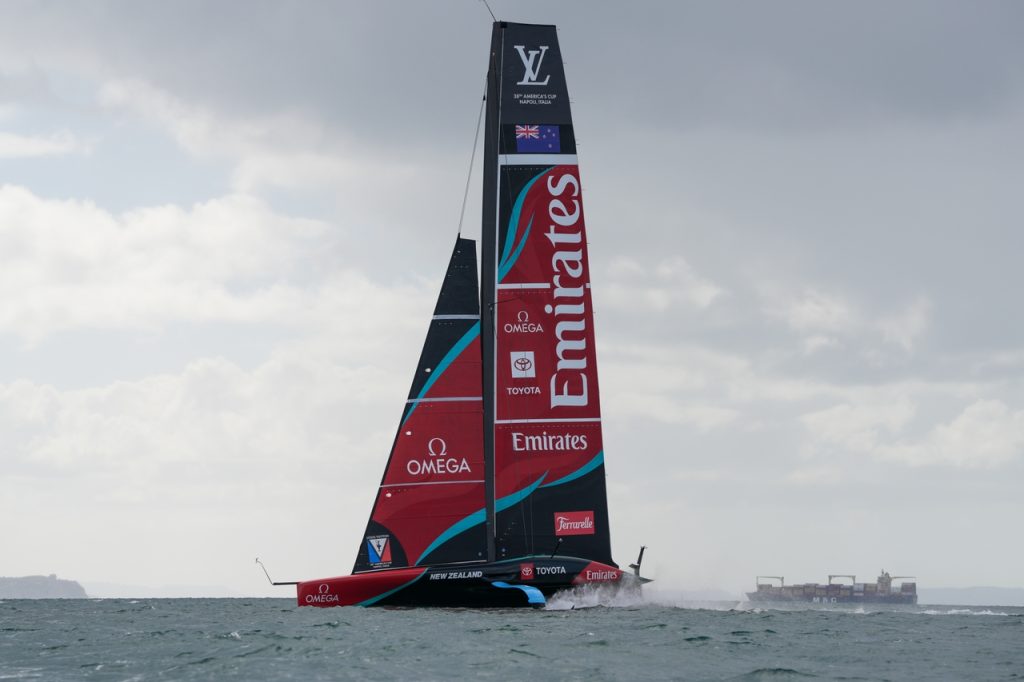
The session ended with the AC75 under tow back up the harbour at 1515hrs, the crew opting for a full rig check rather than fitting a replacement jib and continuing. Draper confirmed there appeared to be no structural or rig damage, the independent forestay having done its job.
The Kiwis are scheduled to resume testing Monday. There will be another jib ready. Whether the lessons from Thursday translate into a broader rethink of how hard legacy gear can be pushed is a question the whole fleet may be asking before long.
For the official America’s Cup account of the session, including on-camera footage of the jib tack failure, visit americascup.com.