When the first VHF marine radio was bolted into an Auckland Coastguard vessel in the 1980s, it was bulky, power-hungry, and needed constant coaxing. But when it crackled to life, everything changed. Crews could talk to the shore and to each other for the first time. It was, as Coastguard New Zealand reflects in a recent feature marking 50 years as a nationally united service, “the beginning of everything.”
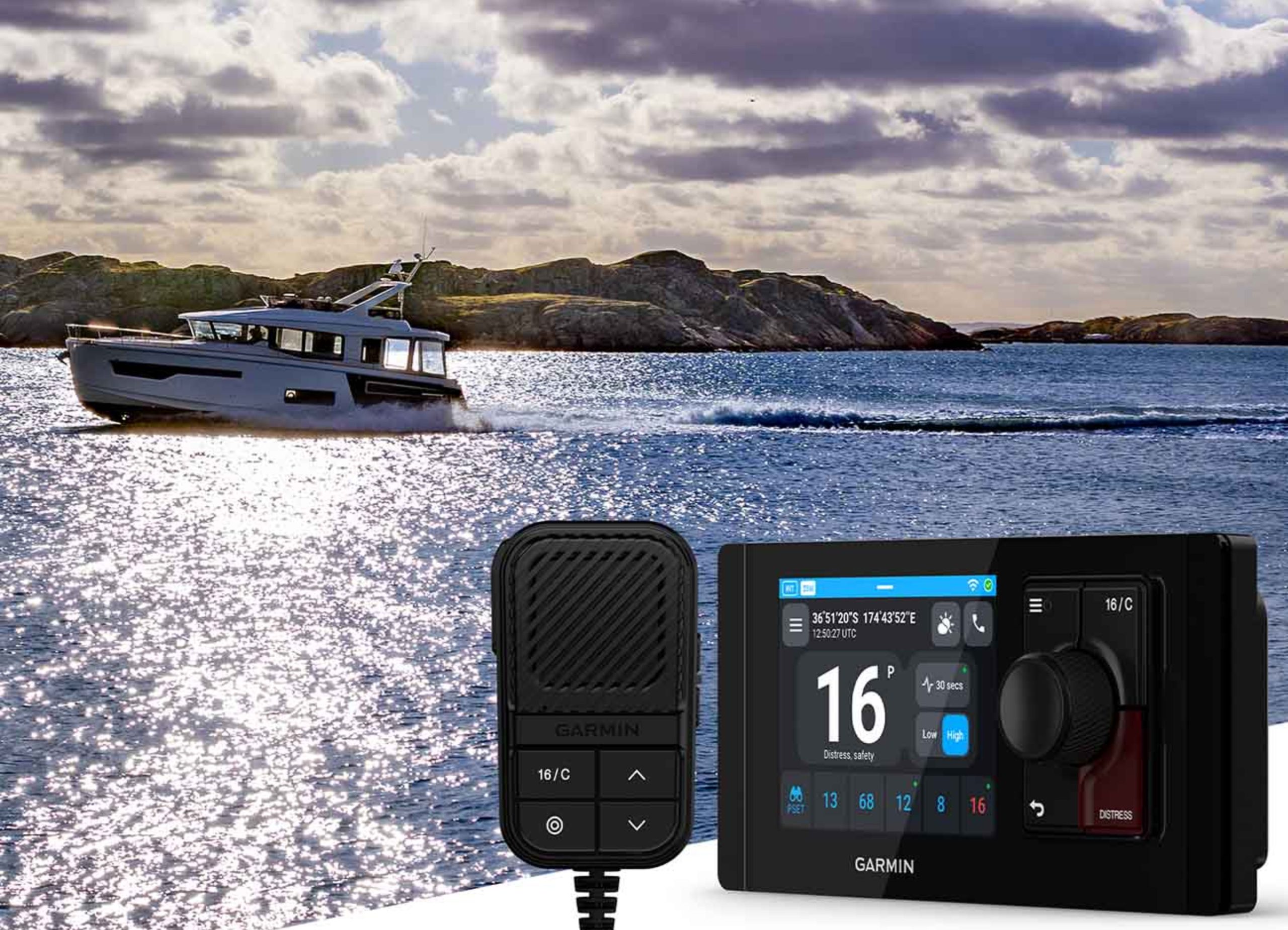
Four decades on, Garmin has just announced the Signal VHF 400 and VHF 220, and the contrast with those early units is striking. The new radios are among the smallest all-in-one marine VHFs ever made, yet they pack in an industry-first 3.5-inch colour touchscreen with edge-to-edge glass, built-in AIS, GPS, DSC, adaptive noise cancellation, and Wi-Fi connectivity. The technology that once needed a technician to install and careful handling to survive a splash now fits neatly at the helm and manages its own software updates over the air.
What’s in the box
Garmin is releasing two models. The VHF 400 ($2,399 NZD) is the flagship, with a Class B AIS transponder built in, meaning it both receives and transmits vessel name, position, course and speed to other AIS-equipped vessels nearby. The VHF 220 ($1,799 NZD) is AIS receive-only, making it a capable choice for skippers who want situational awareness without the full transponder package.
Both radios feature adaptive noise cancellation that automatically filters background noise for cleaner audio, and a VHF playback function that records up to three minutes of transmission from any active channel, across three channels simultaneously. For busy waterways or offshore passages where you need ears on multiple frequencies, an advanced watch mode lets you monitor six channels at once.

The included fist mic produces 95 dBA of audio at 0.5 metres, loud enough to cut through engine noise, waves, and wind, and can be mounted independently from the head unit for flexibility at the helm. Class D Digital Selective Calling (DSC) is integrated throughout: the distress button automatically transmits your vessel’s position and identity to emergency responders and nearby vessels, and DSC calls can be initiated directly from the AIS plotter screen.
Installation is straightforward, with VHF, DSC and AIS all running from a single antenna on the VHF 400, and support for both 12V and 24V electrical systems. The integrated GPS means no separate antenna is required for position data. Configuration, MMSI programming and software updates are handled through the ActiveCaptain smartphone app via Wi-Fi.
For larger vessels or those with a flybridge, the optional Signal RM 100 remote station ($1,199 NZD) connects via Garmin Marine Network and gives full radio control from a secondary helm position, complete with its own 3.5-inch display and fist mic. An intercom function allows communication between the remote station and the main unit.
Both radios integrate with Garmin chartplotters via NMEA 2000, Garmin Marine Network 1.0 and Garmin BlueNet, and support external speakers and loudhailer connections.

Why it is important on New Zealand waters
Coastguard New Zealand’s VHF history is a useful lens here. The challenge that defined early VHF in this country was coverage: signals travel in straight lines and don’t follow the Earth’s curve, meaning a vessel rounding a headland or threading through the Marlborough Sounds could vanish from radio contact entirely. The answer was a national network of repeater stations, built station by station over decades, positioned on high ground to fill the gaps.
That infrastructure is now mature. What’s changed is what you can do within it. The Signal VHF 400’s integrated AIS transponder means other vessels, harbourmasters and rescue services can see your vessel on their plotters without any radio call being made. The DSC distress function transmits your position automatically in an emergency, removing the pressure on a skipper in crisis to relay coordinates verbally. And the six-channel watch mode means you’re less likely to miss a call on a secondary frequency while monitoring Channel 16.
As Coastguard puts it, the radio operators who staff the watches around the clock depend on fast, accurate information: the vessel’s position, the number of people aboard, the nature of the emergency. Technology that automates that handshake, transmitting identity and position without human intervention, directly improves outcomes.
The Garmin Signal VHF 400 and VHF 220 are available now from garmin.com/en-NZ and authorised Garmin dealers.