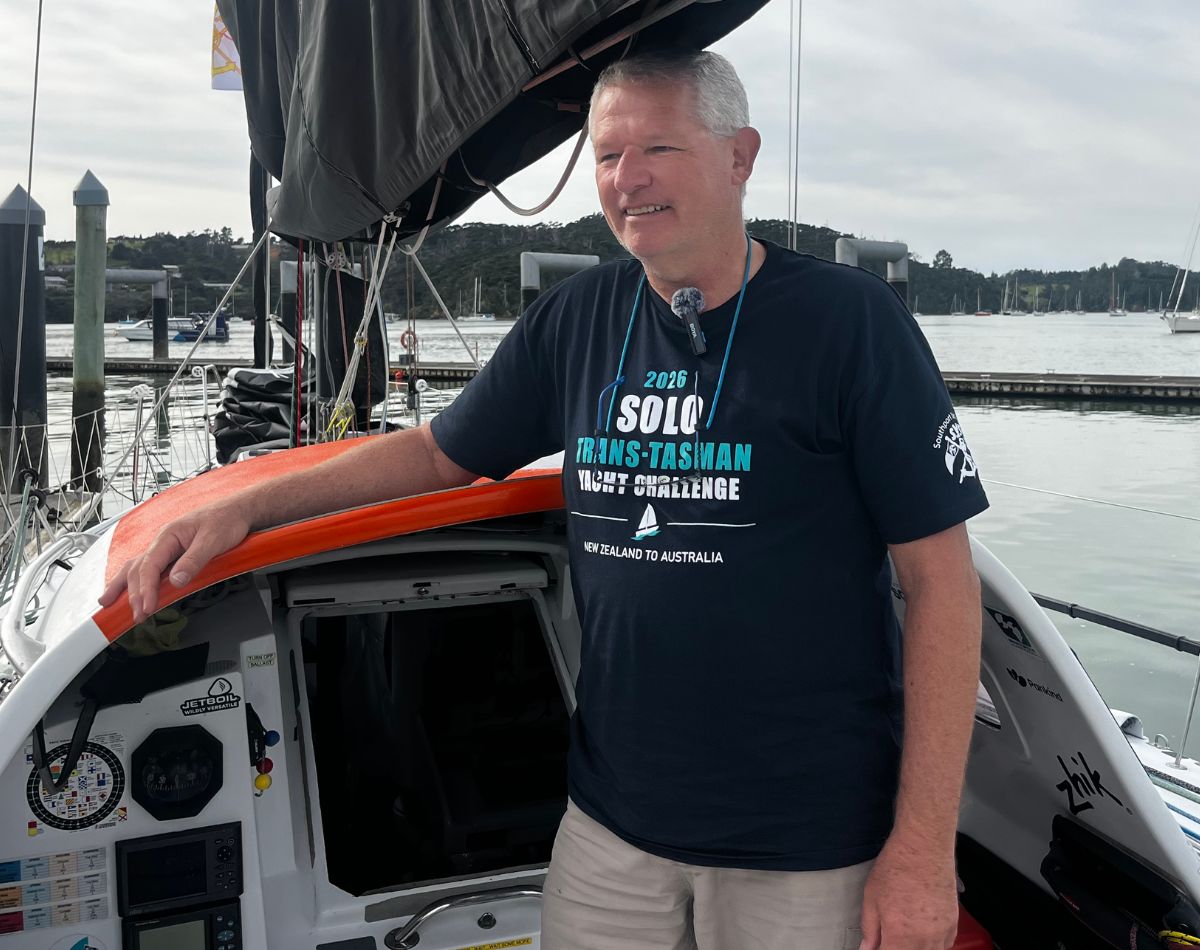
Kevin Le Poidevin is not your typical Trans-Tasman competitor. The Australian sailor arrived in Auckland nine days ahead of race start, having already completed a solo crossing from Newcastle, headwinds and all, just to get to the start line. “Nine days, two hours of brutal punishment on the nose,” he says with a grin. His fellow competitors have been ribbing him ever since for using up all the available easterly.
Le Poidevin races under the burgee of Port Stephens Yacht Club and brings with him a CV that would make most offshore sailors blink. He spent 15 years as a mechanic before serving 31 years in the Royal Australian Air Force, qualifying in avionics, instruments, radar and radio. He has done two previous Solo Trans-Tasman Yacht Challenges (2014, 2018) in Rogue Wave a Sigma 36, crossed the Bay of Biscay five times, competed in the Global Solo Challenge, sailed Sydney to Hobart double-handed, and completed a Melbourne to Osaka crewed campaign before soloing the boat home from Japan. By his estimate, he has roughly 35,000 miles on his current boat alone.
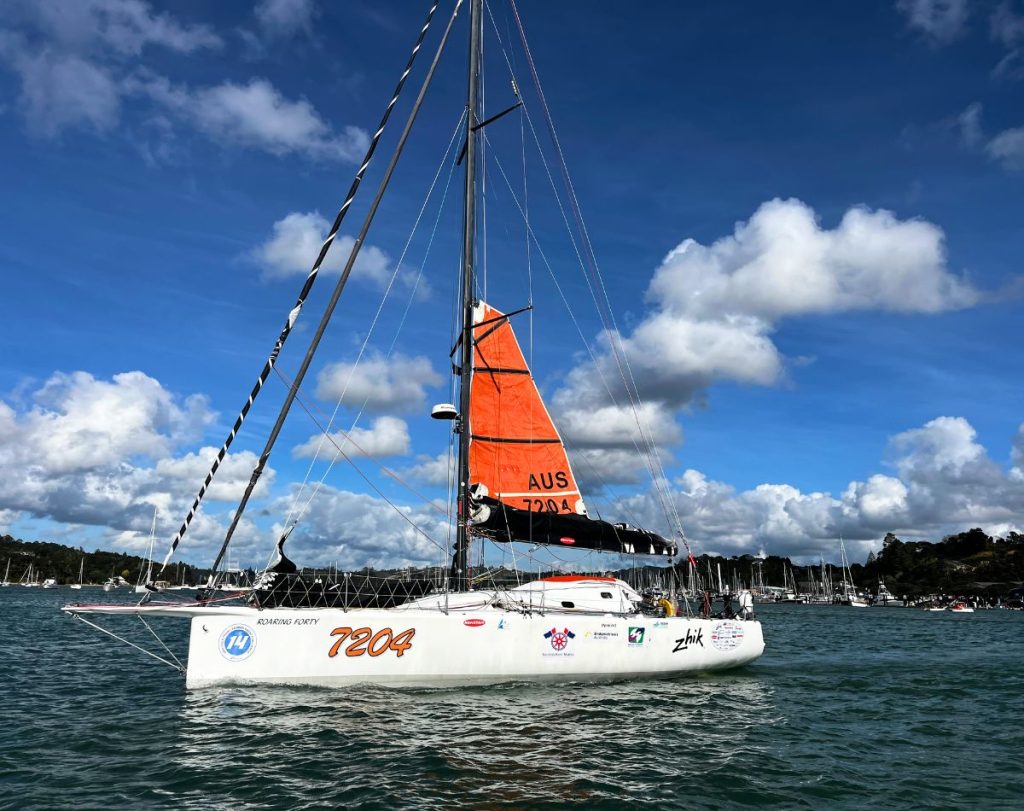
That boat is Roaring Forty, and she is something else entirely.
A rare survivor
Roaring Forty is a 1997 Lutra BOC Open 40, designed in the Netherlands and built in Estonia. She measures 12.2 metres, carries 1,000 litres of water ballast, and is constructed entirely of carbon fibre. Le Poidevin believes there are only around four Open 40s of any design still sailing anywhere in the world. The rest have either sunk or been destroyed, many of them victims of the canting keels that were fashionable in the 1990s. Roaring Forty escaped that fate with a fixed keel.

The Open 40 class was the forerunner to today’s Class 40, competing in the same era alongside Open 50s and the IMOCA 60s that eventually consumed the others. “This is the actual grandfather to that,” Le Poidevin says, gesturing toward a nearby Class 40. The design displacement is around 4,600 kilograms, rising to closer to six tonnes in full race trim with water ballast loaded. The Class 40s she lines up against are built to a fibreglass construction rule with a limited carbon allowance and carry 750 litres of water ballast. Roaring Forty has them beaten on both counts.
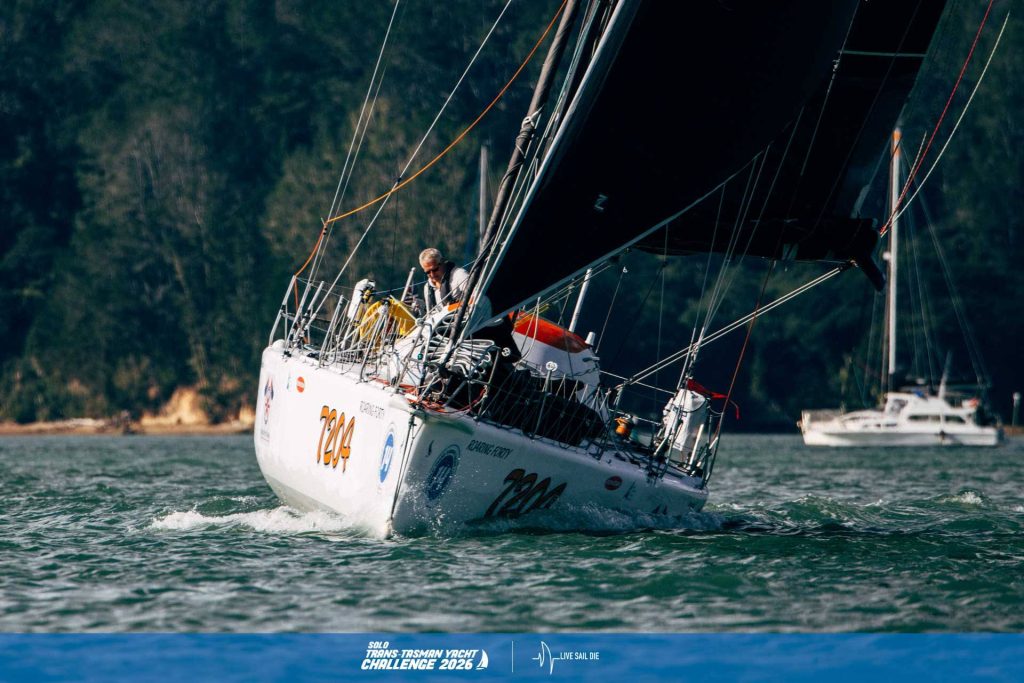
Le Poidevin bought the boat in 2017, having found her on the internet in the Netherlands. “It had a bit less wear. Met all my criteria. Water ballast, which you can’t buy in Australia unless you’re a millionaire.” His sails are made by Zoom Sails, run by Phil Auger, a New Zealander who has worked for the major lofts and now operates independently, with sails manufactured at an OEM facility in Sri Lanka. After eight years, he finally has a complete inventory.
The boat’s history took time to piece together. He tracked down the original designer, Adrian Konijnendijk of the Netherlands-based Lutra Design Group who is still alive and still involved, and commissioned a VPP analysis. Konijnendijk and his fellow team of Dutch designers will avidly follow Le Poidevin in this race, looking to see how one of the still remaining Lutra Open 40s competes.
He also contacted the Estonian yard, which is still in business, and asked whether they remembered a boat called Roaring Forty. “Oh yeah, yeah, that’s a bloody good boat that one,” came the reply, followed by a set of old photographs: what appeared to be a dairy building, a tractor with a makeshift crane, and the hull hanging upside down in a foam jig.

One race result he mentions with particular pride: in 2007, under Belgian ownership, Roaring Forty was entered in the Rolex Middle Sea Race by a crew of four. The race that year was brutal, with half the fleet failing to finish. The four made it through and finished third on line honours.
The setup
There are no creature comforts aboard. A freeze-dry meal system, a jet boil, a metho backup stove, a watermaker, and a bean bag that slides under the hard top so he can stretch out in the cockpit and sleep. “98 percent of the time on autopilot,” he says. “If you’re not doing jobs, you’re napping.”
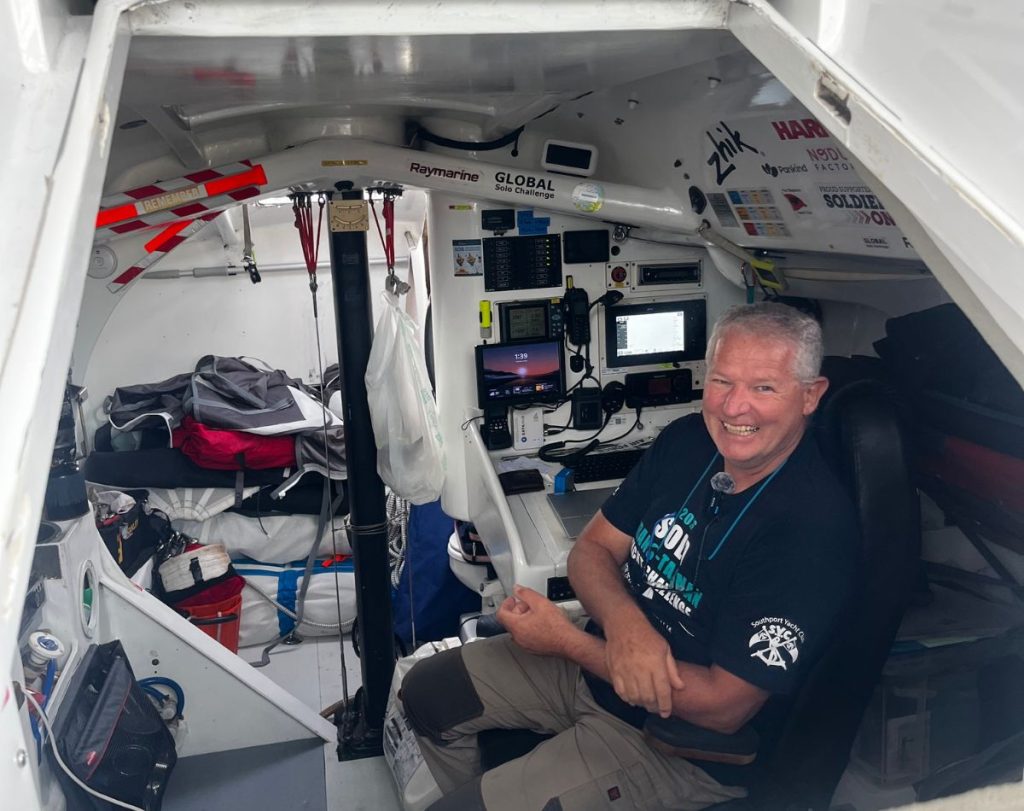
The redundancy built into the systems is serious. Two completely independent autopilots, Raymarine and NKE, are configured so that if one network drops out, he can isolate the fault, reconfigure around it, and run on the backup while repairs are made. The daggerboard doubles as an emergency rudder, sliding into a cassette on the transom if the main rudder is lost. Power comes from two OceanPower hydrogenerators mounted at the stern, German-made, 300 watts each, enough to run both autopilots, a fridge, and Starlink around the clock without touching the engine. He highly recommends the OceanPower: on the solo delivery from Australia, he went six days without starting it.
He runs AGM batteries rather than lithium, a deliberate choice. “The BMS says I’m shutting off and you go dark,” he says of lithium systems, noting that several boats in the Global Solo Challenge suffered exactly that failure at random moments. His spares inventory is comprehensive. “You spend four years preparing for a race and survive on hope and a prayer. It doesn’t make sense.”
The pedigree
Asked what advice he would offer to less experienced competitors facing the crossing, Le Poidevin points to a yellow sign fixed somewhere aboard. It reads: Stop. Wait. Wait some more.
“If you’re used to crewed racing and there’s a bit of a wind shift, someone goes ‘let’s put up the asymmetrical’ and the crew jump to work. When you’re solo, you sit there and you watch it. It might be 15 minutes, it might be an hour. Just crack your sheets and sail with what you’ve got.” The other discipline is rest. “Do an evolution. If you do a tack, have a nap. If you cook food, have a nap after you eat. If you navigate, have a nap before and after.” Sleep management, he says, is the race within the race.

His target for the crossing is seven days and 17 hours, though he is under no illusions about what the Tasman has in store. There are large high-pressure systems out there that cannot be driven around, and conditions could change completely after the first day. “All bets are off,” he says.
Roaring Forty has already crossed the Tasman once this year on the delivery from Newcastle. She has been through the Southern Ocean, the Bay of Biscay, and the Middle Sea. Her fastest recorded speed is 21 knots, surfing in the Southern Ocean under a four reef and a heavy weather jib. She has survived a glancing strike from a ghost container ship, in the process losing her bowsprit and cracking a deck joint, and kept racing to Charleston with the breach sealed by the flooded water ballast tank.

Le Poidevin would like to think all of that counts for something when the Tasman turns nasty. He is probably right.