Auckland boatbuilder Richard Edlin breathes new life into old bones with the restoration of a Pelin Empress, previously consigned to an uncertain future, and in doing so puts forward a compelling case for buying old over new. Steve Raea reports.
The late Frank Pelin was a designer for the people. A champion of accessible boating, his impact on New Zealand’s marine landscape was substantial, built on a firm belief that ordinary Kiwi families deserved a shot at boat ownership and everything that comes with it. Pelin has since passed away, but his legacy remains very much alive: the Pelin Plans service continues to operate, giving builders and restorers access to his extensive catalogue of designs. And given the DIY nature of the brand, many original Pelin boats have found their way into the hands of professional builders for the kind of modern refit that keeps them relevant and seaworthy.
Prolific by any measure, Pelin’s Auckland design office has produced more than 160 sets of plans covering an impressive range of vessels: yachts, catamarans, dinghies, runabouts, and the planing and semi-displacement launches for which he is best known. Like fellow New Zealand designers Richard Hartley and John Spencer, Pelin was a committed advocate for amateur boatbuilding, convinced that basic skills and a modest budget were all that stood between an ordinary Kiwi and a boat of their own.
Backyard boatbuilding had its heyday in the Muldoon era, when it wasn’t unusual to find two or three Pelins, and maybe a ferro-cement yacht, in various stages of construction on any given suburban street. There was a social dimension to it too: impromptu neighbourhood gatherings had a way of materialising under army surplus tarpaulins and rickety sheds at the end of a productive Saturday.

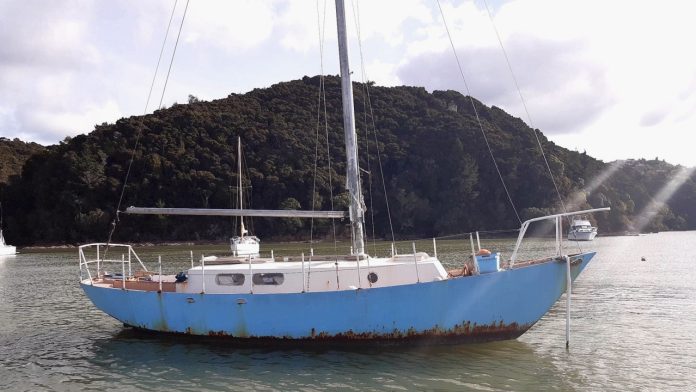
Those days are largely gone, but the legacy endures. You can still find sound vessels sitting on tired trailers in boatyards, tucked away in farm sheds and chook houses the length of the country. Worn but complete, they carry little monetary value as they sit, yet they’re quietly becoming classics. With patience, time, and the right expertise, they can be saved and returned to family service for a fraction of what a comparable new boat would cost today.
Richard Edlin knows this better than most. The Auckland yacht designer and wooden boatbuilder recently completed a substantial rebuild and refit of an original home-built Pelin Empress 24, one of Pelin’s most enduring designs and a boat that continues to surface regularly on the secondhand market, albeit in wildly varying states of repair.
Edlin’s involvement wasn’t planned. The Empress arrived at his Matakohe property on the banks of the Kaipara for what its owner vaguely described as minor repairs. Minor repairs became major repairs, the owner was glad to hand the boat over and recover his investment, and before long Edlin found himself fully committed to a restoration project that would consume 1,700 hours of labour across three years.
Approaching the project with a designer’s eye, Edlin set out to thoroughly modernise the Empress’s interior and transom without compromising its distinctive classic lines. The central question was how to bring all the elements together on a 24-foot hull that, as he quickly concluded, simply didn’t have enough boat to deliver the level of comfort he was after.
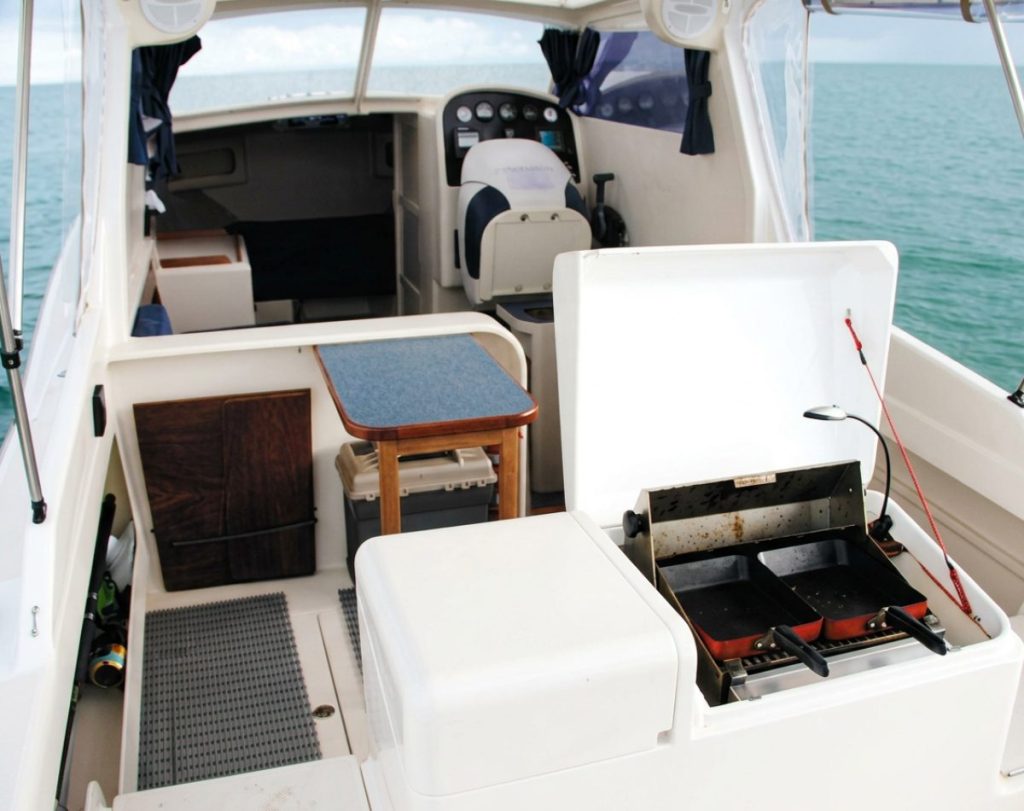
The solution was to cut away the transom and extend it by four feet, a decision made somewhat easier by a patch of rot found well aft. The extension created a generous platform for an island-style walk-through, with new transom lockers housing the barbecue and live-bait tank, and a solid base for a permanent bait board.
Sensitive to the boat’s proportions and the Kaipara’s reputation for getting ugly, Edlin also raised the topsides by introducing a variable bulwark that runs forward to the cockpit. It’s both a practical seagoing improvement and a visual one, giving the hull a pronounced, classic sheer that suits the boat’s heritage well.
Next came a new self-draining anchor locker built into the bow. The original locker drained directly into the bilge, a design flaw Edlin identifies as the ruin of many an otherwise good Pelin. While working on the deck, he also reshaped the cabin trunk, increasing its aft rake to align better with the angle of the new windscreen and a stylish cabin-top eyebrow.
Ninety percent of the interior was gutted to allow access to the entire forward bilge, which was significantly strengthened with a GRP foam core sandwich laid between the existing stringers and frames. With the interior cleared, Edlin built moulds for a new GRP/ply underfloor fuel and water tank, and fitted a 120-litre holding tank discreetly beneath the forward V-berth.
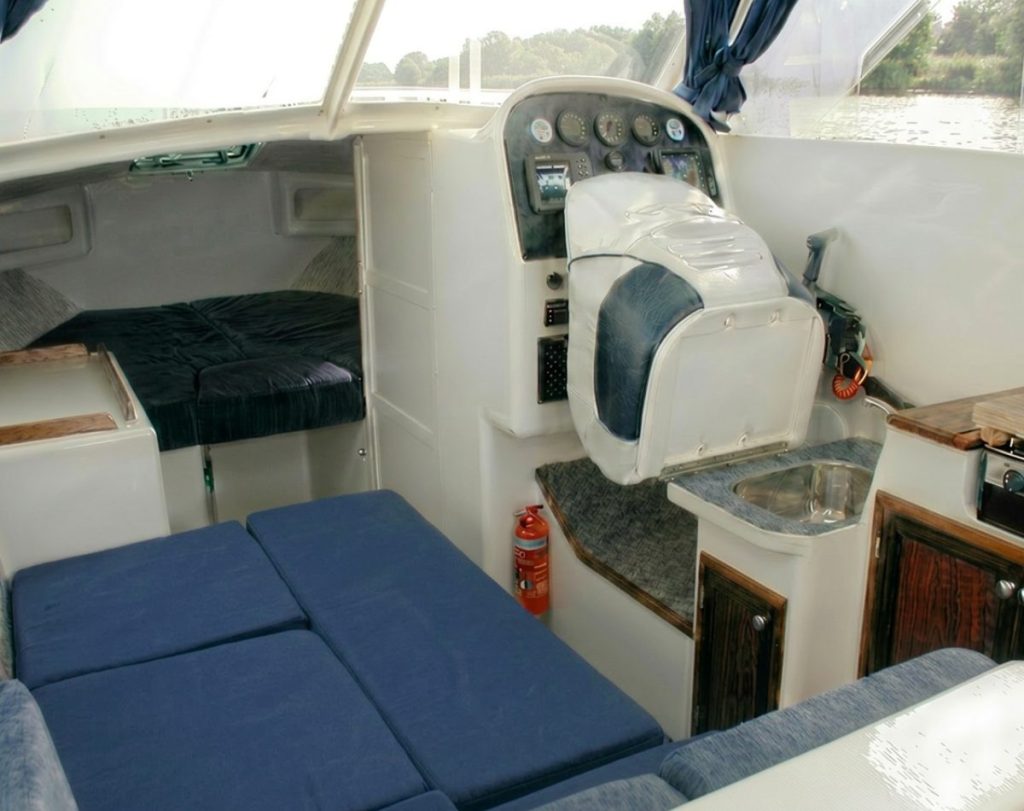
That last addition required raising the forward bunk height by 200mm, the upside being a meaningful increase in bunk width. Edlin went further still, removing the cabin bulkhead frame to open up the full measure of the cabin and create a generous double berth.
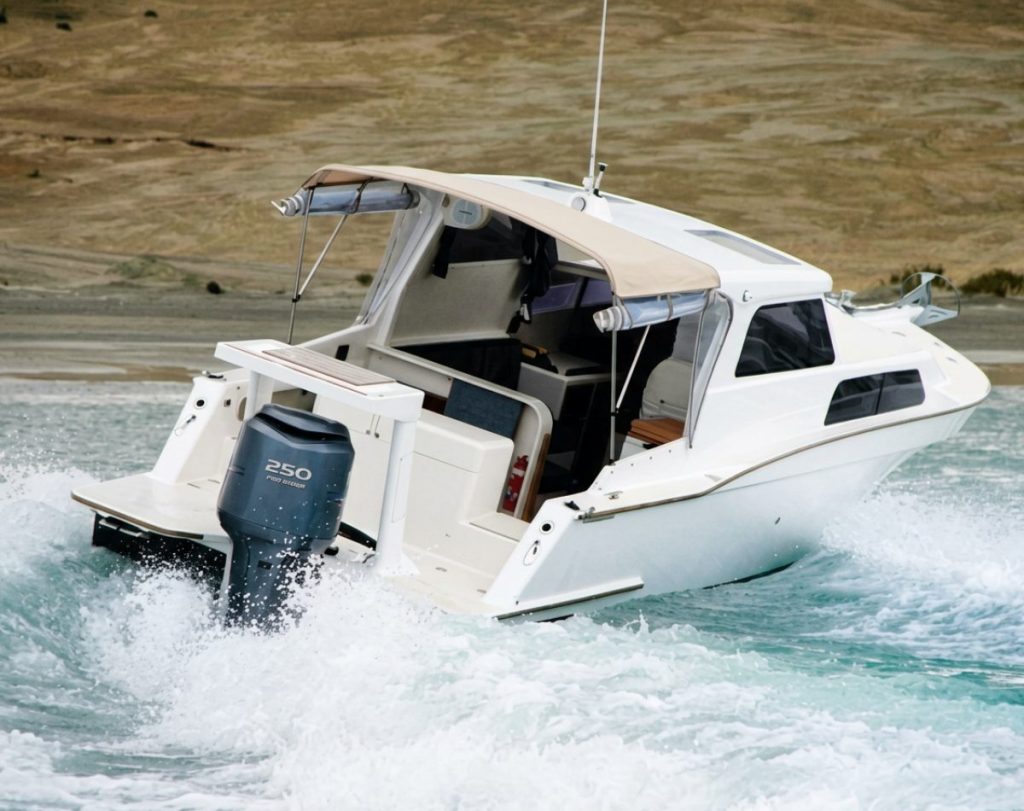
The helm station was stripped and replaced with a custom-built ply/GRP unit, featuring an inset carbon-fibre fascia to house a new electronics suite, all paired with a replacement V6 250hp four-stroke Yamaha hanging off the transom.
The case for buying old
Edlin’s total investment, including his time, covers the replacement Yamaha, an upgraded secondhand Hosking trailer, the original purchase of the boat, new electronics, canvas covers and clears, new squabs throughout, and various sundries. A significant portion of that figure went into making moulds for the new tanks and the various aesthetic touches that, as he acknowledges, add little to practicality or performance.
“There are no regrets on my side,” he says. “Sure, the boat took on a life of its own but I have no problem justifying this, to the extent that we’re committed to owning and using it as our family boat for the next five years. It does everything we want it to do and it does it well. I feel reasonably comfortable that we’re still on the right side of the ledger when I see what people are paying for similar-sized new trailer boats.”

He’s also quick to note that the renovation was completed progressively, as he could afford it, and that this staged approach is one of the real advantages of the refit path over buying new.
“If you’re financing a new boat, the ticket price is not a true reflection of cost. Finance comes at a price, and if that new boat has to be sold, depreciation losses have to be factored in. Buying secondhand and refitting as you can afford is less likely to cause financial stress, and if managed properly, it shouldn’t stop you getting on the water in summer while you refit through winter,” he explains.
Edlin is open to working with clients who want to explore that path. “Custom wooden boatbuilding in New Zealand is in a tough place and boatbuilders have had to diversify. I’ve progressively set my business up for refit work and I encourage owners to be part of that process.” He’s also in the process of extending his workshop to include basic accommodation, so owners can stay on site and work alongside him. His facilities include the ability to launch and retrieve boats up to around 45 feet directly from the Kaipara Harbour.
One note of caution: timber boats need careful assessment before any refit commitment. Edlin is emphatic that a proper invasive survey from an experienced surveyor is not optional. “It’s not enough to get your boatbuilder mate to check it out. As boatbuilders, we know how to repair rot but a surveyor worth his salt knows where to find it. Cutting corners for the sake of a surveyor’s fee is false economy.”
The tour
The value of the extended transom platform is immediately obvious. It makes boarding straightforward, adds volume to the cockpit, and transforms the boat’s credentials as a fishing platform. Edlin has resisted the temptation to fit a game chair and kept most locker space for general family stowage, though a wash-down facility is fitted and one of the aft lockers can be converted to a live-bait tank when needed. The open transom is well suited to diving and swimming, with a simple sliding hatch board providing security at sea when kids are aboard.
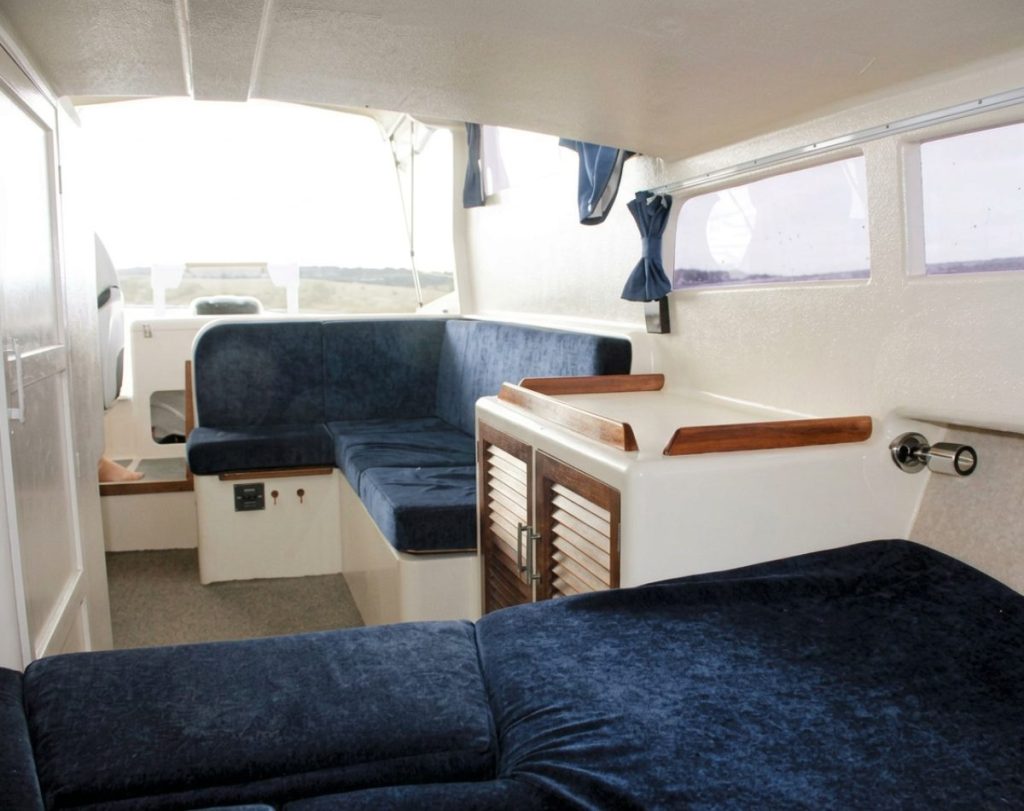
Moving forward to starboard, a compact galley features a two-burner hob and grill, with an LPG water heater supplying hot water on demand to the sink under the helmsman’s seat and a handheld shower in the cockpit. Opposite is an L-shaped settee that converts easily to a double. Forward, the enclosed head sits to starboard with cupboard storage opposite, and the V-berth can be configured as two singles or one large double.
The interior is light and airy, with twin overhead opening hatches in the hardtop and generous windscreen and cabin windows. A canvas bimini and clears allow full enclosure without sacrificing usable space. The layout is practical and the finish is sharp. With 540 litres of fuel and 210 litres of water aboard, the boat is well equipped for overnighting and extended weekend cruising.
Edlin, his partner Trudy, and their two-and-a-half-year-old daughter Alysha spent a week cruising the Northland coast over Christmas, comfortably and without incident across a range of conditions.
On the water
The transom extension adds hull weight, as does the foam-filled bilge, but overall the Empress comes in at around 2,300kg on trailer, comparable to an equivalent alloy boat and lighter than a solid GRP hull of similar size.
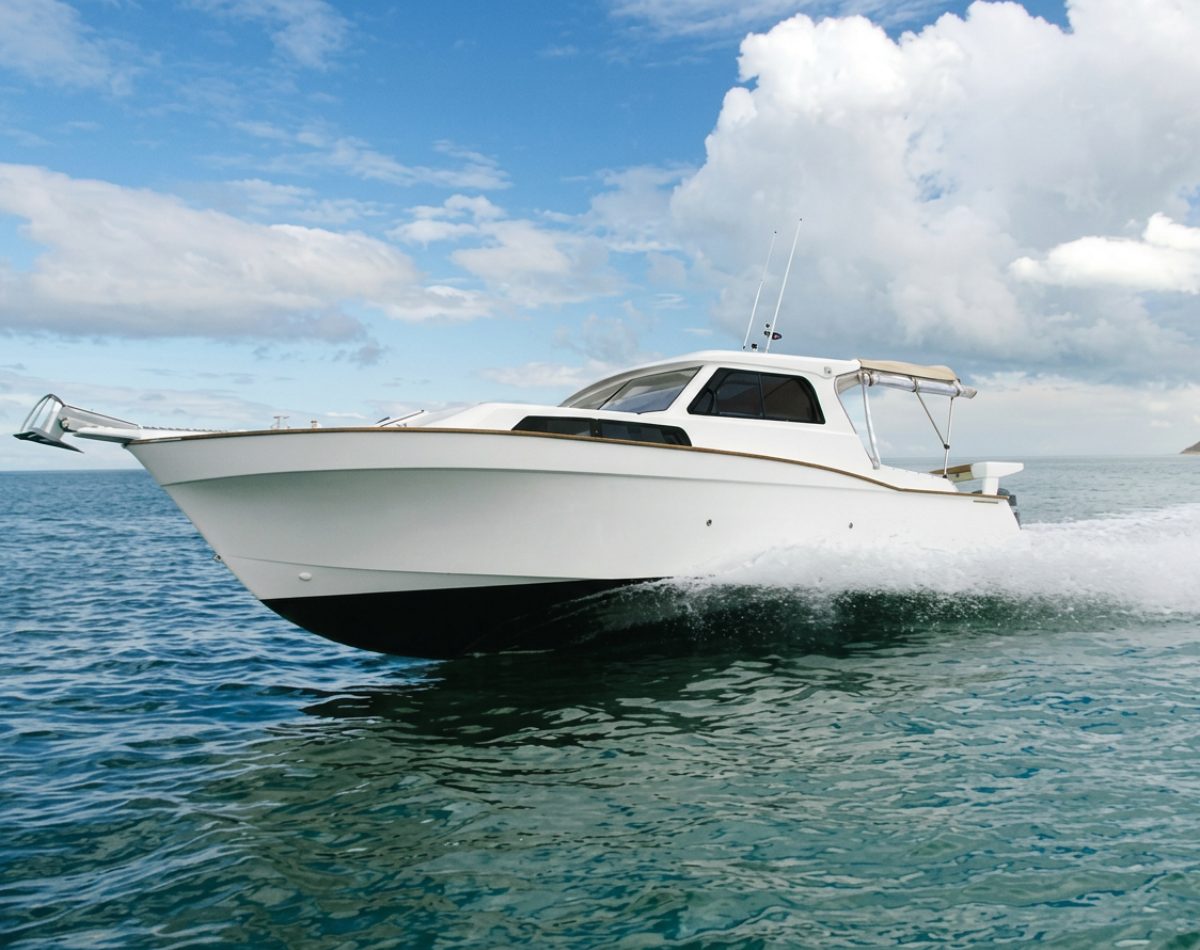
Additional length calls for more power, and the 250hp Yamaha four-stroke more than covers it, lifting the boat onto the plane quickly and efficiently. Trimmed out at wide-open throttle, the Empress pulls 34 knots, cruises comfortably at 25 knots with the tachometer at 4,500rpm, and returns a respectable one litre per 1.3km travelled.
Launched from Tinopai and headed toward Pouto Point and the Kaipara Heads, we encountered a cross-section of conditions, from flat-water running to a short wind-against-tide chop. The foam-filled bilge has had a measurable effect on dampening slap on the timber hull, and the Empress handled it all without complaint. Pelin hulls have a reputation as good all-rounders, and this one bears that out.
Visibility from the passenger side is limited unless you’re standing alongside the helm, though the driver has excellent sight lines with the option of putting their head through the overhead hatch. As a cruising platform the boat flows well, with seamless transition between cockpit and saloon. Bow rails are planned, which will improve forward deck access.
Edlin is candid about the original design’s one limitation, relatively low bow freeboard that could be an issue punching into a serious sea. The raised bulwarks address it effectively, and the new self-draining anchor locker has added meaningful structural strength to the foredeck.
“No boat is infallible in the wrong hands,” he says, “but with good seamanship the Empress will cope with most conditions. We’ve seen plenty of action on the Kaipara and we’ve always got home without incident.”
What Edlin has achieved here is clear: a 1970s vintage hull transformed into a contemporary weekend cruiser, modern in every practical respect but loyal to the character Pelin gave it. He’s made a compelling argument that the refit path, properly approached, is not a compromise. It’s a genuine alternative, one that’s worth taking seriously.
Based on an original article written by Steve Raea, published in 2012 in Tradeaboat.