Italian superyacht builder Sanlorenzo has used Venice Climate Week to call on European policymakers to accelerate investment in green methanol supply chains and port electrification, arguing that infrastructure, not technology, is now the binding constraint on sustainable marine adoption. It’s a problem New Zealand knows well.
Auckland’s first hybrid-electric fast ferry, Waitematā One, was unveiled last week ahead of its entry into service on the Devonport route next month. The vessel is ready. The chargers, as 1News reported, are not. Three mega-chargers at a new $27 million Queens Wharf charging facility, originally due for completion in 2024, remain under construction. Until they’re done, the ferry will charge overnight at Half Moon Bay and run its onboard diesel generator during the day to keep the batteries topped up.
It’s a localised echo of exactly what Sanlorenzo Executive Chairman Massimo Perotti told Venice Climate Week: “The technology is ready. The infrastructure is not.”
Perotti presented the “Venice Call for Maritime Action” at the event, an open letter addressed to EU Environment Commissioner Jessika Roswall and copied to European Commission President Ursula von der Leyen, urging urgent coordinated investment in green fuel supply chains and port electrification across Europe.

“The challenge is no longer proving the technology. It is scaling the infrastructure around it,” he said.
The obstacle, Perotti argues, is the absence of fuel supply and shoreside infrastructure needed to make sustainable propulsion practical for owners. Writing in Il Sole 24 Ore, journalist Raoul de Forcade reported that Perotti cited a direct exchange with a prospective client: build them a yacht running 70 per cent on green methanol, and they reply they won’t buy it because they don’t know where to refuel.
The numbers bear this out. As Jill Sayles reported for IBI, less than one per cent of global methanol production currently comes from renewable sources, with supply concentrated around major industrial ports such as Rotterdam and Antwerp-Bruges. Mediterranean marinas remain largely without access. “Northern Europe is beginning to build the ecosystem,” Perotti noted. “The Mediterranean now needs to accelerate.”
Port electrification sits at the heart of the push. “Port electrification is not separate from the sustainability debate,” Perotti said. “It is central to it.” The Venice Call for Maritime Action, as covered by Andrea Pefianco for Superyacht Times, calls for coordinated action from European institutions, port authorities, energy producers and coastal cities, with methanol proposed for tax-exempt status under European legislation to stimulate investment. A six-month progress review is built into the initiative.

On the commercial reality facing owners, Perotti was direct: “If we want owners to choose cleaner propulsion, we must make it usable, accessible and desirable.” He sees yachting as well-placed to lead. “Yachting has the opportunity to lead because it combines innovation, visibility and desirability.” But the gap between ambition and practicality is widening. “We are seeing innovation move faster than accessibility.”
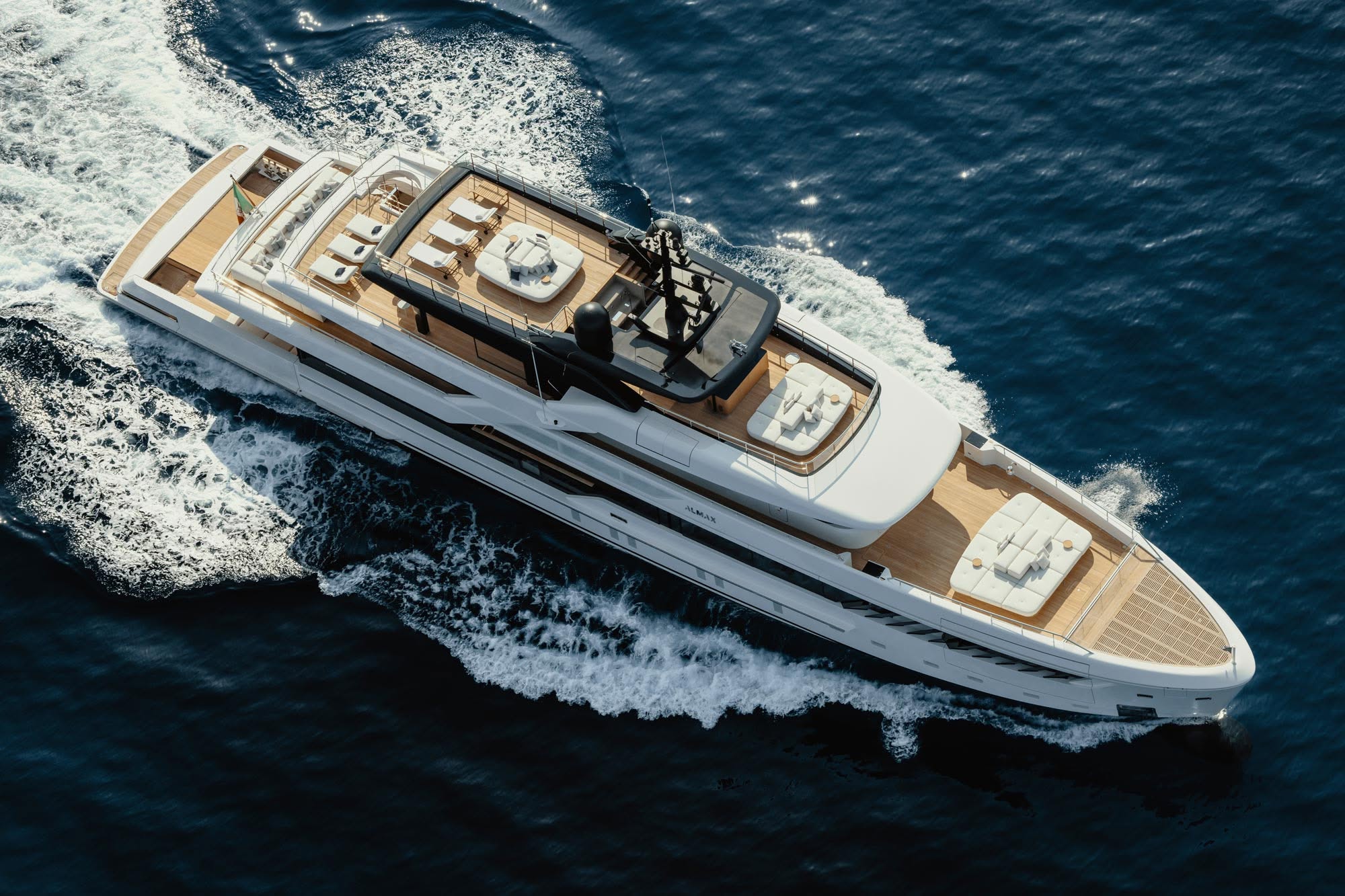
Sanlorenzo has already developed bi-fuel methanol technology as part of its Road to 2030 strategy, including the 50Steel Almax, the first superyacht equipped with a methanol reformer fuel-cell system. Its Bluegame brand developed the hydrogen-powered BGH-HSV foiling support vessel for zero-emission operations at the 37th America’s Cup. But as Alliance News reported, construction of a 50-metre dual-fuel hull has been paused as of early 2026, with Perotti pointing to geopolitical headwinds constraining green fuel production and major finance players retreating from sustainability commitments.