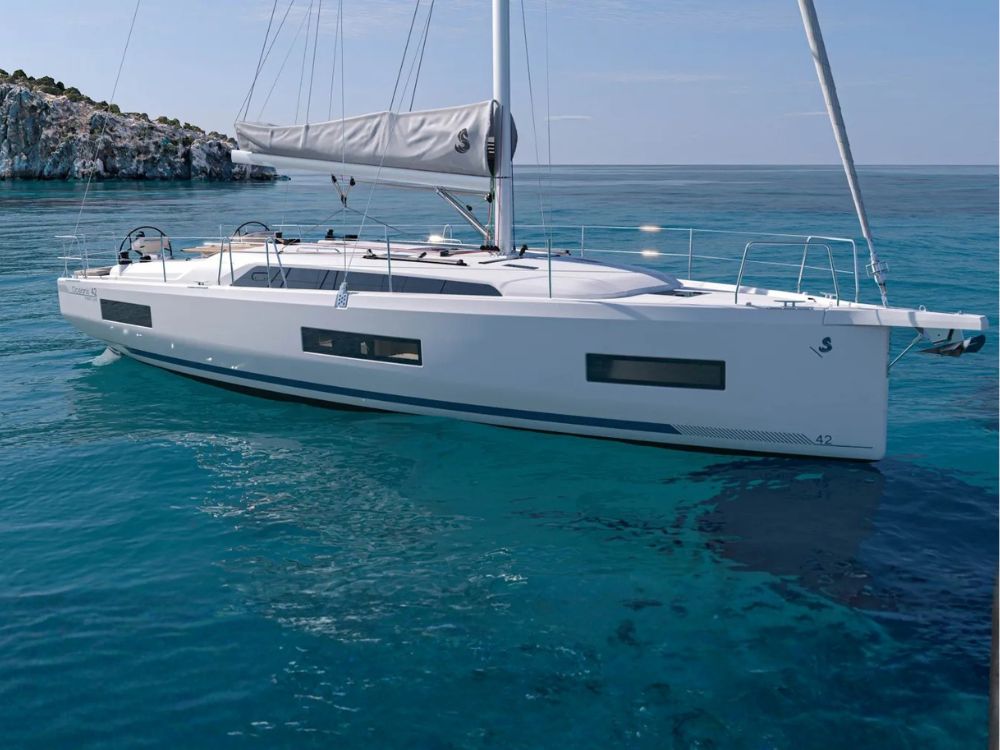
Beneteau has introduced the Oceanis 42, and 36 Degrees, the brand’s New Zealand representative, is now offering the model to local buyers.
The Oceanis 42 replaces the Oceanis 40.1. The launch also marks 40 years of the Oceanis range in production. Beneteau says the new model was shaped by ongoing discussions with owners, dealers and the specialist sailing press, with fleet data used to simplify onboard systems and improve reliability.
The cockpit is the largest in the 40-foot segment, Beneteau says, with floor space up 12 percent and seating area up 10 percent on the outgoing model. Buyers can choose between an open transom that turns the swim platform into an extension of the cockpit, or a closed layout with extra aft seating for those who want more security underway. The helm stations carry over features from the larger Oceanis 47 and 52, including integrated seating and backrests, consoles that gather the controls in one place, and an engine throttle built into the console itself.
Under sail, Marc Lombard Yacht Design has increased sail area by lengthening the rig, with the standard furling mast now 600mm taller and the classic and performance masts up by 300mm. Beneteau says this delivers more power without compromising the yacht’s accessibility or control.

Below decks, the saloon and cabin hull windows are now two and a half times larger, with the coachroof glazing also enlarged to bring in more light. The galley offers 215 litres of refrigeration capacity, which Beneteau says is the most in its class. Layout options run from a two-cabin, one-head version through to a four-cabin, two-head charter configuration, with five layouts available in total. Beneteau says it’s the only 40-footer on the market offering that range, along with a choice of two distinct interior architectures.
Learn more at Beneteau and 36 Degrees Brokers.
| Beneteau Oceanis 42
Technical Characteristics
|
|
|---|---|
| Length overall (LOA) | 12.86m / 42’2″ |
| Hull length | 11.99m / 39’4″ |
| Waterline length | 11.42m / 37’6″ |
| Hull beam | 4.23m / 13’11” |
| Deep keel draught (cast iron) | 2.25m / 7’5″ — 2,050kg / 4,518lbs ballast |
| Shallow keel draught (cast iron) | 1.68m / 5’6″ — 2,237kg / 4,930lbs ballast |
| Air draft (Classic Mast) | 18.72m / 61’5″ |
| Air draft (Roller Furling Mast) | 18.36m / 60’3″ |
| Light displacement (CE) | 7,985kg / 17,600lbs |
| Fuel tank (Standard) | 195L / 52 US Gal |
| Freshwater capacity (Standard) | 235L / 62 US Gal |
| Engine power (Standard) | 45hp |
| Furling mainsail (Standard) | 37.70m² / 406 sq/ft |
| Self-tacking jib (Standard) | 28.70m² / 309 sq/ft |
| Furling Genoa – 105% (Standard) | 35.60m² / 383 sq/ft |
| Code 0 (Standard) | 58.30m² / 627 sq/ft |
| Standard mainsail | 45.10m² / 485 sq/ft |
| Furling Genoa – 105% | 37.20m² / 400 sq/ft |
| Code 0 | 143.00m² / 1,539 sq/ft |
| Asymmetric spinnaker | 187.00m² / 2,012 sq/ft |
| CE Certification | A10 / B10 / C12 |
Specifications are provisional and subject to change. Naval architecture: Marc Lombard Yacht Design. Interior and exterior design: Nauta Design.