


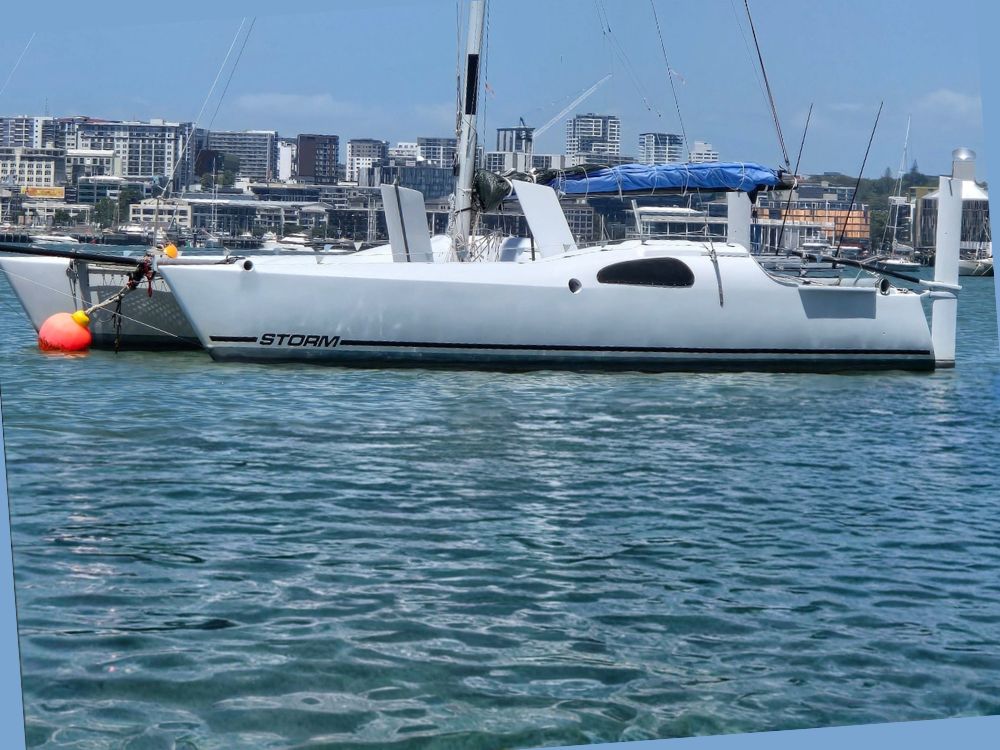
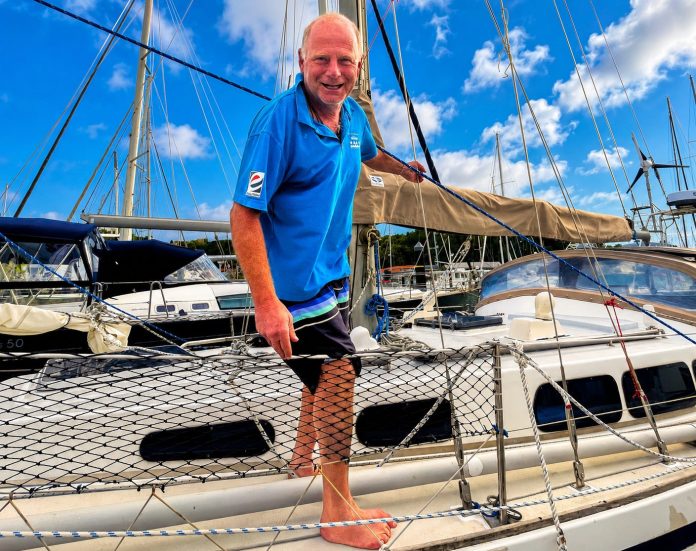
Kahl Schierling bought Storm his Great Barrier Express in 2024. She’s part of the 8.5 metre catamaran scene that’ve been knocking around the Hauraki Gulf since the early 1970s. At the time of puchase he figured he had it worked out: sail her for a year or two, learn how to handle a cat properly, then trade up to something bigger.
Then he put her up on the hard to do some work, had a bit of a think, and changed his mind.
“Storm is where I want to be. I don’t want to throw any more money at a bigger boat at this stage in my life.”
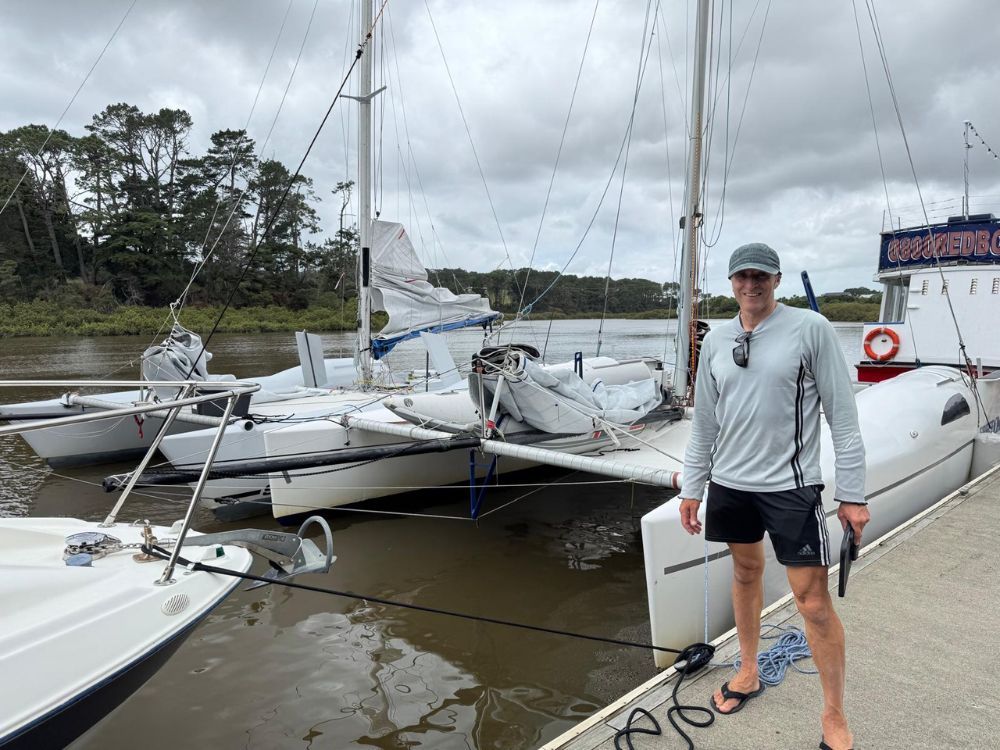
So instead of selling, he’s putting a new mast on her. The old one had a tapered top, a nice idea but it left him a bit light up high once he started thinking about heavier rigging, besides there was corrosion at the base. The new aluminium extrusion turned up a few weeks back. Duane at Yacht Spas is doing the rigging, because as Kahl says, that’s not a job he trusts himself with. Give her a couple of weeks and she should be back on her swing mooring in Bayswater, about 150 metres off the marina, not far from where a fleet of GBEs normally anchor.

The boat goes back to Malcolm Tennant, who drew the original GBE because he (updated) knew Richard Pilkington who had land on Great Barrier Island and who wanted a quick way to get there from Auckland. That was the whole brief, just a fast boat. He sold over a hundred sets of plans and the design barely changed for the best part of twenty years. By the early nineties there was a Mark III, a bit bigger, a bit faster, taller rig, roomier centre pod, built mostly because a bunch of ageing Hobie sailors in New Caledonia wanted something with more room to grow into. Some of those boats came off the same moulds as ones built fifteen years earlier, just with the bow reshaped. Over 300 GBEs were built worldwide in the end, and in the early 2000s the dimensions of the original design became the basis for the Open 8.5 box rule, which is still what most of the racing fleet competes under today.
That rule is a big part of why the class has lasted. It keeps costs down and stops older boats going obsolete, so a forty year old GBE can still be genuinely competitive against something built last year. The existing fleet in Auckland stays at around 10 competitive boats, with others further afield in Tauranga and the Bay of Islands. Upwind at over 10 knots isn’t unusual, 15 to 18 downwind is normal, and depending how brave you are and conditions allowing, you can push past 24.
What’s kept the class alive this long isn’t really the boat, it’s the camaraderie that’s grown around the fleet. There’s a loose scene based at Richmond Yacht Club, racing every second Wednesday through summer, with other clubs covering the gaps in between. There’s no formal membership, if you want in, you ring the yacht club, and soon you’re in contact with someone who puts you on a boat. That’s how Kahl ended up crewing on Freedom, the racing GBE owned by Coen Ursem and Phil Clark, alongside sailing his own boat.

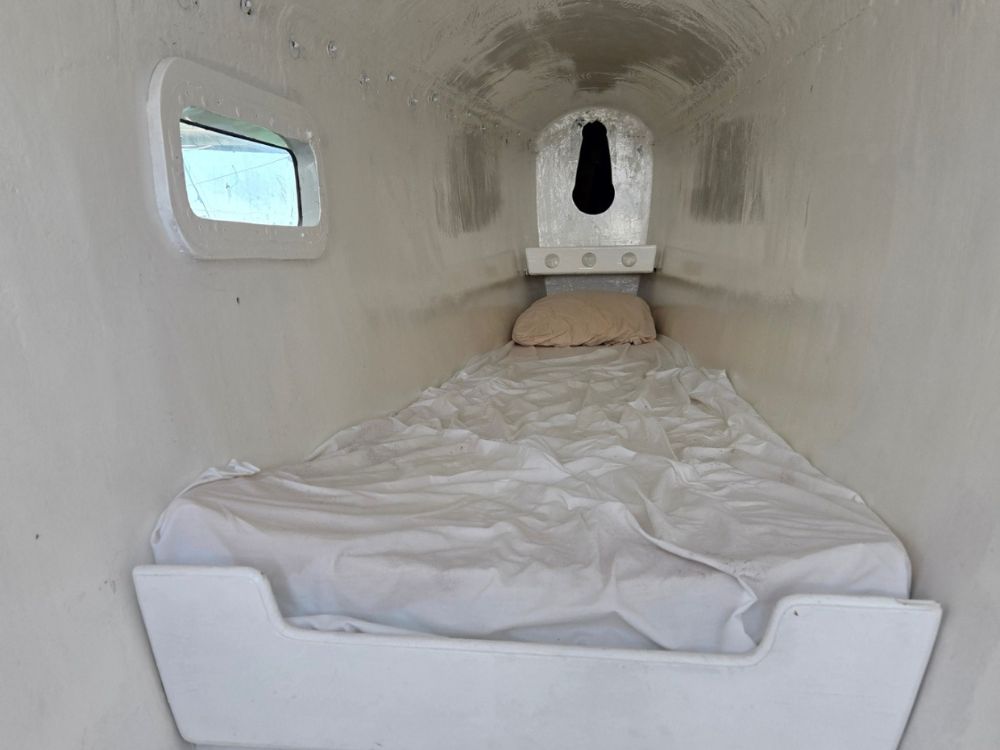
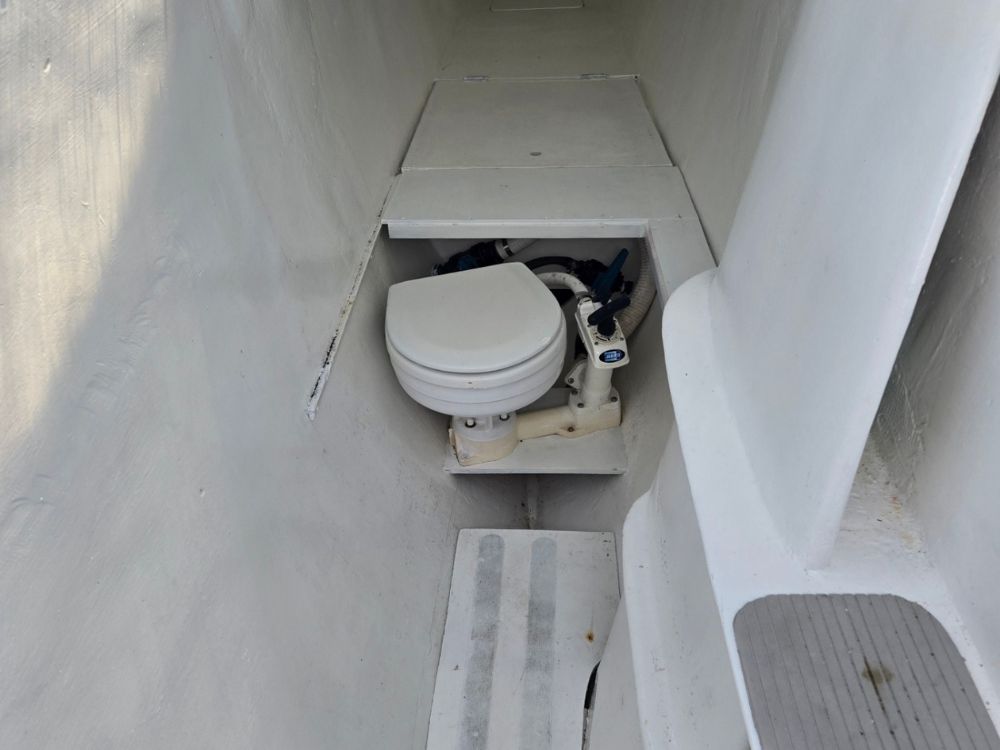
Storm is set up as a cruising GBE rather than a racer, a hard deck aft where a racing boat would carry a trampoline, built for comfort more than outright speed. If you want to push a GBE to its limits, you want a boat built for it, and Kahl admits Storm was never going to be that.
He grew up with a dinghy on Lake Pupuke as a kid, then didn’t do much sailing for years. As life settled down, he started thinking about how he wanted to spend his time, and the idea of sailing got under his skin again. Storm came up for sale at the end of 2024 and he bought her pretty much on the spot. From there it didn’t take long for him to start crewing on Freedom too, picking things up from Coen and the rest of the crew along the way.
“At one end of the scale you’ve got sailors in their early 20s who are nationally ranked dinghy racers. Then at the other end of the scale, you’ve got me at 60, with my Zimmer frame and my walking stick,” he says, with a wink. It’s that spread, more than anything, that defines the fleet. Attitude, Hooters and the trimarans Lucifer and Stealth round out the rest of the regulars, and tend to skew younger again, but nobody seems to mind who’s sailing what or how old they are, as long as they turn up.
Kahl’s raced his share too, the Coastal Classic and this year’s ’round the cans’ race up to Marsden Cove, sailed shorthanded, getting in around one in the morning after a long, light day. But racing isn’t really what pulls him out most weekends. On Storm, it’s more about touring.
“If it’s blowing 12 to 15 knots, I’m sailing 12 to 15 knots. On a monohull in that breeze, you’re doing six. I’m not racing anyone. I’m just going fast for the hell of it, and getting somewhere quicker, so I see more before everyone else has even left the harbour.”
That’s the real split in the fleet, not skill or age, but what people actually want out of a GBE on any given Wednesday. Earlier this year, Storm and Freedom sailed up to the Riverhead Tavern together and rafted up for lunch, Coen on the helm to get them through the narrow channel. Kahl’s quick to point out, to anyone on Freedom who might say otherwise, that they were reefed the whole way and not racing. Another wink.
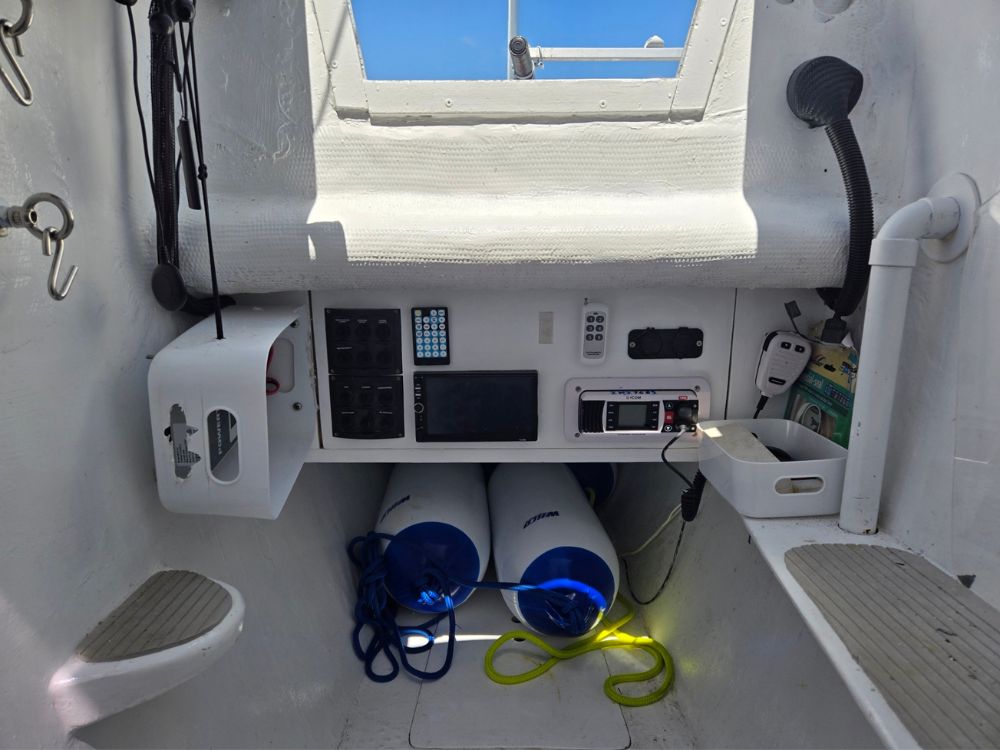
The class is getting a bit of a boost lately, too. Micah Wilkinson, who sailed Nacra 17 for New Zealand at the Olympics, spent time after the 2024 Games rebuilding a 1970s GBE with a few mates, and says there’s a small wave of people doing the same, buying up old boats and refitting them to keep the fleet alive. One of those boats, Va Va Voom, has recently had her own delivery sail down from the Bay of Islands to Sandspit.
With the new mast going up and Storm due back on her own mooring within weeks, Kahl’s already thinking about the season ahead, more trips further round the Gulf, not just the Wednesday series. He likes overtaking the slower monohulls on the way, putting a bit more water between himself and the rest of the fleet than anyone expects from a GBE doing its own thing rather than racing. But mostly he’s looking forward to being back out there with the others, swapping stories at the next stop, because for many of the GBE sailors, that’s always been as much the point as the sailing itself.

More on the history of the 8.5 class

Good to read that people are keeping them on the water. My uncle used to own/race GBE 8.5 Gopher Broke around the Picton area. He took us for a sail not long before he passed away, I remember being amazed by the acceleration. Apparently it’s now bright green and on a swing mooring in Orakei.