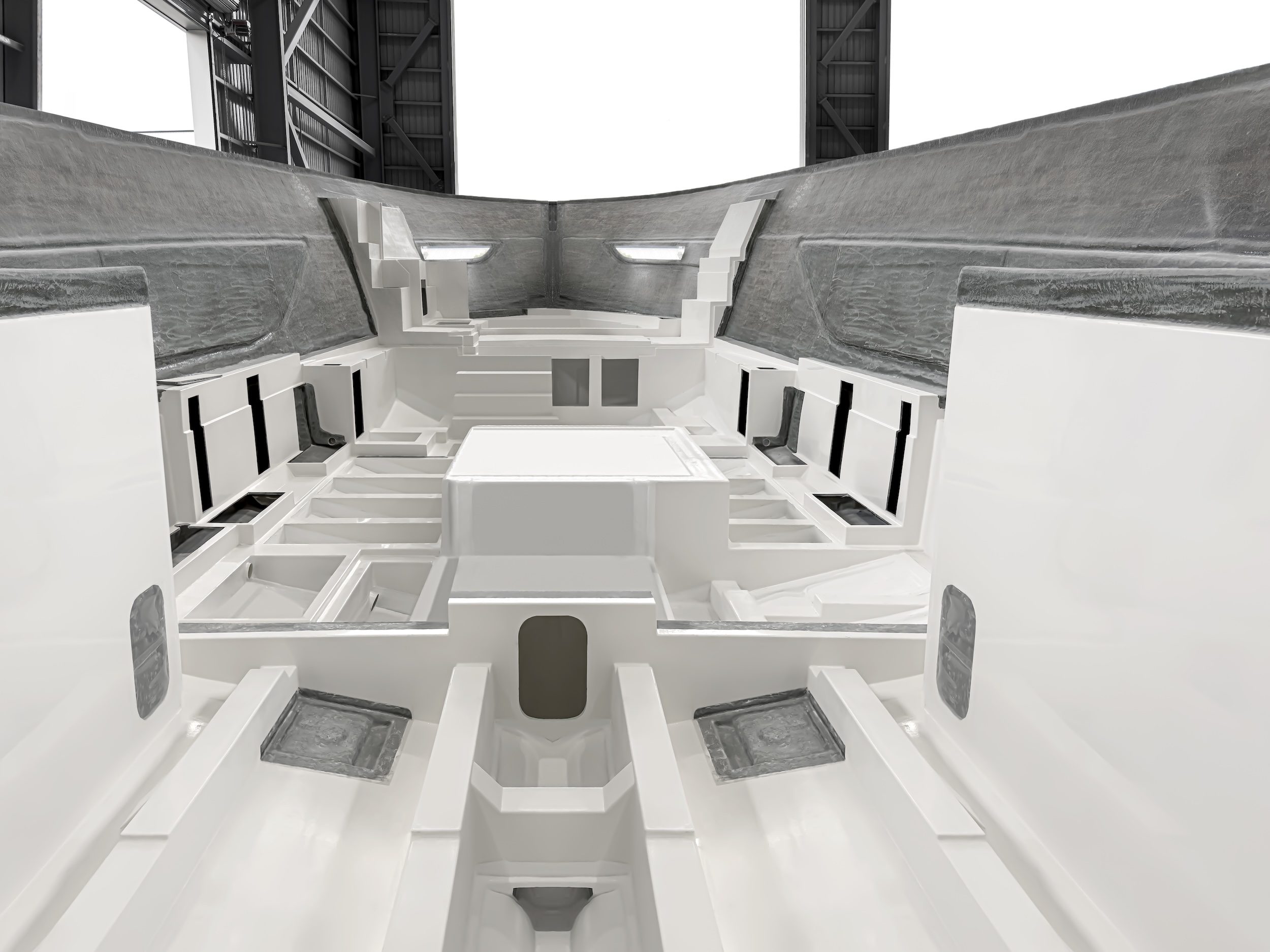
Inside the mould room, every Maritimo hull earns its strength months before the varnish goes on and the cabinetry arrives.
This article, the original from Maritimo Motor Yachts, explores a stage of yacht building that almost no owner ever sees, but one that determines everything the finished vessel is capable of.
Long before an engine is bolted in or a single timber panel installed, a Maritimo motor yacht takes shape as layers of resin and fibreglass inside a mould. This is composite construction, the structural bedrock of the entire build, and arguably the most exacting stage in the whole process. Owners will never actually see this stage. It disappears beneath the polished exterior long before the yacht reaches the water.
At Maritimo, production schedules don’t dictate this stage. The process dictates the timetable. Every layer laid, every measurement taken and every cure cycle completed adds to the strength of the finished hull, and unlike almost everything else on the boat, none of it can be retrofitted or corrected after the fact.

Falling for the process
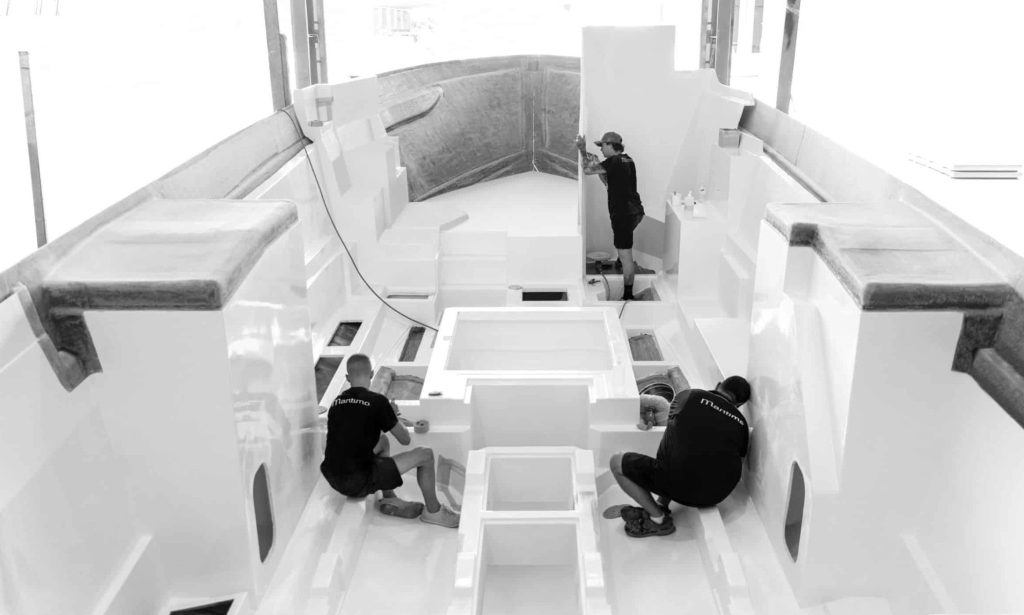
Chris Reeve now leads Maritimo’s lamination department, and more than 20 years into the trade, he’s still captivated by watching raw materials become something structural.
“I absolutely fell in love with it. I’ve always enjoyed building and working with my hands, and once I realised what was involved, I just wanted to learn everything as fast as I could,” said Reeve.
That reaction makes sense once you understand what the trade actually involves. It’s a manufacturing discipline unlike most others: precision moulds, purpose formulated materials and trained hands are the entire toolkit, yet what comes out the other end are hulls, decks and structural parts destined for some of the most capable long range motor yachts on the water.
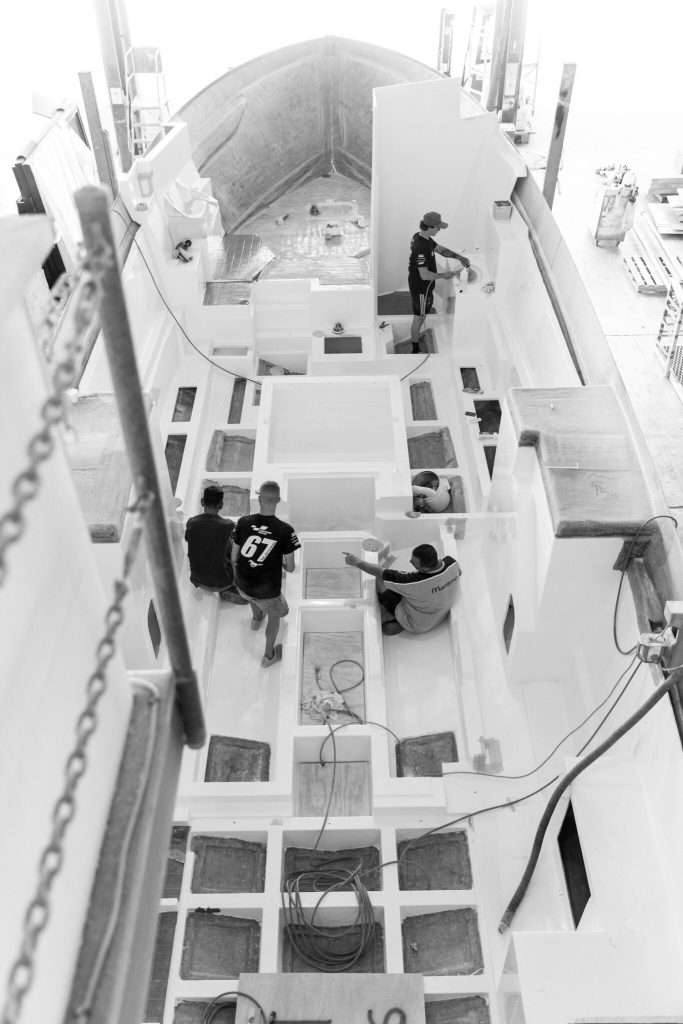
On the surface, it looks simple enough. A mould is prepped, a coat of white gelcoat goes on to form the eventual outer skin, then layer after layer of fibreglass and resin builds up in a tightly controlled order until the part has the rigidity and strength a Maritimo demands.

The reality is far less forgiving. Every laminate schedule is the product of years of engineering iteration, weighing strength against weight against long term durability. Each layer has a defined structural job to do, and it only works if the layer beneath it was done right. Composite work leaves very little room for shortcuts. If something isn’t right, it needs to be right before the next layer goes on.
A hands on culture
Quality gets locked in at the very start, and Maritimo’s approach to staffing reflects that. Rather than rotating laminators through isolated tasks, the same people stay with a component across its full build, building genuine familiarity with each mould and its laminate schedule.
That investment pays off in a specific moment.
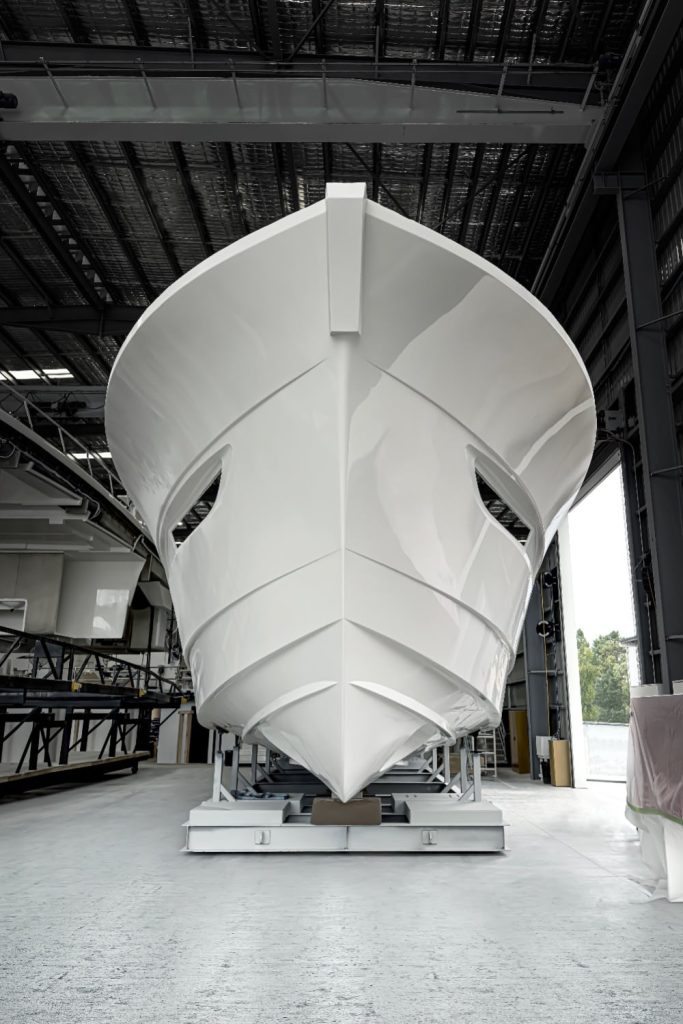
“You get to hook up the cranes and pull the product out of the mould. I used to get a little buzz every time, and you know what, I still do today,” added Reeve.
Weeks of preparation lead to that moment. Liquid materials have become a structural component, and every decision made along the way is suddenly visible. But no amount of engineering discipline can override one variable entirely outside anyone’s control.
Weather.
Reading the sky as part of the job
Humidity, temperature and general atmospheric conditions all shape how resin cures, and even minor shifts can throw off a batch if they’re not caught and managed in real time.
“It is so susceptible to the weather changes. You’ve sort of got to be your own weatherman,” explained Reeve.

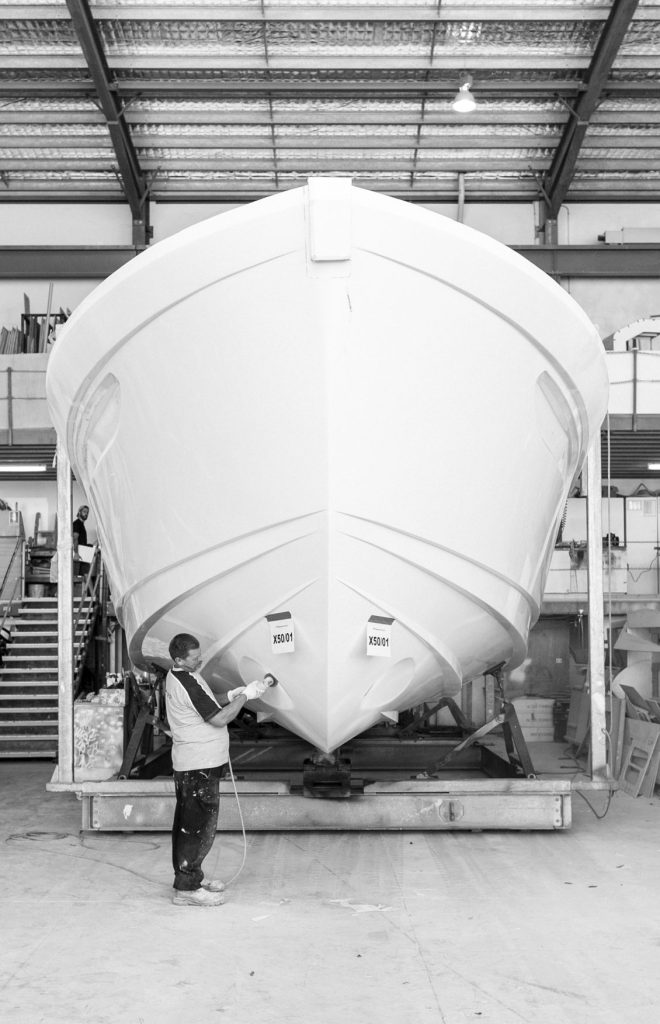
Maritimo works with the weather rather than against it. In Queensland’s summer heat, the big laminating jobs often start before dawn to dodge the worst of the temperature swings. Come winter, the schedule flips, taking advantage of the warmer stretch in the afternoon.
It’s a small but telling example of how the business operates: the calendar serves the process, never the other way round, so that quality stays consistent hull after hull.
Experience counts for just as much as timing. Every mould has its own quirks, and reading how it behaves through a cure cycle is a skill built over years, not weeks. Hulls cure differently to decks, and the smaller, more geometrically complex parts bring their own set of headaches.
Learned, not programmed
“Every time you get a new mould, it’s a learning process,” said Reeve. “Learning how that mould is going to behave and where the critical areas are is so important.”
No machine can replace that sort of judgement. It comes from years of hands on observation, and it’s exactly the sort of detail that owners never consciously notice but would certainly feel the absence of.
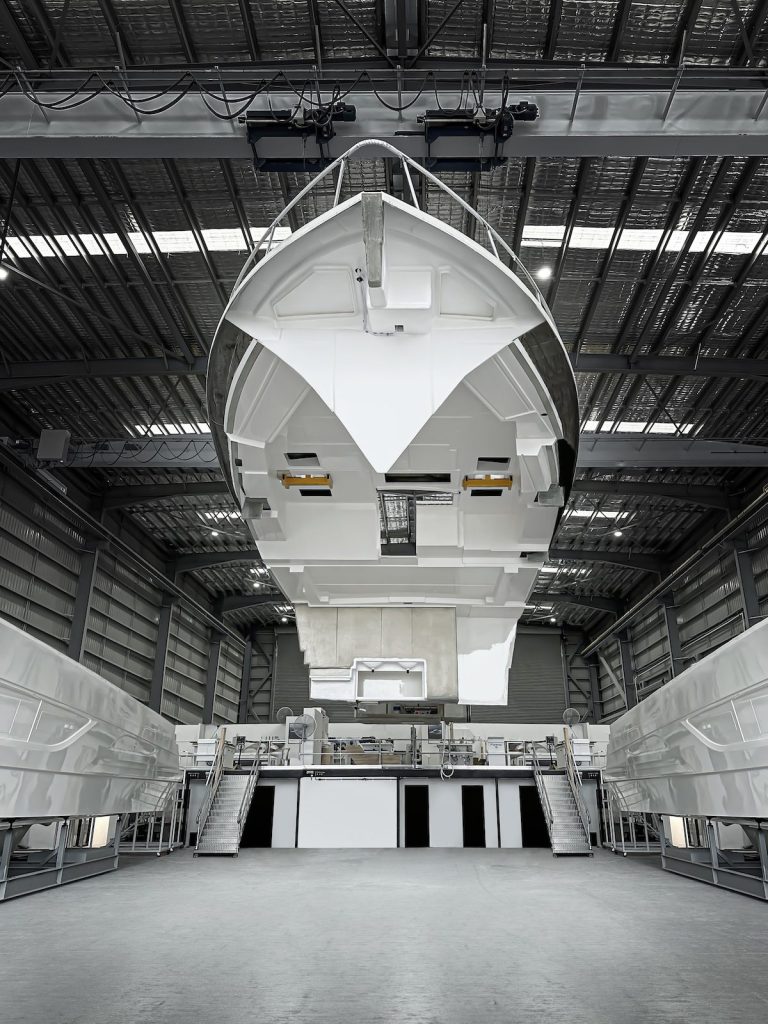
Precision here is measured in millimetres, not centimetres. Laminate thickness is engineered and tested to exact tolerances, and every section of a hull has to meet those figures while holding its shape across complex curved surfaces. Even a slight inconsistency during curing can distort the final form, so precision has to be maintained from the very first pass of gelcoat right through to the last layer of laminate.
“If one area cures differently from another, it can begin to distort. The hull has to be incredibly even from start to finish.”
A checklist alone won’t achieve that standard. It takes ongoing judgement calls and a genuine feel for how the materials are behaving at every point in the process.
The weight equation
Craftsmanship aside, the engineering side of composite construction is constantly moving forward. One of the toughest problems in the industry is cutting weight out of a structure without giving up any strength or offshore durability. Every kilogram removed can improve efficiency and performance, provided the hull keeps all of its strength.
“The lighter the boat is, the better the performance. The challenge is reducing weight while maintaining the structural integrity,” stated Reeve.
Striking that balance is a joint effort between the engineering team, the designers and the laminators who turn digital plans into physical reality. Progress here tends to be incremental rather than dramatic, each new model quietly benefiting from small gains in materials, laminate layout and technique.
Looking after the tools of the trade
The moulds themselves matter just as much as what comes out of them. Each one represents a serious investment of engineering and design time, so its condition directly affects the quality of every part it produces.
Rather than running tooling into the ground, Maritimo pulls moulds out of rotation on a set schedule for a full refurbishment: surfaces repaired, refinished and restored before they go back into production. It’s another behind the scenes detail owners will never clock, but one that keeps the finish consistent over the tooling’s entire working life.

“Ideally, about every eight parts we pull the mould out of circulation and give it a full birthday,” said Reeve.
Quality control doesn’t stop once a part comes out of the mould, either. Every hull, deck and structural component gets inspected before it moves further down the line, checked over ahead of final finishing and polishing so that the gloss owners see is backed by structural integrity underneath.
Fixable at any stage
Composite construction also has one major advantage. Problems can be corrected whenever they’re discovered. “It doesn’t matter what stage you come across an issue, you can fix it.”
That mindset runs right through Maritimo’s production floor. Nothing is assumed to be right, it gets checked, verified and refined until it meets the standard expected of a luxury long range motor yacht.
Composite construction rarely gets the attention that interior fit out or exterior styling does, but it’s arguably one of the most specialised trades in modern boatbuilding, blending chemistry, engineering, craftsmanship and hard won experience. It’s demanding work, physically and technically, and clearly rewarding for the people who’ve mastered it.
For Reeve, that satisfaction hasn’t faded with two decades in the trade.
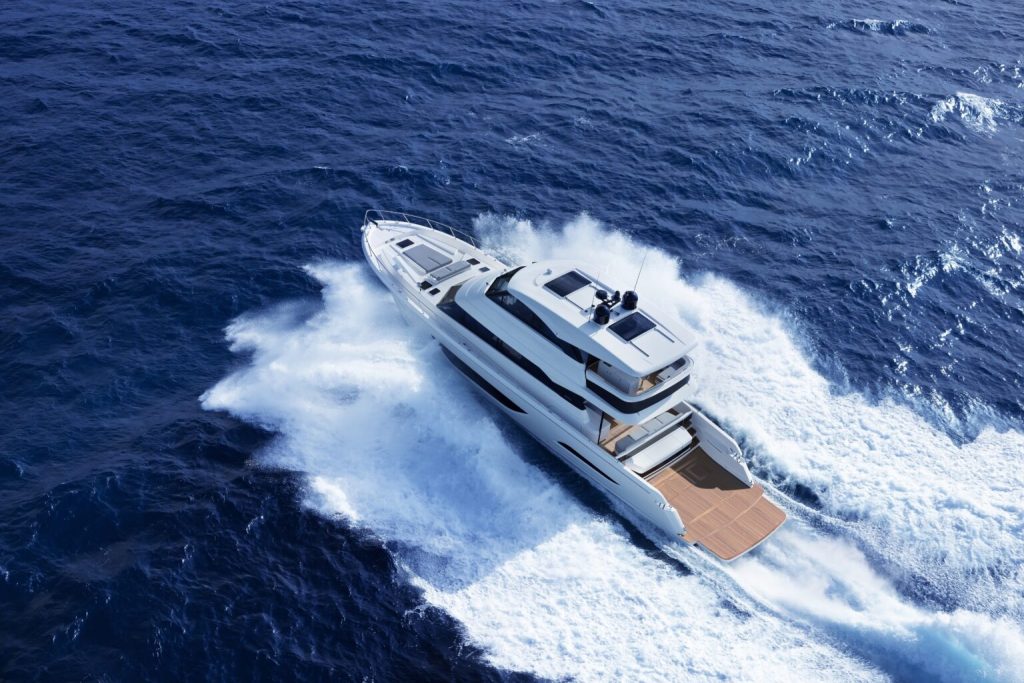
“When you walk people through Maritimo and show them these magnificent, gloss white, shiny vessels, then take them to the moulds they come from, I still get a buzz out of it every day.”
That’s not just one man’s enthusiasm, it’s a reflection of a wider culture built on pride and constant refinement. Owners will likely never see the thousands of hours that go in beneath the gelcoat, or fully grasp what it takes to turn liquid resin into a hull capable of crossing oceans in comfort.
Every owner sees the finished yacht. Very few ever see the months of composite work hidden beneath the surface.
That’s where every Maritimo really begins. Long before the timber fit out, the machinery and the first sea trial, skilled laminators have already built the structure that everything else depends on. Most owners will never witness that work, but every voyage starts with it.