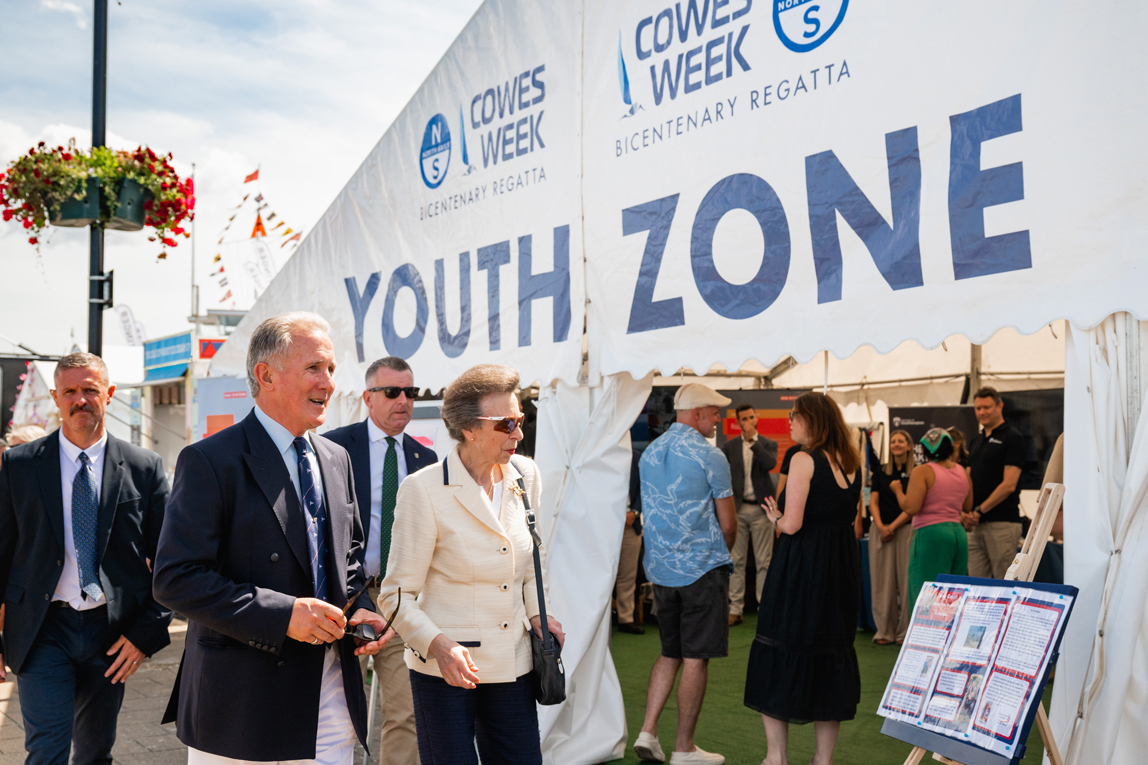
When The Princess Royal stepped into Regatta House during the opening weekend of Cowes Week, she was returning to a place she has known her entire life. Not as a spectator, but as someone woven into the fabric of sailing’s most storied gathering.
The visit marked the 200th anniversary of a regatta that began in 1826 when seven yachts lined up off the Isle of Wight. This year, more than 630 boats crowded the Solent across 40-plus classes. But for the Princess, the numbers matter less than the lineage. As a girl, she sailed aboard the Royal Yacht Britannia while her father, Prince Philip, Duke of Edinburgh, raced on these waters. She later competed here herself, helming the UKSA’s Farr 65 Albatross II in 2014 and crossing the finish line ahead of her husband Vice Admiral Sir Tim Laurence, who was racing Whirlwind II.
Behind the scenes at Regatta House, staff and volunteers orchestrate the daily racing spectacle that draws thousands of competitors. The Princess spent time with the people who manage races, run communications, and keep the event ticking. It’s the unglamorous work that makes Cowes Week function, and she saw it firsthand.
The visit also connected her to an exhibition exploring Britannia’s time in Cowes and the Royal Family’s relationship with the town. At the centre sat Coweslip, a Flying Fifteen given to the then Princess Elizabeth and Prince Philip in 1949 as a wedding gift from Cowes residents. The yacht has been restored and returned to the town where she was built and launched.

Bruce Huber, Chairman Elect of Cowes Week Limited, recognised what the visit represented. “Her Royal Highness has known the regatta from many perspectives,” he said. “From spending time aboard Britannia as a girl while her father raced, to competing here herself, and through her longstanding involvement with organisations at the heart of sailing in Cowes.”
Today, The Princess Royal holds the title of Admiral of the Royal Yacht Squadron and serves as Patron of both the Island Sailing Club and UKSA. These roles reflect a connection that spans generations. For Cowes, her presence at the bicentenary was more than ceremony. It was a validation that this corner of the Solent remains central to British sailing, and that some families carry the water in their blood.