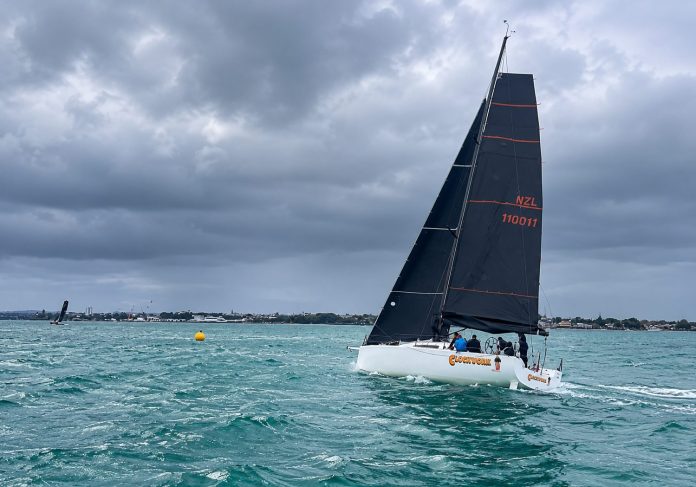
Ten minutes behind at Saddle Island, Steve Mair’s Clockwork came charging back towards Auckland to take line honours by just 1 minute 51 seconds, and overall handicap by a little over 6 minutes.
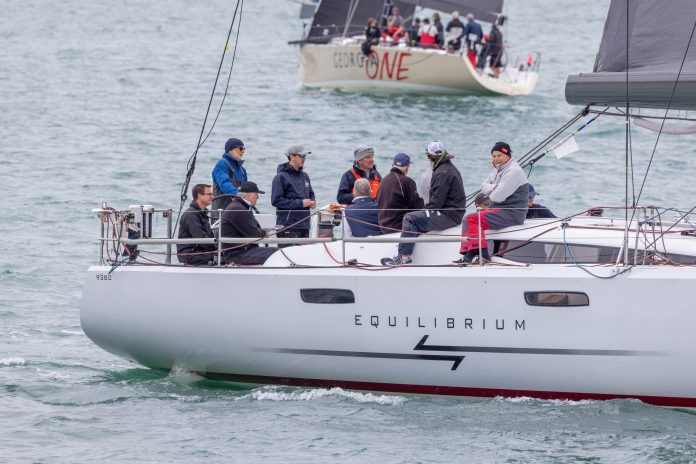
Graham Matthews’ Equilibrium had spent much of Saturday’s Bean Rock Race building what looked like a comfortable lead. By the time the Botin Carkeek 55 rounded Saddle Island, off Mahurangi, the unofficial tracker put it more than ten minutes ahead of Steve Mair’s Clockwork. Matthews’ crew had already won line honours in the opening two rounds of the Doyle Sails Gold Cup, and a third appeared well within reach.
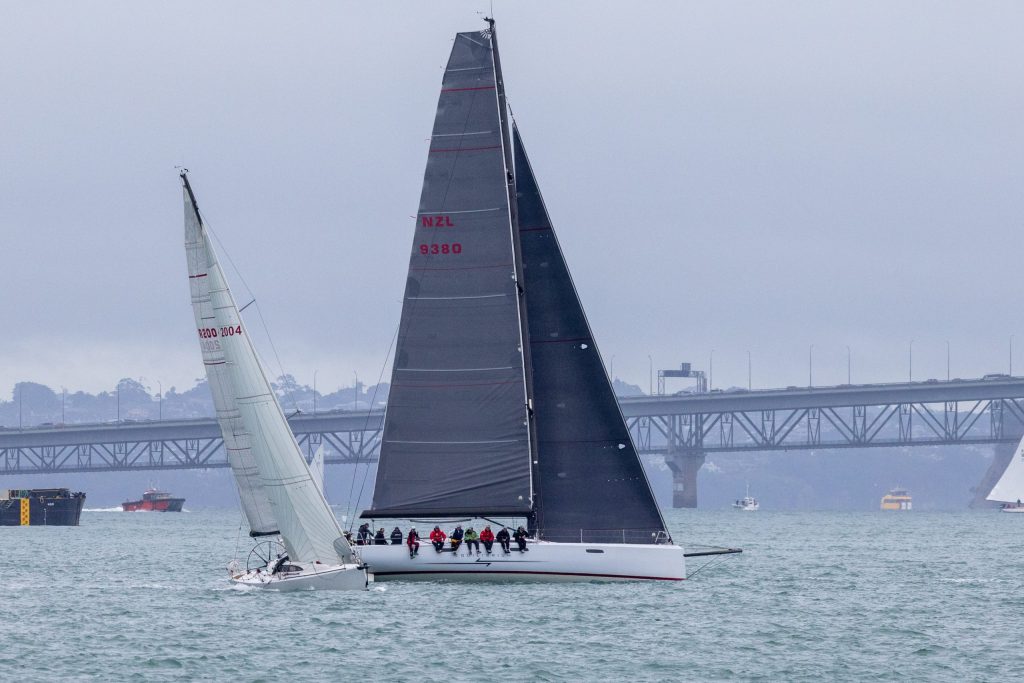
Graham Matthews’ 55 foot Equilibrium (left) almost dwarfs Jonathan Gravit’s 38 foot Visage as they prepare for the start. Photo: Roger Mills.

The return leg changed that. Clockwork steadily clawed back the deficit, catching Equilibrium as the yachts raced towards the finish. The pair traded places in the closing stages, with Mair’s crew crossing at 3.22.11pm, just 1 minute 51 seconds ahead. The win gave Clockwork its second PHRF victory from two Gold Cup starts this season, having missed the RNZYS’ Roy McDell round in October. For Equilibrium, it was the first time this season that another monohull had beaten it across the Gold Cup line.
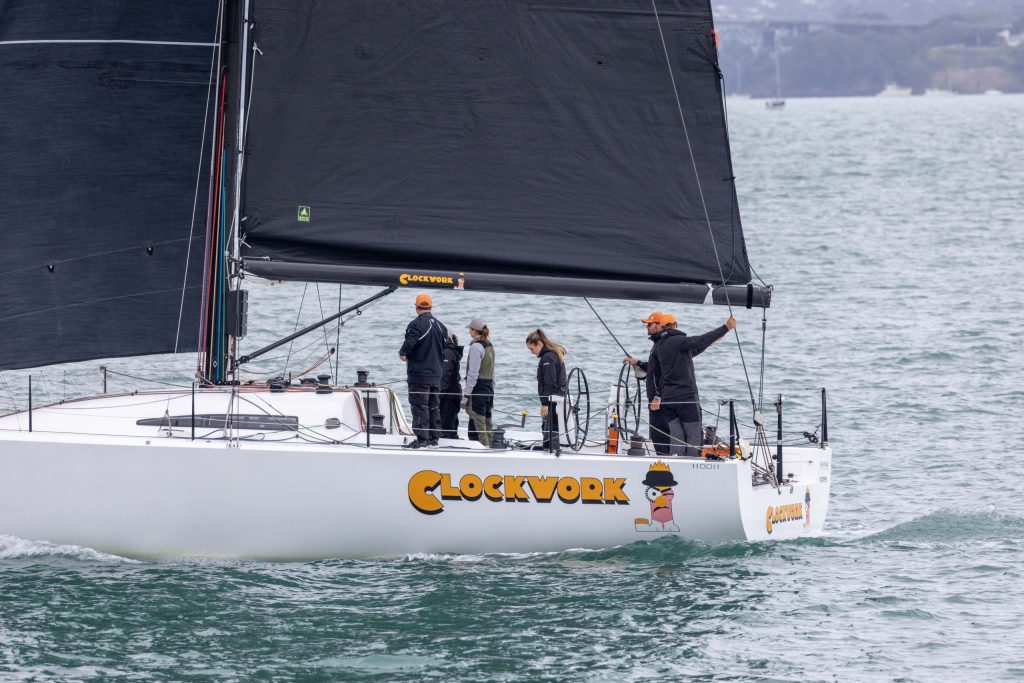
Steve Mair’s Shaw 12, Clockwork, at the start of the Bean Rock Race. Photo: Roger Mills.
Equilibrium builds its lead on the way north
Royal Akarana Yacht Club hosted the approximately 44 nautical mile course through the Hauraki Gulf on Saturday 7 November. Starting from Ōrākei, the fleet sailed past Rangitoto Beacon before heading north around Orarapa Island, better known as Haystack, and on to Saddle Island, the northernmost point of the course. From there, the yachts turned south towards Auckland, passing the Eastern Navy Buoy off Whangaparāoa on the way home.

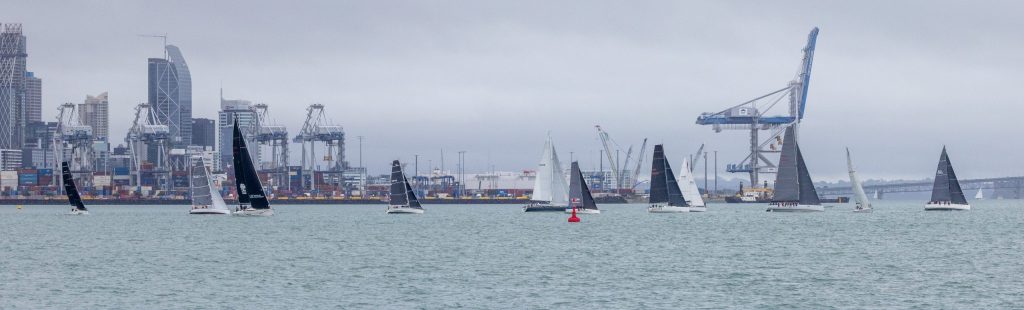
The fleet preparing for the start of the Doyle Sails Gold Cup Bean Rock Race. Photo: Roger Mills.
Crews woke to a drenching Auckland morning, although conditions had improved by the 10am start. Low lying fog still hung over the course towards Haystack, but the yachts found clearer conditions as they headed towards the channel between Tiritiri Matangi and Army Point. MetService had issued a Severe Thunderstorm Watch, warning of heavy rain, lightning and sudden squalls through the morning and potentially into the afternoon. Fortunately, much of the course escaped the worst of the forecast weather. The run home was a fast one, with yachts sailing wider to make the most of the breeze. But conditions deteriorated again as the fleet approached Auckland, with some crews choosing to head for the shelter of a marina rather than continue towards the finish line.
From our vantage point at Army Point, Equilibrium first emerged through the haze, leading Clockwork and Quintin Fowler’s Rum Bucket.
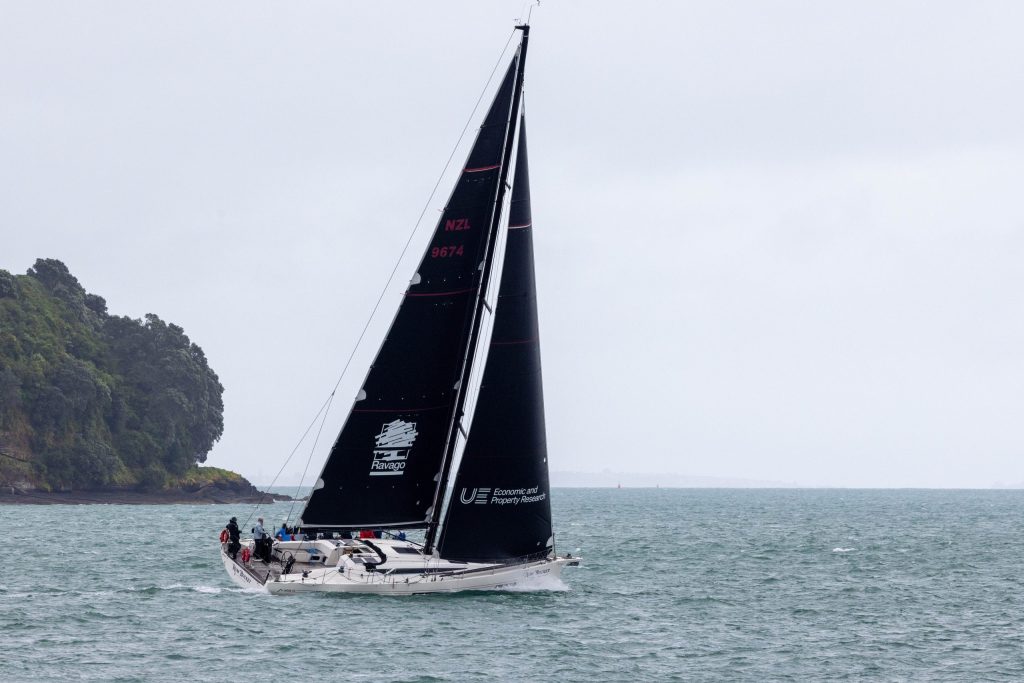
Quintin Fowler’s More 55, Rum Bucket. Photo: Roger Mills.
By this stage in the race Matthews’ advantage had grown. At Rangitoto Beacon, Clockwork was an estimated 3 minutes 28 seconds behind. By Haystack, the gap had stretched to 6 minutes 14 seconds, reaching 10 minutes 8 seconds at Saddle Island. Equilibrium had been first among the tracked yachts at every rounding mark.
With the northern end of the course behind them, the leading boats still had plenty of sailing ahead.

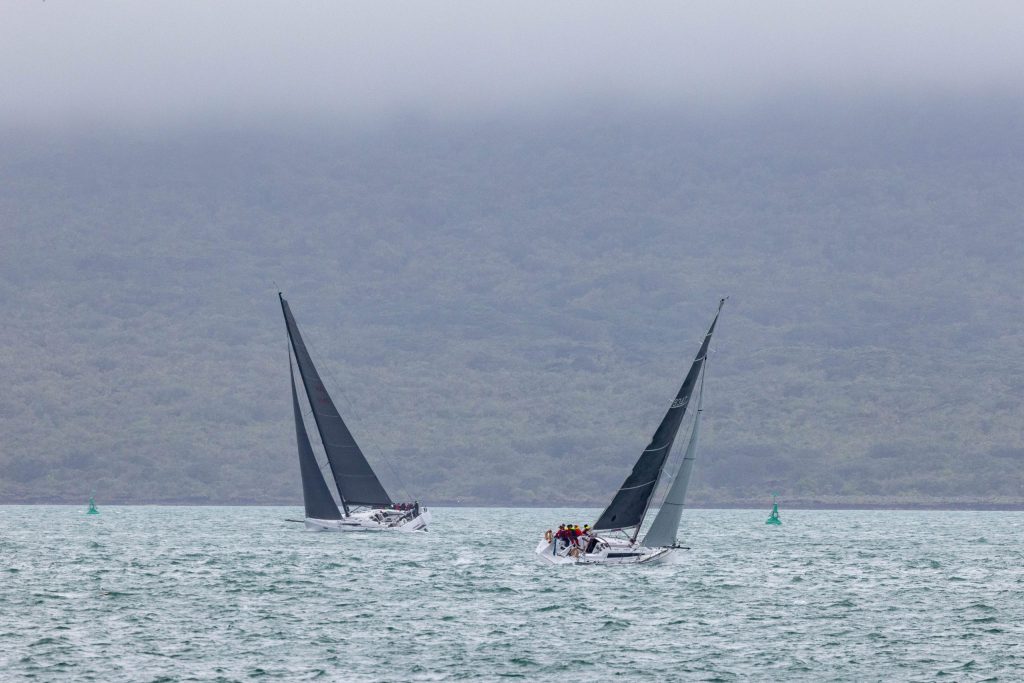
Heading into the haze are Graham Matthews’ Equilibrium and Tony Morgan’s Whitebait, just after the start. Photo: Roger Mills.
Mainsails were reduced, and spinnakers were flying as the yachts headed south between Tiritiri Matangi and Whangaparāoa. We didn’t need the tracker to tell us Clockwork was flying. The yacht is wickedly fast in the right conditions, and Saturday’s wind conditions suited her beautifully. The tracker soon confirmed what we were seeing, with Clockwork steadily eating into Equilibrium’s lead. By Eastern Navy Buoy, Mair’s crew had clawed back 2 minutes 27 seconds, reducing the estimated gap to 7 minutes 41 seconds.
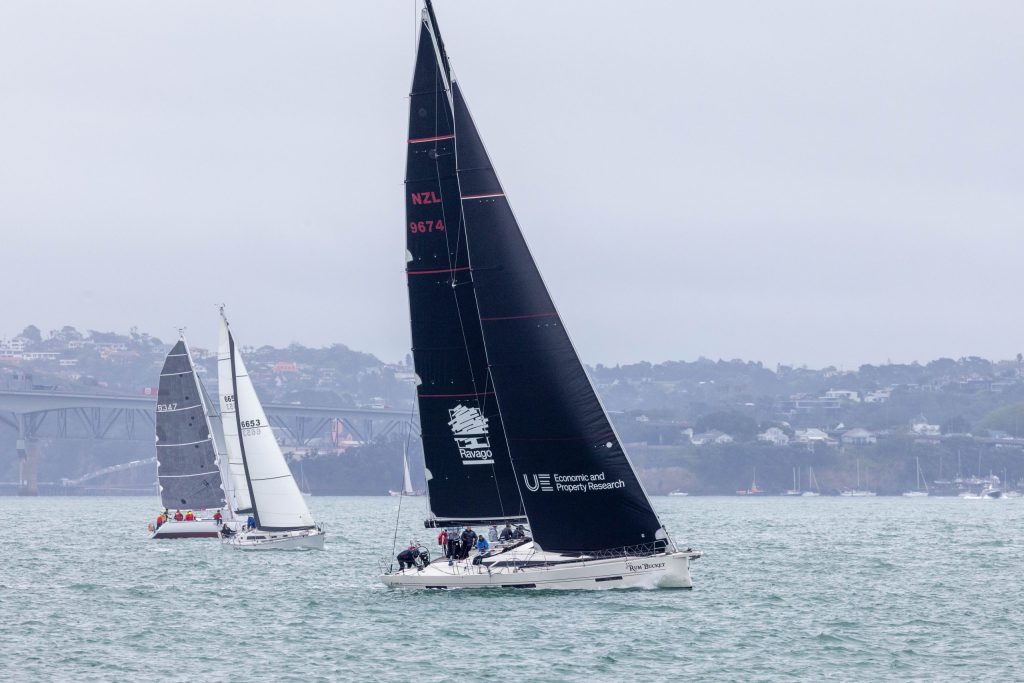
From left: Tony Morgan’s Whitebait, Mack Storey’s Tonto and Quintin Fowler’s Rum Bucket. Photo: Roger Mills.
The biggest gains came on the final leg. The tracker calculated an average speed of 14.8 knots for Clockwork, compared with 13.3 knots for Equilibrium. Its estimated gain of 9 minutes 30 seconds was enough to overturn the remaining advantage.
North of Rangitoto, the two yachts were close together. By the 3.07pm update, Clockwork was ahead with Equilibrium hot on its tail. The official finishing times settled the contest.
Clockwork crossed at 3.22.11pm, with Equilibrium following at 3.24.02pm.
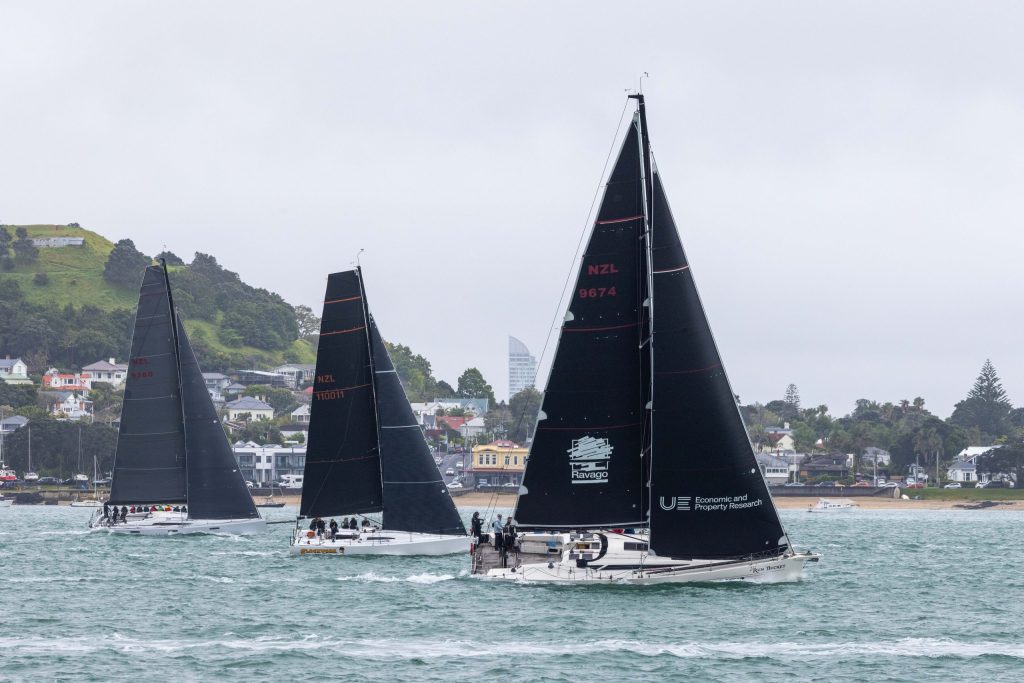
Steve Mair’s Clockwork between Graham Matthews’ Equilibrium and Quintin Fowler’s Rum Bucket. Photo: Roger Mills.
A second Gold Cup handicap victory for Clockwork
Clockwork’s elapsed time was 5:17:11, with a corrected time of 5:11:47. It was the fastest monohull on the water and the winner on PHRF. Equilibrium finished second on line honours in 5:19:02, but dropped to third on handicap.
Between them on PHRF came Rum Bucket, which crossed the line at 4.00.19pm before correcting to 5:18:01. That gave Fowler’s crew second place, 6 minutes 14 seconds behind Clockwork and 6 minutes 46 seconds ahead of Equilibrium.
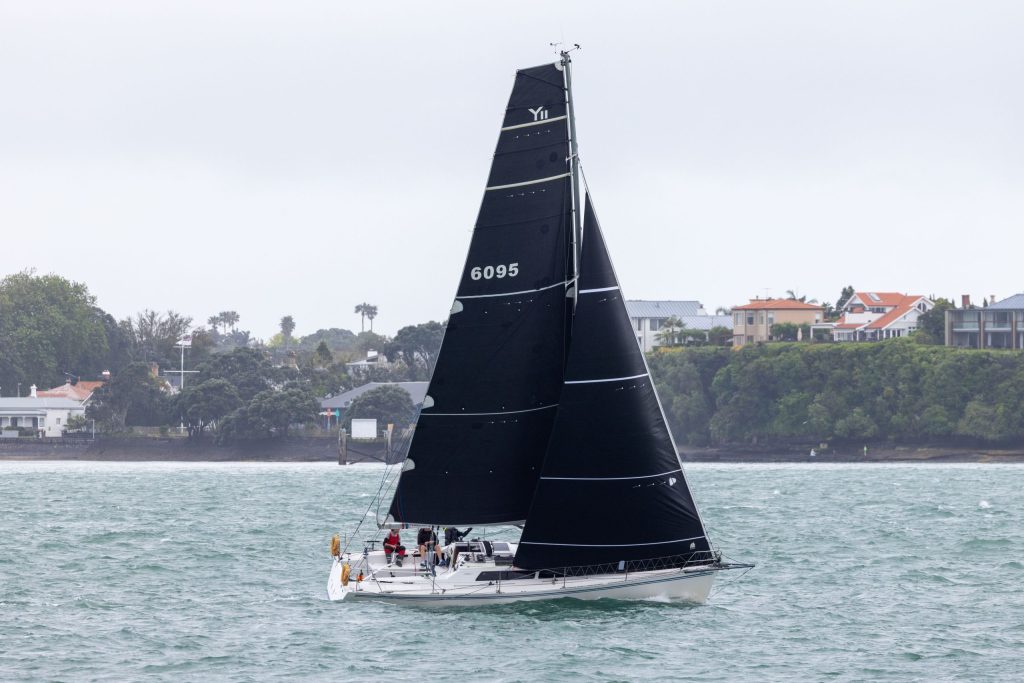
Chris Beaumont’s Young 11, Flying Boat, at the Bean Rock Race start. Photo: Roger Mills.
For the Gold Cup, the result adds another chapter to the developing contest between Mair and Matthews.
At Richmond Yacht Club’s Spring Regatta in September, Equilibrium took the Gold Cup division line honours, but Clockwork beat it by three minutes and six seconds on corrected time. Mair’s crew then missed October’s Roy McDell Memorial, where Equilibrium collected both Gold Cup line honours and the PHRF victory. Matthews’ yacht consequently arrived at Bean Rock leading the provisional championship standings, with Nirvana second and Rum Bucket third on handicap points.
Bean Rock was the first time Clockwork and Equilibrium had raced one another since Richmond. This time Mair’s crew won both classifications, giving Clockwork two PHRF victories from its two Gold Cup starts.
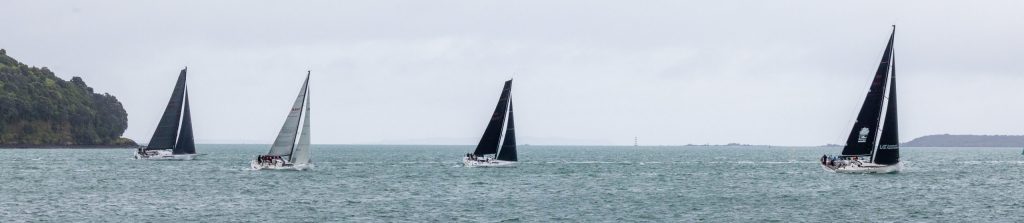
The Doyle Sails Gold Cup Bean Rock Race gets underway. Photo: Roger Mills.
Close finishes further down the fleet
The first three yachts were home shortly after 4pm, but several crews still had hours of racing ahead. John Meadowcroft’s MC31 Carrera 3 finished fourth at 5.01.00pm, keeping that position on handicap. Alastair Macauley’s Beneteau Questa, spotted earlier leading the following group near Tiritiri Matangi, came home fifth in both classifications.
One of the closest finishes came later in the evening.
Jonathan Gravit’s Bakewell White 38 Visage crossed at 6.29.27pm. Chris Beaumont’s Young 11 Flying Boat followed just 31 seconds later, after more than eight hours on the water. PHRF reversed their order, putting Flying Boat ahead by 2 minutes 36 seconds.
Further back, the tracker had shown Tony Morgan’s Whitebait eight seconds ahead of Flying Boat at Eastern Navy Buoy. By the finish, Beaumont’s crew had moved 6 minutes 13 seconds clear. Mack Storey’s Farr 1220 Tonto had also been ahead of both at that buoy, but was the final yacht home at 7.01.11pm.
On handicap, Tonto fared considerably better. Ninth across the line became sixth on PHRF, the largest improvement between the two classifications.
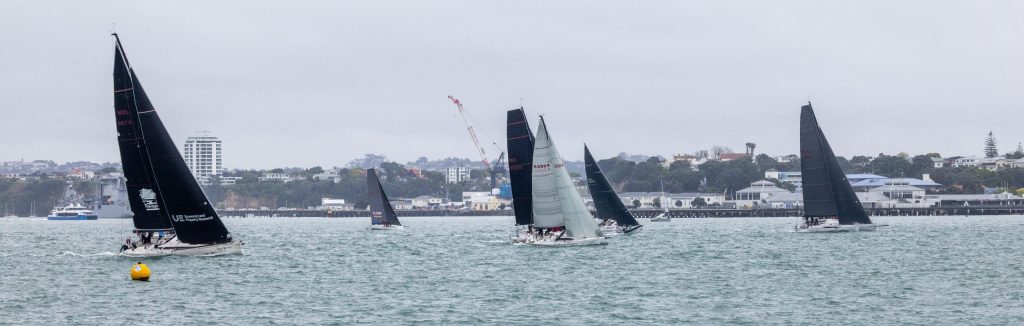
From left: Rum Bucket, Carrera 3, Clockwork and Visage. Photo: Roger Mills.
Whitebait finished eighth on the water, while Indis and Nigel Hendy’s Nirvana were the only confirmed DNFs.
The Bean Rock Race was the third of five rounds in this season’s Doyle Sails Gold Cup. With Clockwork holding two handicap wins and Equilibrium having finished in the top three on PHRF at every round, the updated standings will be worth watching.
The next race is the Percy Jones Memorial on 5 December, followed by the Balokovic Cup in February 2027.
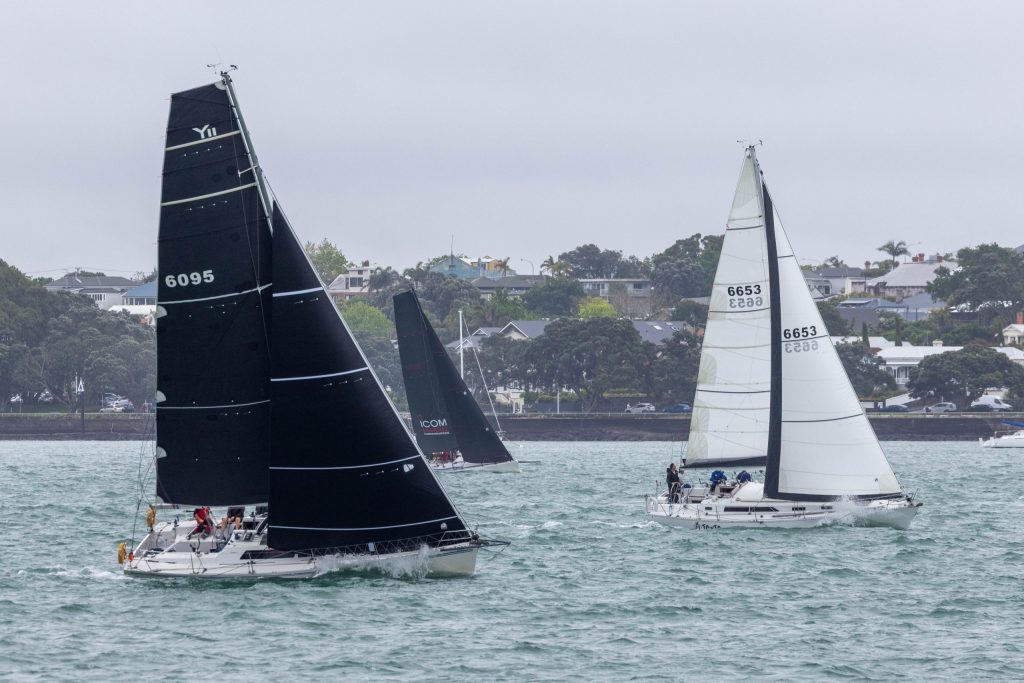
From left: Chris Beaumont’s Flying Boat, John Meadowcroft’s Carrera 3 in the background, and Mack Storey’s Tonto. Photo: Roger Mills.