Boating New Zealand Boat Reviews
Reviews
Boating New Zealand News
News
Boating New Zealand Sports
Sport
Boating New Zealand Lifestyle
Lifestyle
advertise
Boating New Zealand Boat Reviews
Reviews
Boating New Zealand News
News
Boating New Zealand Sports
Sport
Boating New Zealand Lifestyle
Lifestyle
BOAT-REVIEWS-MOBILE
Boat Reviews
BOAT-NEWS-MOBILE
News
BOAT-SPORTS-MOBILE
Sports
BOAT-LIFESTYLE-MOBILE
Lifestyle
HomeIndustry UpdatesInnovations in Boat DesignHow Sailing Yacht Zero is redefining lightning protection for electric yachts

How Sailing Yacht Zero is redefining lightning protection for electric yachts

Lightning strikes have long been a part of life at sea—but electric yachts face a new kind of vulnerability. Sailing Yacht Zero’s developers are rethinking lightning protection from the hull up, using Faraday cage principles and custom rigging to shield sensitive systems. Their breakthrough could shape the future of electric boating.

As yacht design moves steadily toward full electrification, traditional safety systems are being tested in new ways. One unexpected challenge? Lightning. For most vessels, it’s a known hazard with well-established defences. But for electric boats like Sailing Yacht Zero, a direct hit risks total electronic failure.

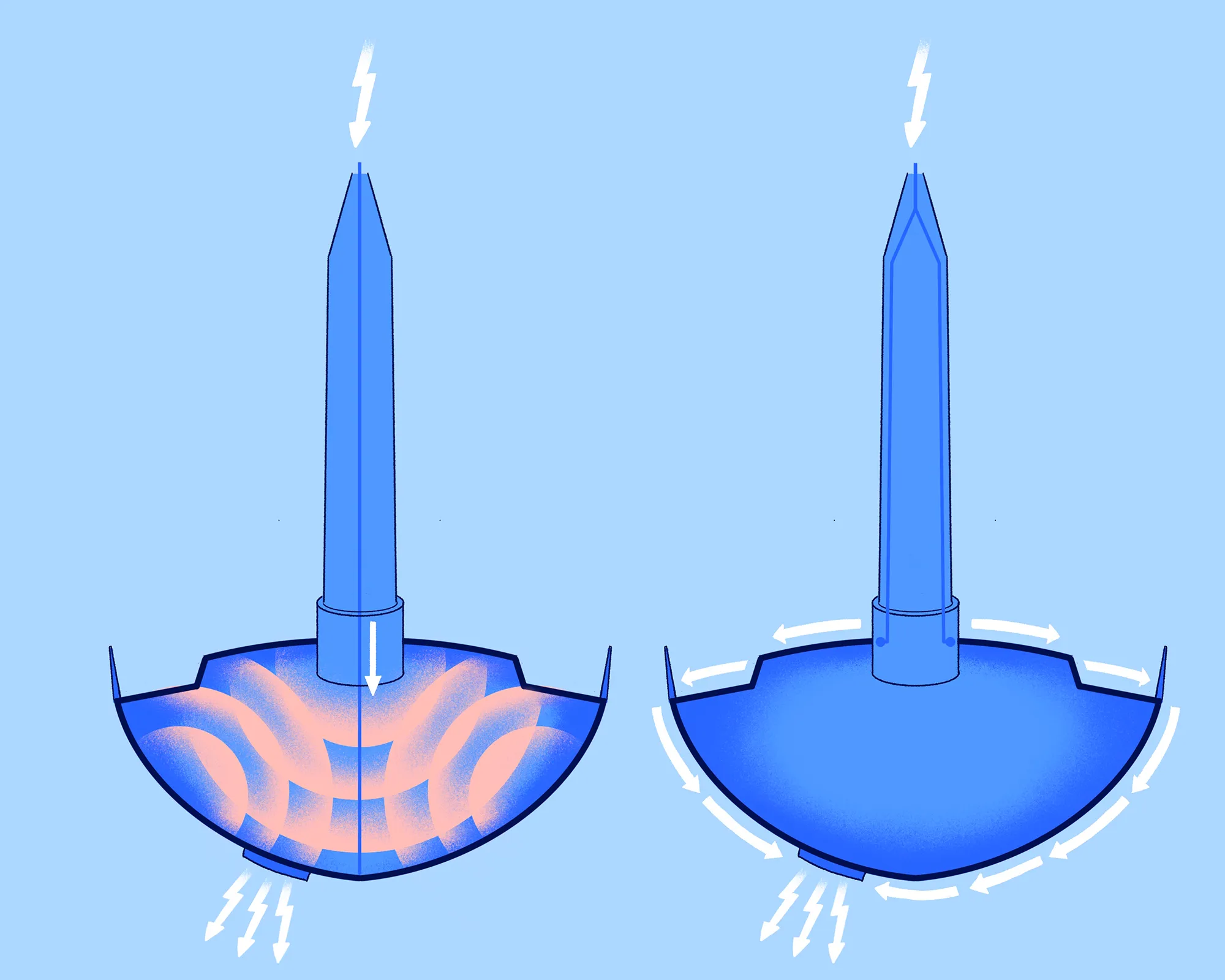
Developed by the not-for-profit Foundation Zero, Sailing Yacht Zero is an experimental yacht powered entirely by renewable energy. Early in the build, the team realised the standard lightning path—mast to hull to water—couldn’t guarantee protection for sensitive systems. That’s because while the strike itself might not burn through batteries, the electromagnetic pulse (EMP) it generates can cripple them in microseconds.

Physicist Bob van Someren, part of the yacht’s technical team, explained the core risk:

“This high current pulse gives a very big electromagnetic pulse (EMP), and that’s usually what damages your electronics. That’s our problem.”

- Advertisement, article continues below -
Sports Marine Logo
2025 Nimbus T11
2025 Nimbus T11
NZD 1194872
2025 Model Year Run-Out . One Only! Save $187,601

Standard surge protectors weren’t enough. Instead, the team turned to a powerful but underused idea in yacht construction: the Faraday cage. Their goal was to keep lightning current outside the vessel’s body, allowing the metal hull to deflect the EMP away from onboard systems.

This required a rethink of mast design. The team partnered with Carbo-Link, a Swiss composite engineering firm, to engineer a lightning cable exit point outside the hull—just above the deck—so the strike wouldn’t pass through the interior. Carbo-Link ran detailed stress simulations to find a structurally sound spot to install the outlet. The result is a custom exit that won’t compromise the mast’s strength, even under load.

Additional design tweaks include isolating system cables that might breach the Faraday cage and installing fuses that cut off surge pathways. Together, these create a protective bubble around the yacht’s electrical heart.

This new approach has already attracted attention for its innovation. But for van Someren and project manager Eduard van Benthem, the real test will be at sea:

“Although as much testing as possible will take place ahead of the sea trials, there are many aspects that simply need to be put into real-world environments.”

As electric yachts become more common, solutions like this may soon set the new industry standard.

- Advertisement, article continues below -
Busfield Marine Logo
Bavaria S36 -2017
Bavaria S36 -2017
$ 459 000 NZD
11.66 m | With 550 hours on the clock this Bavaria S36 hard top is a luxury launch with 2 cabins and spacious interior. View at Westhaven Marina.

You can read more details of the installation atwww.foundationzero.org/insights/protecting-electric-yachts-from-lightning-strikes.
Share this
// Photo credit: Paul Spencer / Facebook
Article
Article

Human powered circumnavigation boat built in New Zealand rewrites ocean endurance rules

Boat Profile
The New Zealand-built pedal boat designed to fix a flaw in human powered circumnavigation.
Article
Article

Rethinking the rescue boat: How next generation vessels could transform SAR

Innovations in Boat Design
Mike Hammond says tomorrow’s rescue boats may look very different from the fleets we know today. ...
Article
Article

Wave-piercing hulls and the Kiwi cat that redefined offshore performance

Innovations in Boat Design
A new direction in offshore hull design When Ultimate Lady launched in 1998, most private motor yac...

Comments

This conversation is moderated by Boating New Zealand. Subscribe to view comments and join the conversation. Choose your plan →

This conversation is moderated by Boating New Zealand.

LEAVE A REPLY

Please enter your comment!
Please enter your name here

Boating New Zealand
Boating New Zealandhttps://www.boatingnz.co.nz
Boating NZ is New Zealand’s premier marine title devoted to putting its readers behind the wheel of the latest trailerboats, yachts and launches to hit the market. It inspires with practical content and cruising adventures, leads the fleet with its racing coverage and is on the pulse of the latest maritime news and innovation.

LATEST NEWS