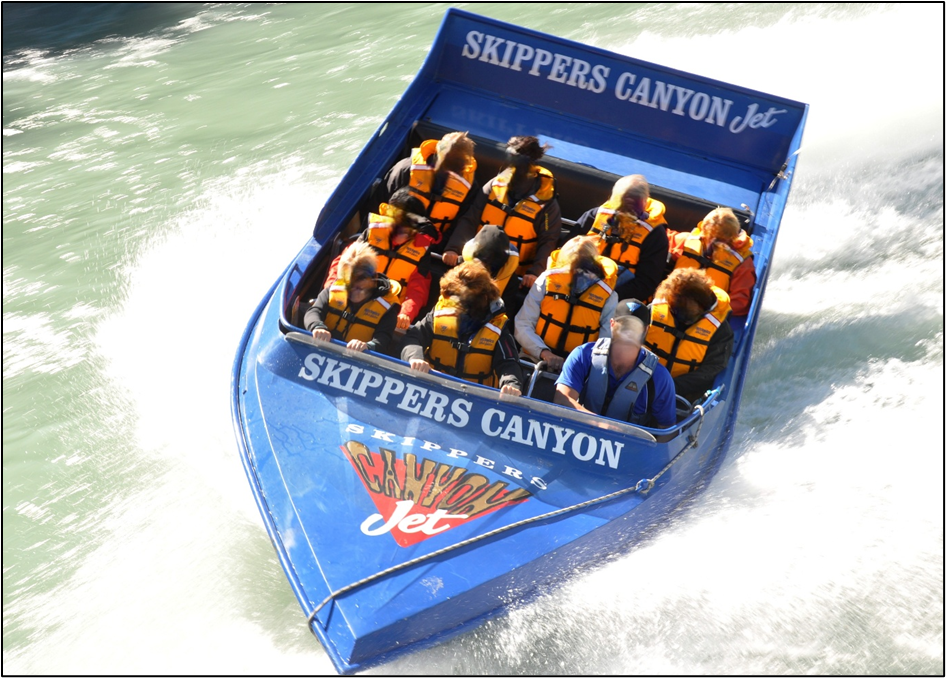
At 1647 on 25 February 2025, Discovery 2 departed Deep Creek with 11 passengers on board for what the operator’s website described as canyon jet boating at its best, with highly skilled drivers manoeuvring the boat just inches from the sheer canyon walls, speeds in excess of 80 kilometres per hour, and a series of 360-degree spins. At about 1701, on the return leg from Skippers Bridge, the engine cut out. At about 1702, the boat collided with the canyon wall.
The Transport Accident Investigation Commission’s final report, published in April 2026, traces the immediate cause to a wiring harness. A lead connecting the engine’s pedal position sensor had been gradually chafing against a rough casting edge on the engine. Over time, the wire’s protection wore away. On the return leg from Skippers Bridge, it shorted out, cutting the 5-volt reference signal shared by the engine’s critical sensors. The motor stopped.
Confirming this took months of methodical work. The engine’s diagnostic system registered no specific fault code when it cut out. Initial testing and tracing of the engine system by the operator’s technicians, observed by Commission investigators, could not identify or replicate the fault. Further in situ testing and inspection followed in March 2025, conducted by Commission investigators and an independent expert alongside the operator. The wiring harness was then removed for closer inspection. Under laboratory conditions, forensic examination identified chafing damage to the wire protection on the pedal position sensor lead. KEM Equipment Incorporated confirmed that arcing on that lead would probably cause the engine to cut out.

On 21 August 2025, the wiring harness was refitted to Discovery 2 and tests were carried out. When reinstalled, it naturally rested against the area of the suspected short circuit, at a point that appeared to be a rough casting edge on the engine. When the wire was earthed at idle, and again at 4,000 revolutions per minute, the engine stalled both times. It is, the Commission found, virtually certain that the engine shut down because part of the wiring harness had chafed against that casting edge.
The engine installed in Discovery 2 was manufactured prior to 2018. KEM informed the Commission that the wiring harness on post-2018 engines was routed differently because the new design included relocation of the engine fuse/relay box, and that additional sheathing of the wires was introduced to ensure adequate protection of the wiring harness.
The wiring fault explains why the engine stopped. The Commission then examined what followed from that.
When the engine cut out, the boat had no propulsion and no thrust to provide steering control. The driver immediately reset the ignition, but the engine would not start. The vessel continued across the river, making heavy contact with the canyon wall at an estimated 30 to 35 kilometres per hour, having been travelling at an estimated 60 to 65 kilometres per hour when the engine failed. As a single-engine jet boat, Discovery 2 had no back-up propulsion, and the driver had no means to steer the boat without power or thrust. Once control was lost, there was little opportunity for recovery.
The Commission noted it had previously investigated jet boating accidents that resulted from a single point of failure in a critical control system. In 2019, Discovery 2 had struck the same canyon wall after the driver lost control due to failure of the steering nozzle attachment, with three of the four stud-bolts securing the steering nozzle to the jet unit having cracked, leaving the steering and propulsion system ineffective. In 2021, a commercial jet boat on the same river lost propulsion and steering after a fuse within the engine control system failed, resulting in the engine stopping. The cause of both earlier accidents was a single point of failure in a critical jet boat control system, which resulted in total loss of control.
A significant finding in the report concerns not the boat, but the passengers.

Some passengers had been expecting a thrill-type trip while others initially expected a more sedate tour of Skippers Canyon. The pre-departure briefing and the first few minutes of the trip made clear to all passengers that this was intended to be a thrill-type trip. Passengers described the thrill components of the ride as the spins and the boat approaching bends and rocky outcrops at high speed then swerving away at the last minute.
Because the passengers came to expect these high-speed, close-call manoeuvres, their ability to recognise and respond to danger when a potentially dangerous situation arose was reduced. One passenger noted that they heard the driver shout “brace” but still couldn’t process that there really was an accident evolving and thought it was all part of the ride.
Passengers had not been informed of what an appropriate brace position was for an emergency on board a jet boat, and were therefore uncertain how to respond. They did not know what the brace position was, nor had the operator informed them at the pre-departure briefing of what “brace” constituted. The Commission found it likely that some passengers suffered worse injuries due to this uncertainty.
There is a further irony in the report. Skippers Canyon Jet Limited had chosen not to use liability waivers because it considered it had a responsibility to look after customers affected by an accident while participating in its activities. TAIC found this had an unintended consequence: some passengers interpreted the absence of liability waivers as an indication of a lower-risk activity.
The regulatory picture is no simpler. Maritime Rules Part 82 requires that hard surfaces on commercial jet boats be padded where practicable, and that seating for thrill-type trips be adequately upholstered. The Commission found that the padding requirements prescribed in the Maritime Rules did not include enough detail to form a measurable standard for passenger protection. When TAIC asked Maritime NZ what “adequate” meant in practice, Maritime NZ confirmed it had no specific guidance on the meaning of adequate with respect to jet boat seating upholstery. Annual inspections of Discovery 2 had found the padding met the requirements of the rules.

TAIC has recommended that the Director of Maritime New Zealand work with New Zealand commercial jet boating stakeholders to review and improve the requirements prescribed to commercial jet boat operators to ensure that safety measures on board are adequate to protect passengers from injury. Maritime NZ has indicated it will engage with industry stakeholders through its harm prevention programme of work to determine the scale of the issue and consider what type of response, whether rule changes, practice or guidance, would best fit the needs of the recommendation.
Since the accident, Skippers Canyon Jet Limited has introduced a risk disclosure as part of the booking and ticketing process, posted a risk disclosure sign at the jetty, and introduced new procedures in its safe operational plan to brief passengers on safety equipment and emergency procedures, including actions to be taken for a loss of power or sudden impact scenario. In the Commission’s view, this safety action has addressed the safety issue.
Full report: MO-2025-202 Jet boat Discovery, Skippers Canyon, Queenstown, 25 February 2025