Pets bring a dose of reality, lots of laughs and an ocean of love to their seafaring owners.
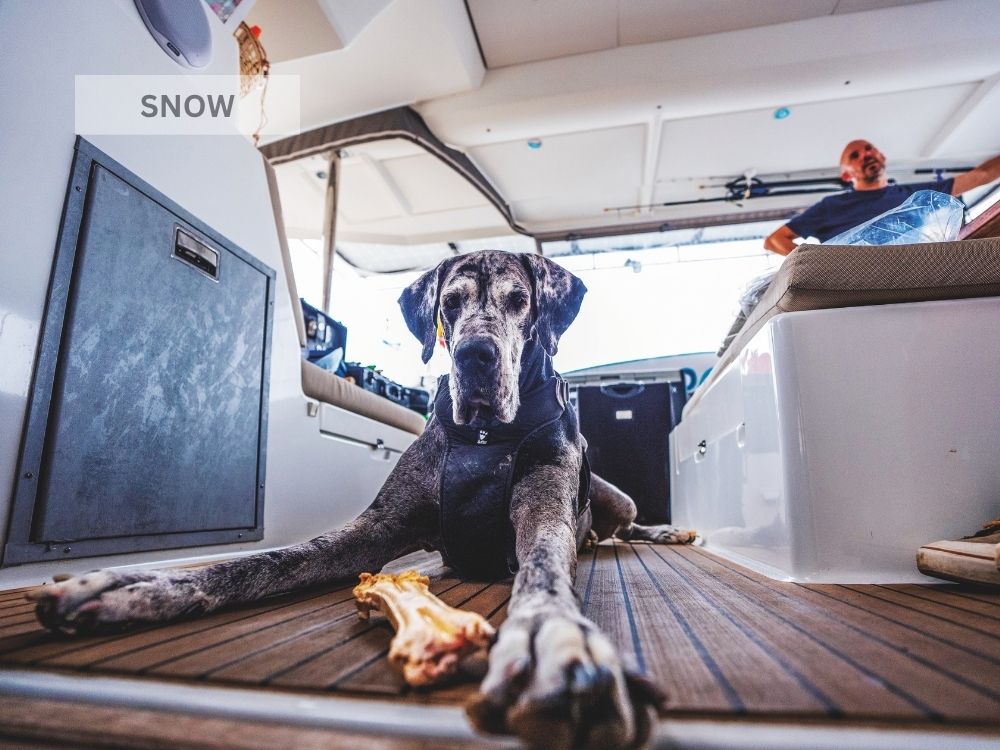
The Atlantic Rally for Cruisers, the annual transatlantic rally from the Canary Islands to the Caribbean, is big on numbers: hundreds of yachts, dozens of multihulls, and a half dozen pets. The biggest among these superlatives in a recent rally is certainly Snow, the great dane who made the crossing on the Belgian-flagged, what else, Great Dane.
“Snow is probably the largest dog to have ever sailed with the ARC,” says Rachel Hibberd, the head of communications for the World Cruising Club.
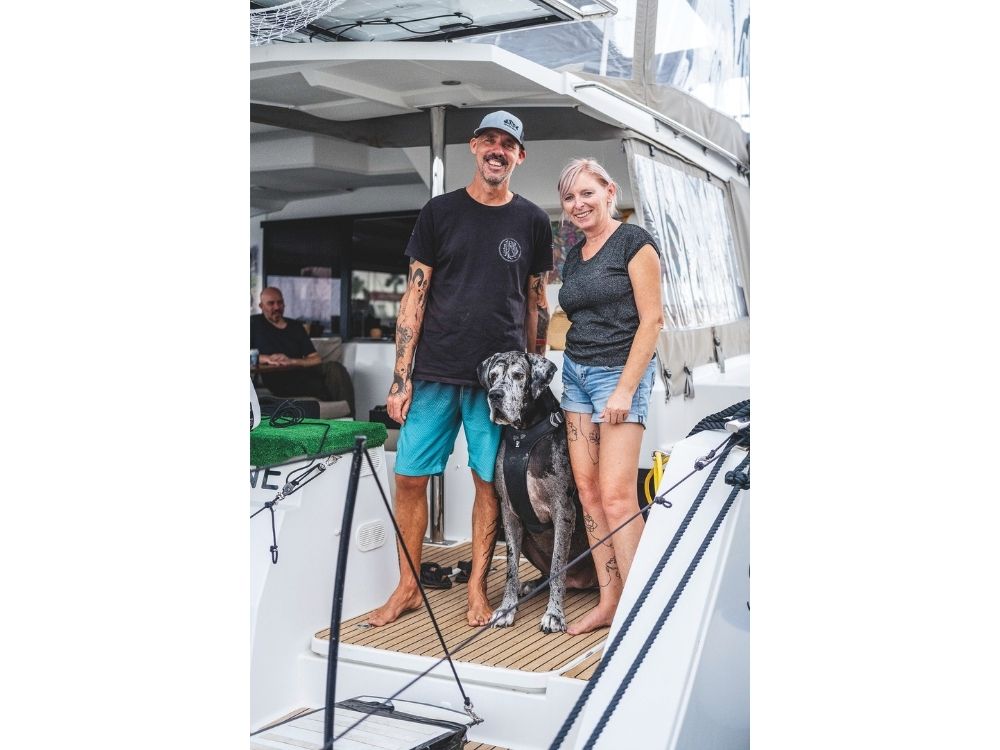
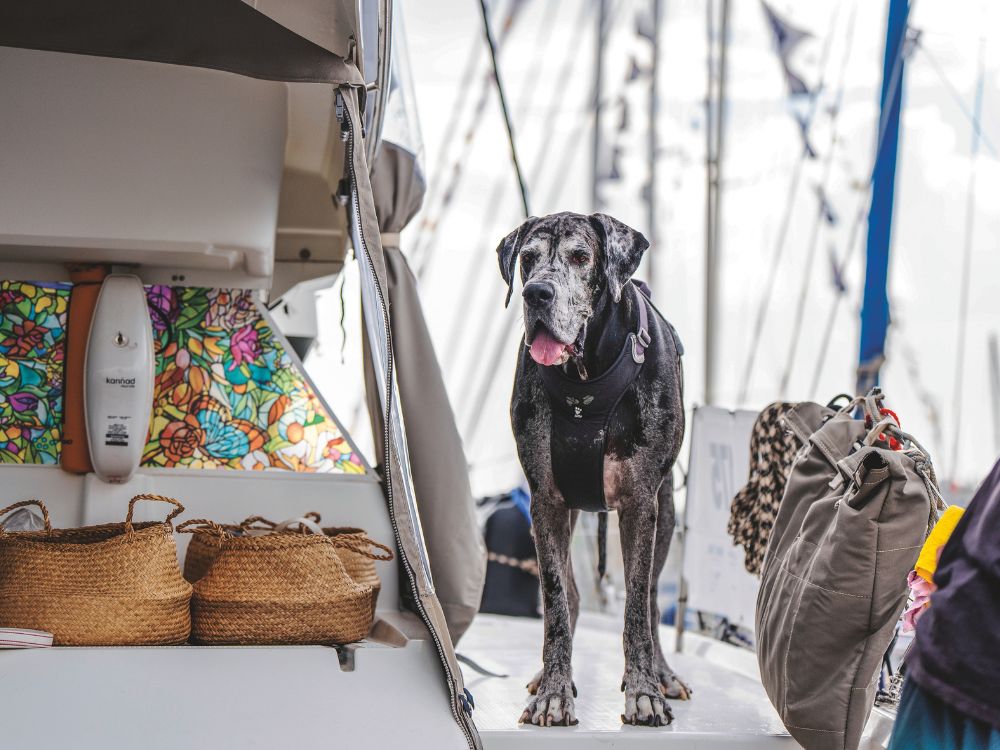
Granted, there may not be a lot of entries in the ‘Great Danes who have sailed across the Atlantic’ competition, but still, Snow is pretty impressive. She weighs in at around 160 pounds and, from her big paws to the top of her impressive head, stands just over three feet (1m) tall. She eats 800 grams a day of dog food, plus lots of snacks. And then there’s this special spot at the business end of her 2018 Fountaine Pajot Saona 47, off the port pontoon…




“We get asked that a lot, where does she do her business?” said Sophie Ingels, who, along with Sven Bruynooghe, make up Snow’s human parents.
Sophie and Sven worked from home, in Belgium, and had two merle great danes. They sold their business and travelled throughout Europe with the dogs in a camper van. Sven tested a few sailboats in the Caribbean and suggested they try cruising on an FP.
“When Sven proposed we get the boat, I said, yes… but the dogs are coming too!”
They sailed the Mediterranean for six months; when they saw that boat life actually worked with the great danes, they decided to join the ARC and cross the Atlantic. Sadly, one of their dogs passed away, but Snow has adjusted to multihull life like a champ.

There are a few challenges with having a pet onboard, and a lot of benefits, Sophie said.
Pets onboard are treated as a member of the fleet, and as a member of the family. The pet owners said each leg of a voyage requires unique planning, lots of paperwork and special provisioning.
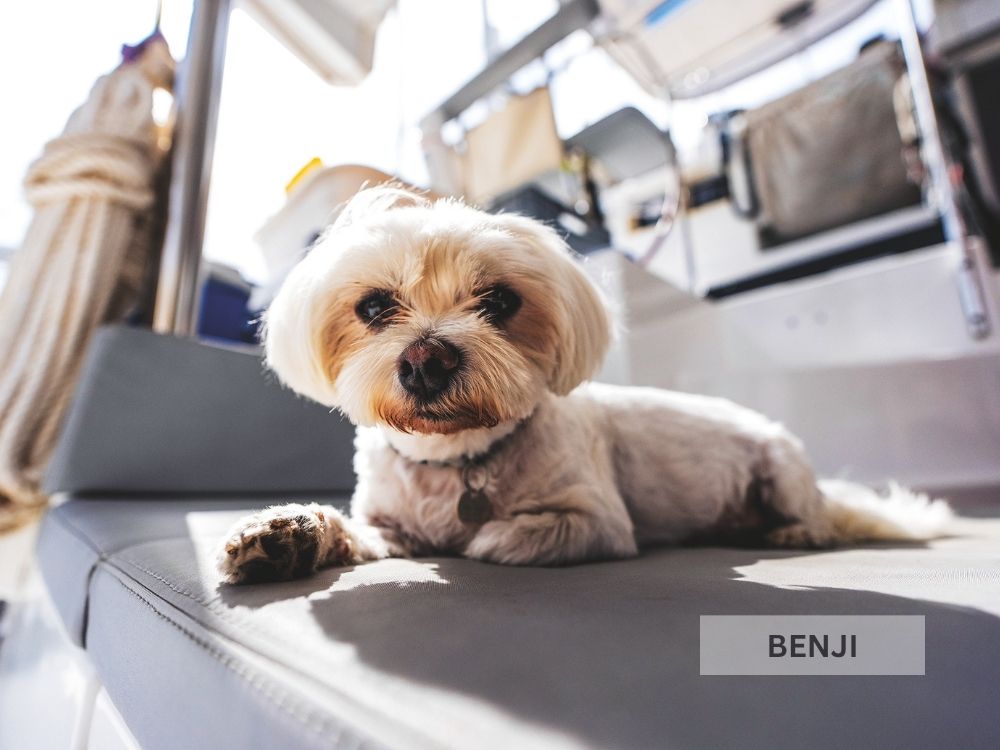
“We look at everything Benji might need quite a long time in advance,” said Mark Belcher, who along with his wife, Penny, make up the British human parents of possibly the cutest member of the fleet, the Maltese, Benji.
A rabies vaccination must be done a certain amount of time in advance, Mark said, to prove it has worked sufficiently. In St. Lucia, for example, the Titer test needs to have been administered at least three months prior to arrival.
In addition, there are only certain labs whose tests are accepted by different countries, so an owner must search them out and use the labs that are universally accepted. In the United Kingdom, there are two labs. In the United States, there are only two or three labs that are universally acceptable, he said.
“Other tests needed to be done in Las Palmas, because the tests need to be done within 14 days of departure, but then, there’s the whole problem of getting the results back from the lab in time!” he said.
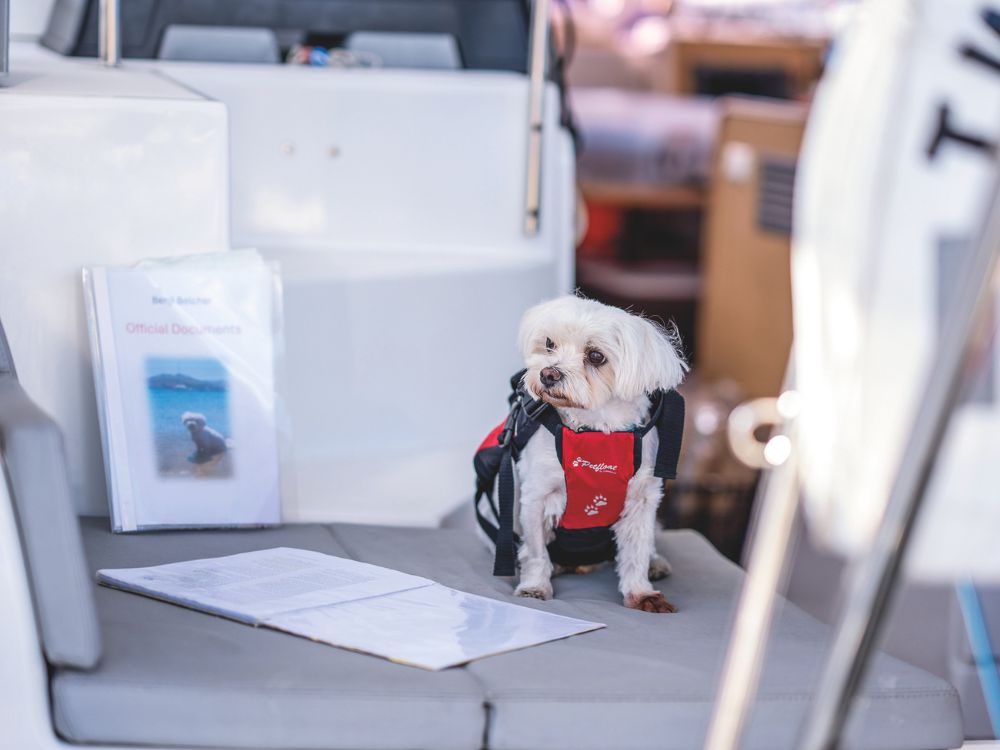
You need to get the health certificate, in order to get the export permit, to then get the import permit…
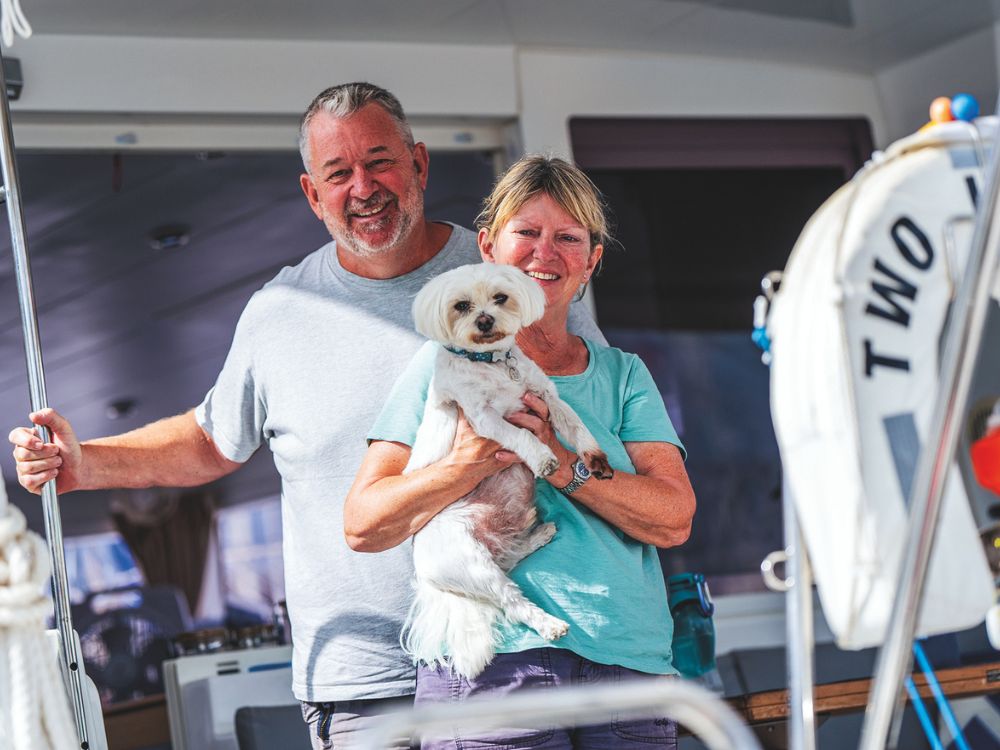
“You end up with a massive file of paperwork for Benji, and we just have our passports.”

Benji, for his part, shows very little concern for the complicated process and the Belchers’ efforts to maintain an extensive personal file for him on board. He does enjoy a really fast dinghy ride, to and from his Lagoon 400 Two Hoots, fast enough that his cute white ears flap in the breeze, and he shows a strong interest in any cheese and ham snacks in the shoreside cafes.
“Snow didn’t get off the boat once in the Mediterranean. She does occasionally fall in, and just paddles around until we get her out,” Sophie said. Moving around the European Union was not difficult, but we had to deal with some paperwork to get her into Morocco. The Caribbean is more of a challenge.
To go to St Lucia, Snow had to make three trips to the vet in Las Palmas. Sophie had to manage blood sample tests, health reports and export custom requirements.
An extensive amount of paperwork is sent to St. Lucia, and they decide if Snow can come, said Sophie.
“Each island has different requirements and asks for different things.”
St. Lucia is fairly strict, and a few cruising pet owners opted for a Grenada landfall, where they faced an easier process.
“It’s been a nightmare,” said Sonia Johal of the red tape she faced in Gran Canaria. Johal sailed with her chihuahua, Buoy, on her GBR-registered Hanse 385 Salacia. “To leave the UK, you need to have an export permit, then France gave us an import permit and sailing the EU was fine. But we had a hard time leaving Las Palmas. I thought I had all of the paperwork in order, from my vet. It was a challenge.
“But, I love having a pet onboard. I sail solo most of the time and Buoy is good company. He makes me happy, he makes me laugh, and really, he puts life into perspective.
“If something goes wrong you can get a little bit fed up sometimes, you turn around and look at Buoy, and it’s like, I get it, it’s all good.”
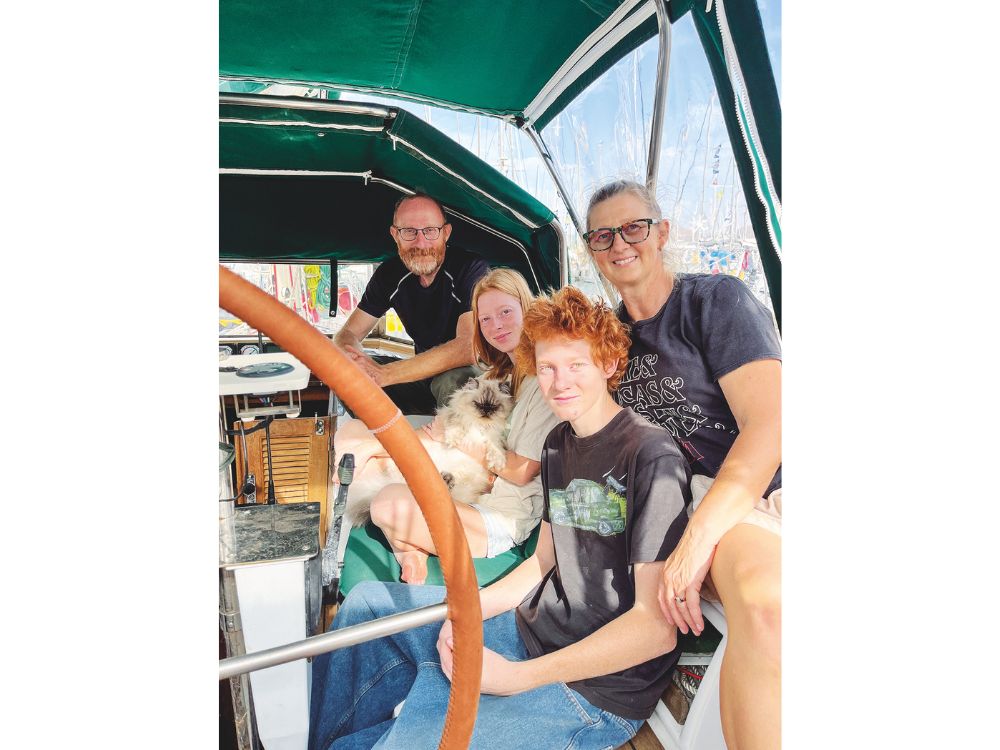
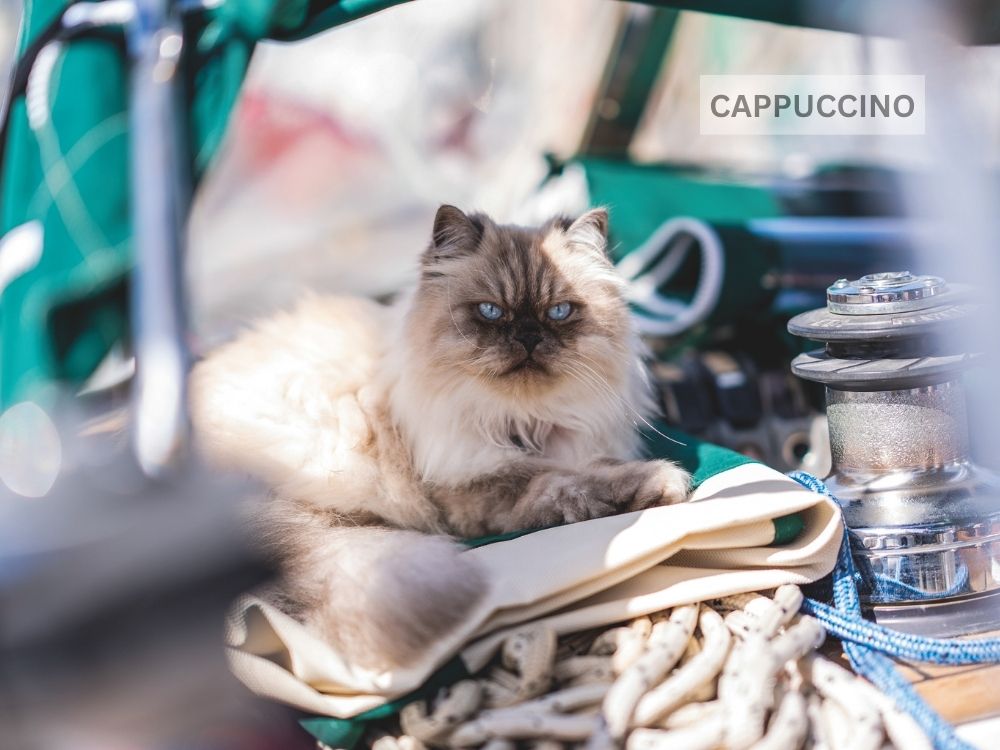
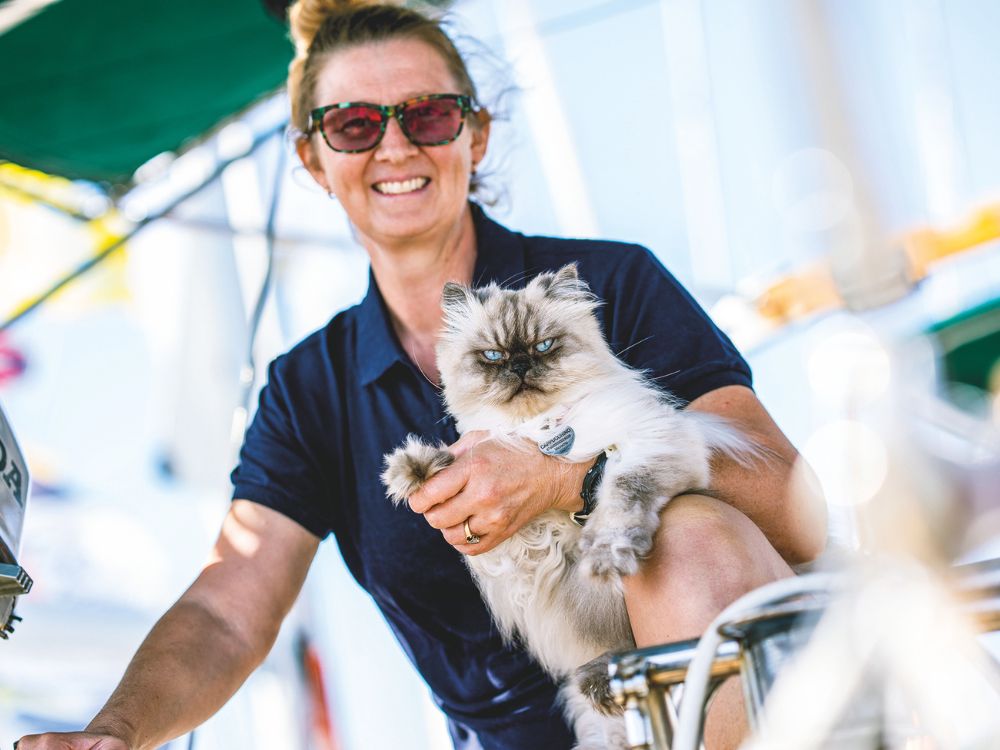
The Smith-Haywood family on the New Zealand-flagged 1991 Tayana 47 Apres Ski feels the same about their nine-year-old blue point Himalayan, Cappuccino. Cappuccino may be the fluffiest cat to have ever crossed the Atlantic.
Annika Haywood, Lloyd Smith and their two kids adopted Cappuccino in Saudi Arabia. They lived aboard Apres Ski and worked in the Middle East for 12 years. Lloyd was the director of the Coastal and Marine Resources Laboratory, part of the King Abdullah University of Science and Technology (KAUST) program. Annika did post-doctoral research on the genetics of sponges and worked with KAUST’s research wing. When they departed Jeddah, sailed up the Red Sea, and transited the Suez Canal, Cappuccino handled the hard travel and head winds like a champ, mostly sleeping and laying around in the sun.
He became a member of the EU in Cyprus and was not fazed by the technical and logistical challenges his humans faced when the engine failed between Cyprus and Rhodes. With his EU passport in hand, he pretty much enjoyed the five-month, 4,300-mile trip across the Mediterranean to the Canary Islands, although he was notably indifferent about the on-deck, front-row seats to the America’s Cup in Barcelona’s harbour and relatively unimpressed with the rest of the exotic logbook: Rhodes, Gallipoli, Rome, Amalfi Coast, the Strait of Gibraltar, Tangier, Casablanca.
“Each country has different rules. It’s easy to travel in and out of Europe, once you’ve met the requirements. In the Caribbean, however, while the French, UK and US-affiliated islands have clear procedures, the others are more challenging.”
Rabies is the big one, Annika said of the requirements for cats. As long as you have a certificate and the rabies vaccinations are repeated every 12 months, most countries are ok.
“Once we arrived in the Caribbean, we had our permit for St Lucia, but we stuck to the French Islands, otherwise, to simplify things.”
“We have a really nice backpack for him and have taken him on a few adventures on shore. We generally take him when we leave the boat for more than a few hours, or if we’re staying somewhere overnight.
“He went swimming once, after a miscalculated jump back to our boat. We were at a marina in Greece and he was working his way down the dock, jumping from boat to boat. He was a fantastic swimmer, but a complete looney, and swam in circles around different boats. I had to get in and fish him out and then Lloyd washed him down with fresh water. I have since put some netting around the boat.
“Mostly he is happy wherever we are. He loves walking around the dock or around the boat at night. I am paranoid so I watch him and bring him below when we are done for the evening.
“The challenges onboard are minimal for a cat. We just need to remember his food and clean out his litter.”
When they’re offshore, they keep his passport, rabies certificate and import permit in the overboard grab bag, and if the ship were to sink, “He comes with us on the life raft. We have a life jacket for him right in the companionway,” Annika said.
“During the transatlantic crossing he was mostly in the cockpit, sleeping in his favorite spot under the dodger where it’s always dry. But when it was food time, he would let me know.”
“It is difficult to get annoyed with him. He is so darn cute. We all love him.”
When Two Hoots is offshore, Penny puts Benji in his harness, then puts on her own life jacket and takes him for a walk around the boat. He gets so excited when he sees the lead, she said.
When they’re sailing, his special spot on board is in Penny’s lap and he generally sleeps in the cabin if someone’s below. The Belchers got him a new toy for the Atlantic crossing, which keeps him busy and wears him out.
“He’s so entertaining. He gives me perspective and provides distraction. He’s sweet and loving, and so good for morale,” Mark said.
He’s a small dog and doesn’t need many provisions.
“We’ve got dog food, dried stuff, and he loves salmon, tuna, chicken. We take him with us when we eat onshore. He loves sea bass and sirloin.”
“I’m looking forward to anchoring in some little Bahamian bay with a little spit of sand, and Benji having free range, where he can just go nuts and run around in the sand.
“He absolutely adores the beach, when we were in Greece he would just go running down, roll around in the water, go for a swim.”
Buoy’s in a small dog carrier or on lead when he’s on deck, offshore, Sonia said. At anchor he’s allowed to run around.
“I keep Royal Canin chihuahua dog biscuits on board for him, so he has dog biscuits available to him 24 hours a day,” she said.
When the crew has dinner, he’ll get pieces of chicken that have no sauce, no garlic, no onions. He loves sailing; he’s been living on board since he was 10 weeks old.

And she said he’s really, really good for crew morale.
When the weather’s rough, and everything’s hectic and you’re trying to sort it out, Buoy just chills everybody out.
“When he’s on land he becomes a bit of a puppy again, and runs around. He’s rather a small dog. He’s smaller than my sister’s rabbit!
“But when he’s on the boat, he pops his chest out and he’s a proper guard dog who barks at everyone.”
“Snow doesn’t like to leave the boat,” Sophie said.
“I take her out for a walk and five minutes later, she wants to come back.”
When they’re sailing, Snow stays under the cockpit table; she feels like that is her safe spot. At night and in bad weather, Sven will put her inside the saloon.
“She doesn’t try to get off the boat; she’s an ideal boat dog,” Sophie said. “If the weather is calm, she lays up front. If she sees dolphins, she barks. Sometimes at the dock or at anchor if she sees someone she howls. There’s not a lot of safety concerns for the crew when she’s around.”