He had spent the last 18 months in England and Scotland doing his initial training on Motor Launches (MLs) on the Solent and then being posted on active patrols, first to Granton (Edinburgh), to the Orkneys and latterly to Great Yarmouth, Norfolk. In later years, like so many WW1 servicemen, he was tight-lipped with his family about his war experiences, but his time in MLs patrolling out of the Firth of Forth and later the Orkneys in bitter conditions must have been life-changing.
On October 15, 1918, Webster received an order to proceed to HMS Research on the Isle of Portland Island, Dorset in the English Channel, a Royal Navy establishment which took its name from the Naval paddle survey vessel, built in 1888, stationed there as a base for minesweeping trawlers in the English Channel. The Royal Naval Air Service also had a base at Portland for floatplanes patrolling the English Channel. His orders were “for CMBs in command”. So, what were these ‘CMBs’?
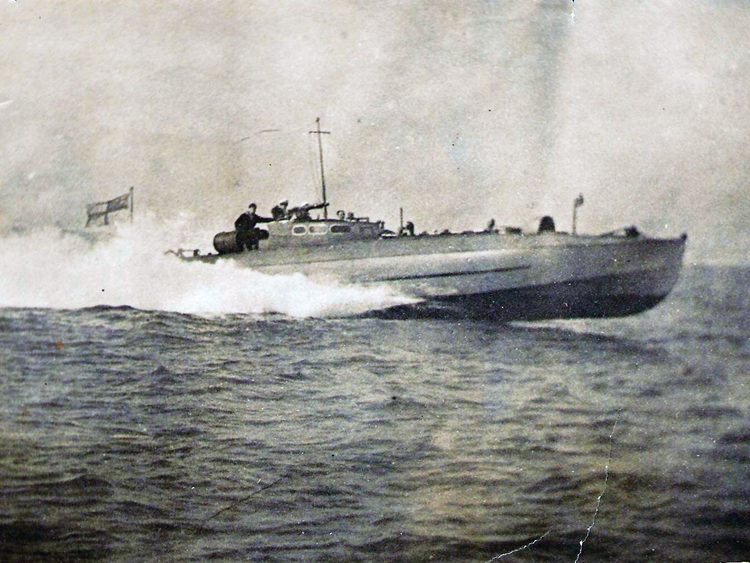
While the 550 MLs that the Royal Navy had ordered from Elco in the United States had proved to be a considerable deterrent against minelayers and submarines around the coast of the United Kingdom, they relied principally on their presence in numbers with hydrophones and radio equipment to keep the Germans’ heads down. Their kill ratio of submarines was tiny, and the few successful actions usually were by ramming which disabled the ML by ripping off its propellers. The MLs were unsuitable for carrying torpedoes in an attack role.
In the early summer of 1915 three young Naval Officers from the Harwich Destroyer Force conceived the idea of a small, extremely fast motor boat that could be carried in the davits of a light cruiser and capable of firing a single self-propelled Whitehead torpedo. Such a boat could be dropped as near as possible to the enemy coast to carry on at high speed through or over German minefields to attack shipping and shore targets and sow mines in the ports of occupied Belgium where the enemy had constructed havens for its large fleet of submarines then harrying British shipping in the Atlantic. The Navy gave the officers authority to approach the contractors and engineers J.I. Thornycroft & Co Ltd with their plan. The initial concept was for a planing hydroplane that would discharge its torpedo over the stern.
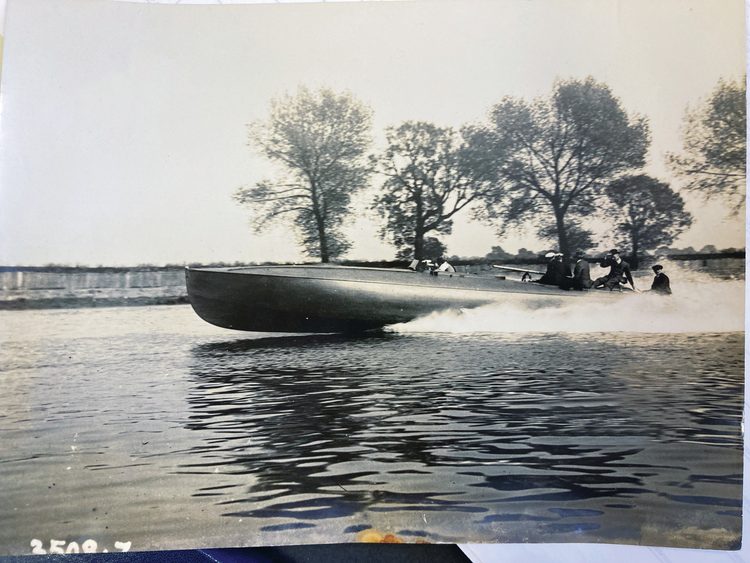
The hydroplane type of hull had been developed round 1910 to induce planing with a step, or a series of steps, about half the length of the boat. The stepped hull construction was more practical and not so challenged by material technology as were the existing foiling designs which were far too fragile for combat, or for work in any seaway. The same type of stepped hull quickly found its way into the design for flying boat hulls and seaplane floats to enable the aircraft to get up on the plane and ‘unstick’ from the surface of the water with as little power as possible.
Thornycrofts were not only major contractors for steel warships to the Royal Navy but also had been at the forefront of experimental racing craft. John Thornycroft’s designs for the eight-cylinder 110hp 26-foot stepped hydroplanes Miranda IV and Zigarella of 1910 were well on the way to providing a prototype. By 1915, too, light, high-powered aero engines, based on immediate pre-war racing car practice, were being built in England in quantity.
The new highly secret design was codenamed ‘Vedette’ just as the caterpillar-tracked armoured fighting vehicle of the same period was codenamed ‘Tank’. The Vedette was a wooden, unarmoured single-step hydroplane that could work up to a speed of thirty-five knots in a matter of minutes and discharge its torpedo forwards, over the stern, whilst steering directly for its objective.
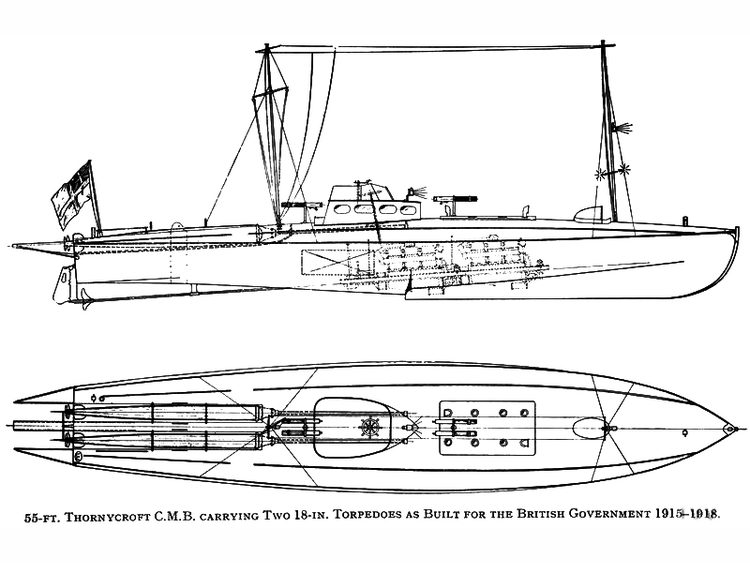
The first boat produced came up to the expectations of the specification. The Admiralty ordered 12 boats to be built as soon as possible and established a base on the South Eastern Railway Company’s pier at Queenborough, Kent. The first three boats were ready for service in April 1916. In order to preserve the utmost secrecy during the training period the crews took the boats out only at night.




Each boat had a crew of two RNVR officers and a mechanic (ERA) who spent several weeks at Thornycroft’s Basingstoke works to see the engines and boats built and the trials run. Because of his exceptional knowledge of the shallows of the Belgian, Dutch and German coast, Irishman Lt. Erskine Childers, RNVR, joined the flotilla as Navigator. His novel The Riddle of the Sands set in that area was the sensation of 1903 (and is still a wonderful read).
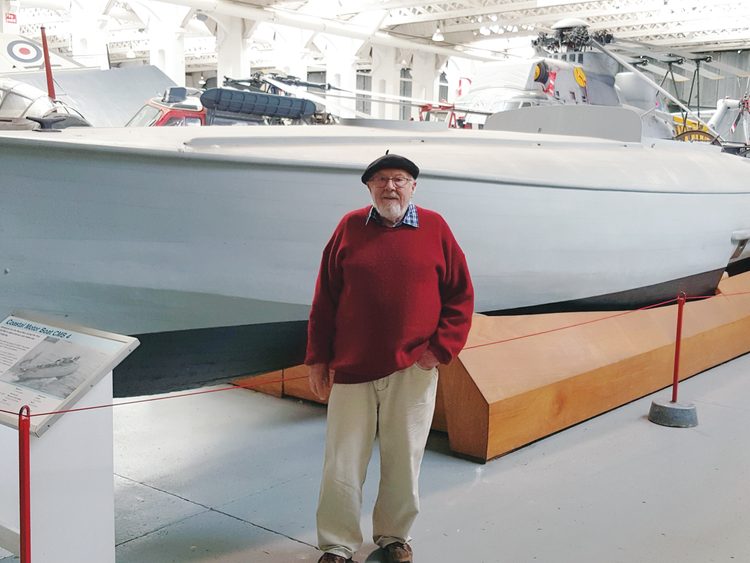
The new craft eventually received the official designation ‘Coastal Motor Boat’ (CMB) which gave nothing away, but their crews called them ‘Scooters’. And scoot they did. In 1916 planing hulls were entirely novel outside the ultra-expensive speedboats racing in the Solent, Monaco and North America.
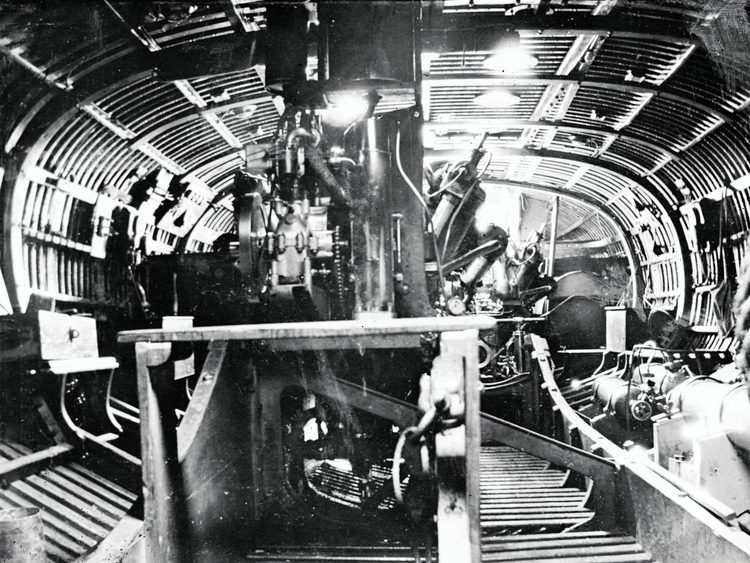
This first batch of CMBs were 40ft loa with a beam of 8ft and a draught of only 2ft. The hull was a double skin of mahogany, the frames and knees were of American elm, and stringers were of oregon. The hull was designed to be resilient to withstand high-speed slamming in a choppy sea. At planing speeds the hydroplane step lifted the centre part of the hull to reduce resistance. A spiral propeller was fitted for jumping booms. The torpedo sight, which consisted of a metal triangle somewhat resembling a sextant in a horizontal plane, was fitted at the forepart of the cockpit. A fuel tank with a capacity of 100 gallons of aviation spirit was installed in the cockpit amidships and beneath the Commanding Officer’s seat. A special design of lifting gear was fitted to the forward engine bearer and to the torpedo trough aft, for slinging under davits. However, all the action to come along the Belgian coast was from the CMBs’ own bases at Dover and Dunkirk.
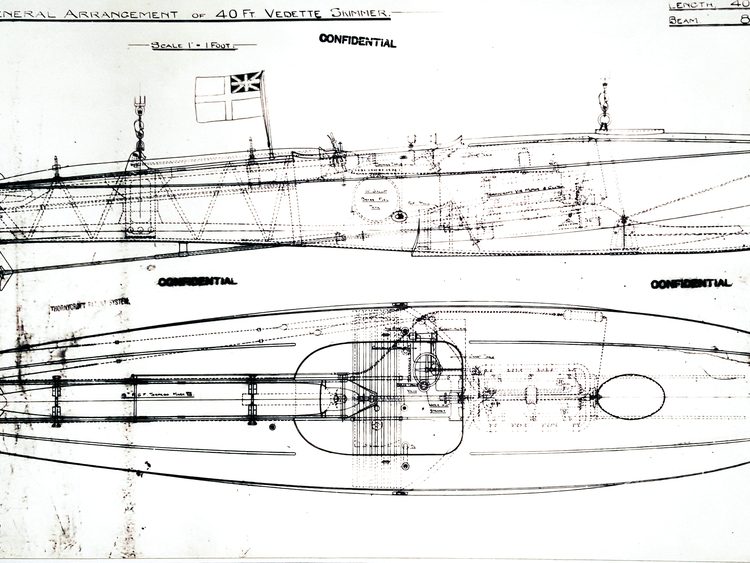
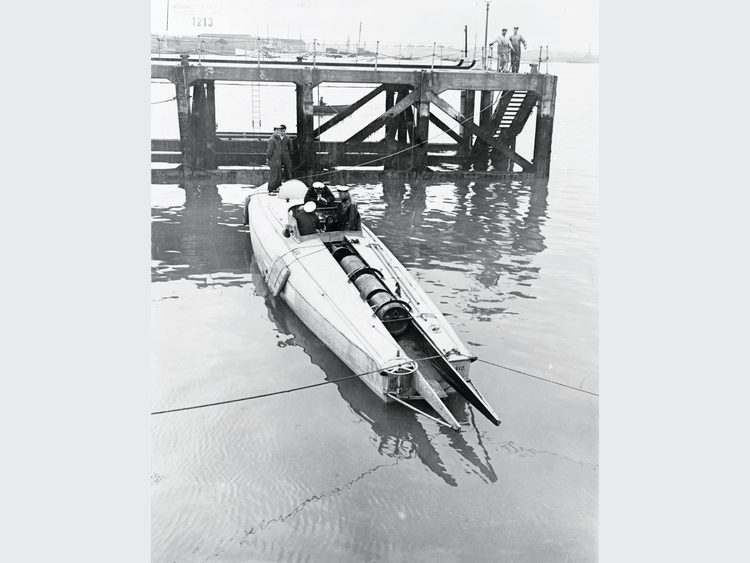
A single 18-inch diameter Whitehead torpedo was carried on the centreline in a cradle in a trough aft and was launched by a bell-head ram which was impelled by a cordite charge exploded in a steel bottle. 1,500 grains of No. 37 cordite provided the power, giving a pressure in the explosion bottle of four tons, but reduced to 1,000lbs pressure on reaching the ram. The torpedo firing lever was conveniently to the right hand of the Commanding Officer. The torpedo weighed three quarters of a ton. At launch its initial speed was 13 knots. The whole rig looked scarily Heath Robinson but it worked, although the CMB had to sheer away before the torpedo could accelerate! In place of a torpedo, depth charges or mines could be launched from the after trough. There were two twin Lewis guns on portable swivel mountings fore and aft in the cockpit for use against attack by enemy aircraft.
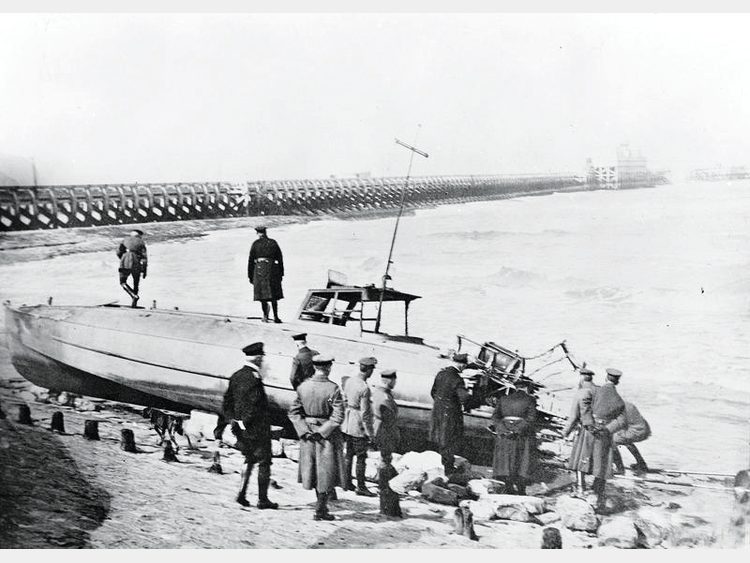
But the heart of the boat and its bigger descendants was its single, later twin, aircraft/airship engines, and a variety were used, mostly V12s of 250hp-350hp, marinised and branded by Thornycrofts, but built by Sunbeam, Green, FIAT and Napier for aircraft use.
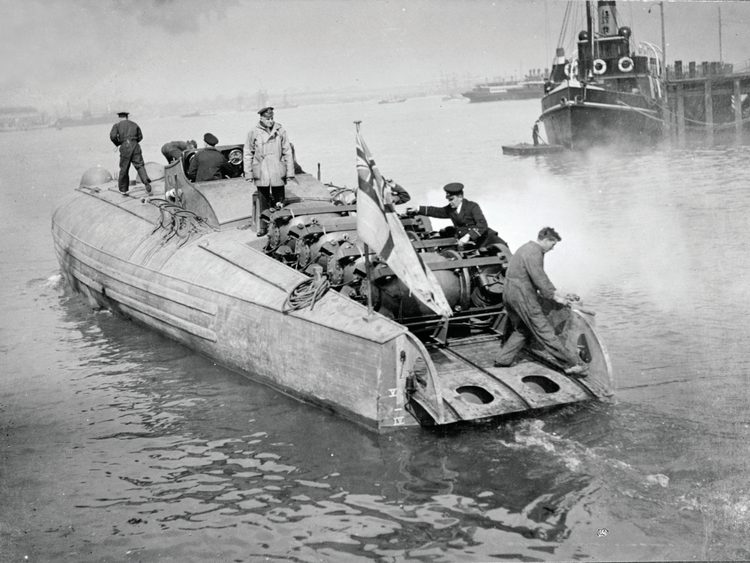
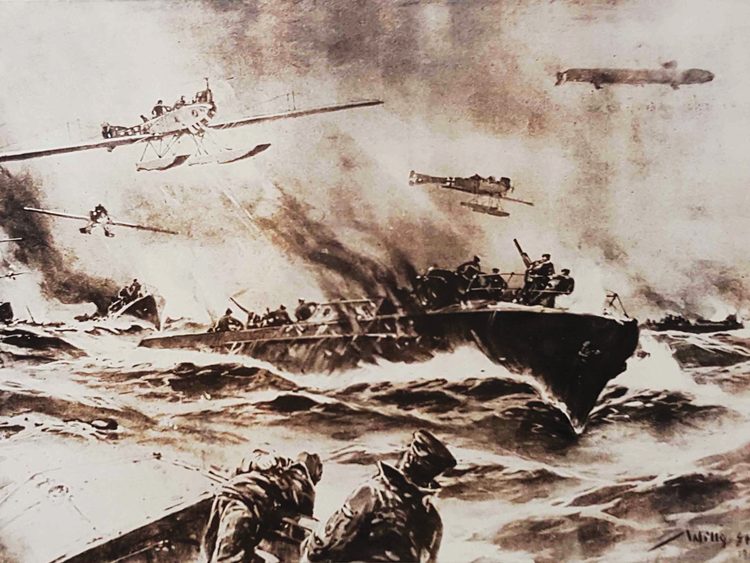
The two RNVR officers on each CMB wore kit similar to that of the Royal Flying Corps of the time. A leather helmet and goggles were their only means of protection against the ice-cold and blinding spray that swept continually across the cockpit. The single mechanic had a job exactly like his airship counterpart, but rode along with his engine, lurching through the choppy seas at high speed. They called themselves ‘The Suicide Club’, probably referring to the mad, but successful, method of launching their torpedoes over the stern.
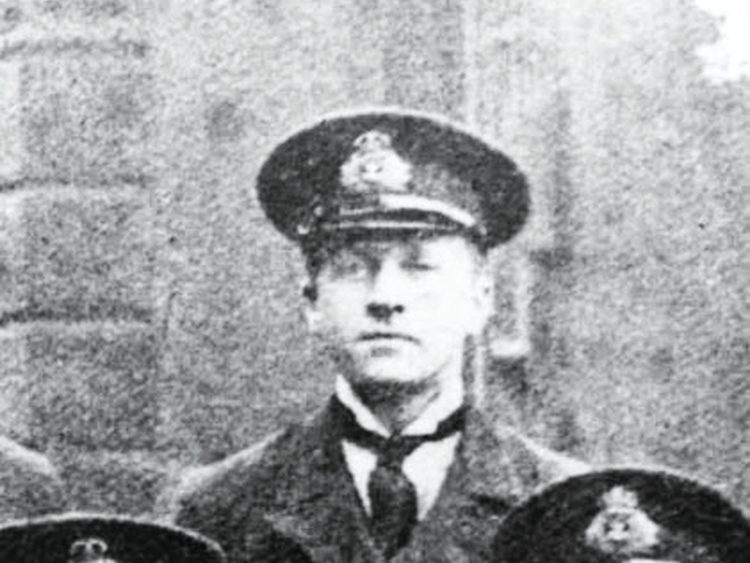
These radical and exciting craft attracted a high level of officers, some of whom had their ‘wings’, a pilot’s licence or had outstanding local knowledge of the Flanders coast like Erskine Childers. Clearly Charles Webster was judged to be a man with such qualities. He had missed the Zeebrugge and Ostend raids of April and May 1918 where the CMBs played a significant role along with MLs in laying smoke screens and getting in close to neutralise the shore defences and nearby airfields with torpedoes and mortars, but he had an amazing experience to come.
In huge secrecy, Professor A. M. Low and his group had been working on a radio-controlled aerial drone since early in the war. By April 1917 a de Havilland-designed drone was flying with Low’s guidance systems. Following its success, the Royal Navy commissioned Low to design a radio-controlled modified CMB, which was now ready for testing. The unmanned CMB was guided by radio signals from a ‘mother’ aircraft and was fitted with a large amount of high explosive. This understandably top secret development was called the Distance Control Boat or DCB. In World War II the Germans adopted a lot of Low’s technology, for example in their V1 ‘doodlebug’ ram-jet flying bomb. The Ukrainians have recently hugely advanced this drone technology but its genesis was in Britain in the early days of World War 1.
In my considered opinion, Charles Webster had been chosen to assist in the tests of the DCBs with aircraft from the RNAS station at Portland Island, which had been taken over by the RAF in August 1918. He made no mention at all of any of these activities to his family in later years. Many servicemen are reluctant to discuss the wars they have fought in, but Charles was still subject to the Official Secrets Act of 1911. Charles was a conservative lawyer in later years so he would have been the last person to breach the Act. Hence, what I have written in the last paragraphs is conjecture but it does tie in closely with the chain of events up to that time.
The Armistice of November 11, 1918 was the end of hostilities for Britain and Germany and its allies. Both nations were exhausted by the war and now were embroiled in the H1N1 ‘Spanish Flu’ epidemic which took more millions of lives world-wide. The CMBs went on to play a large role in attacking the Red Fleet in the Baltic, sinking several warships and did valuable work assisting the White Russians on the Caspian Sea; but the DCBs never saw action.On December 26, 1918 Charles’ war record has the note, “Service can be spared from CMBs in view of reduced amount of running required” and then on January 20, 1919, “To be demobilised from date of arrival in New Zealand. Granted a free passage”. Charles did not return alone. His fiancée, Rose Samuel, from Glasgow followed him very shortly.