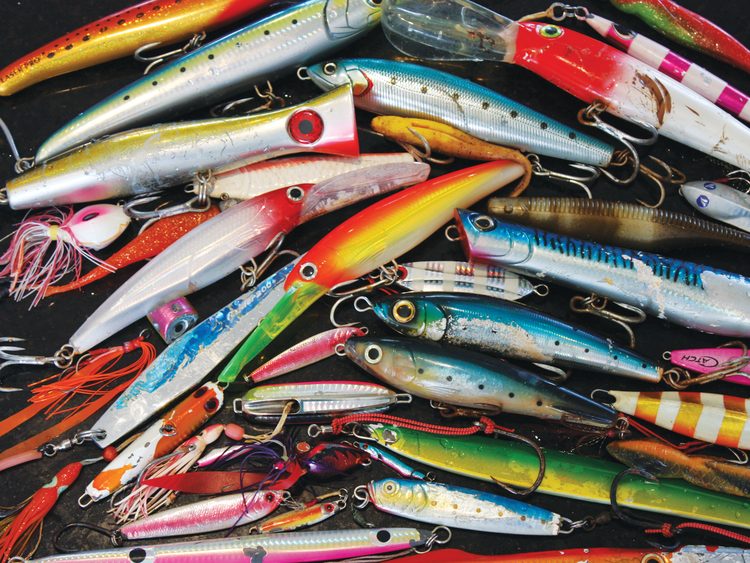
I guess this topic has become somewhat triggering for me since I sell fishing tackle. On countless occasions my customers have told me: “all those different coloured lures on display are BS because fish can’t see colour!”
That’s simply not true. Although fish eyesight varies significantly across species, with each having adapted to its environment in unique ways, fish eyes basically work in a similar fashion to those of most animals, processing visual information through cone cells (which distinguish colours) or rod cells (which detect contrast and movement). While some fish species have few or no cone cells, many have an abundance – and some even have double-cone cells!
Indeed, just like us, most fish are trichromatic (their eyes use three types of light-sensitive cone cells detecting red, green and blue to see a huge spectrum of colours), but some species also see a fourth colour that humans cannot detect – ultraviolet.
Also, as you’d expect, fish generally have excellent underwater vision (unlike humans), thanks to specialised retinas that can detect the slightest movement and changes in light. Their eyes provide magnified views of potential prey, predators and, hopefully, your carefully (?) chosen lure.

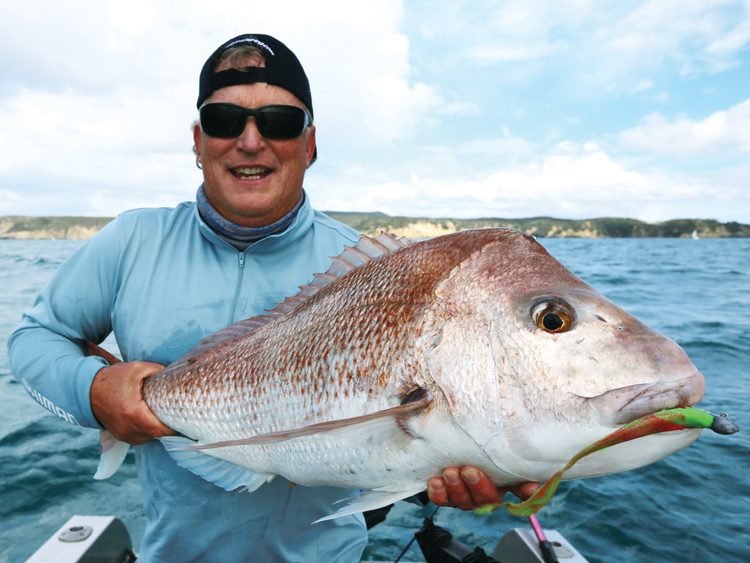
However, exactly what and how a fish sees depends on its species, as well as where it lives and how deep in the water. Indeed, habitat is probably the most important factor in how various fish species see their world. Depending on where they live, the waters around them can be crystal clear or virtually opaque. They might dwell in inky depths or at the brilliantly lit surface. Or perhaps they spend their lives over bright, monochromatic sand or dwelling amongst the rainbow hues of a coral reef.
Generally speaking, though, species that live in shallow water or near the sea surface, or among shallow, brightly-lit coral reefs have excellent colour vision, which they use to find food, choose mates and spot danger. In contrast, those fish species living in low-light environments or that come out at night to feed rely more on the rod cells in their eyes, which are better at detecting contrast and movement.
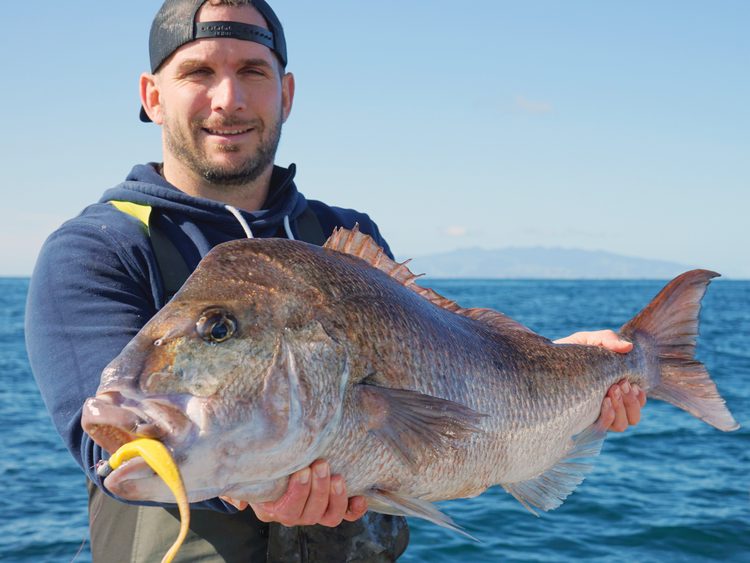

How depth changes colours
Water acts like a giant colour filter, absorbing colours one by one the further sunlight travels through the water. Red and orange disappear first, often turning into grey or black just five to 10 metres from the water’s surface; yellow and green last a bit longer, with blue and purple travelling the furthest/deepest (which is why the deep ocean looks so blue). Because of this, a bright-red fishing lure that looks colourful at the surface soon turns a dull grey as it sinks deeper into the water.
But that’s not the full story of course. As mentioned earlier, many fish possess ‘super vision’ – the ability to see ultraviolet (UV) light, an ability that goes beyond human visual perception.
The role of ultraviolet light
Since UV light waves are shorter than visible light, they can slip through the clouds on an overcast day and penetrate deep into the water column. But, unfortunately for UV-lure users, only up to 15 metres or so deep in optimal conditions, as UV light’s ability to travel through water is limited by its clarity. Suspended particles, organic matter, and minerals such as iron and manganese, serve to scatter and absorb UV rays, drastically reducing the depth they can penetrate. As a result, even in clear ocean waters, about 40% of UV rays reach half a metre, and roughly 10% only can penetrate down to 10 metres. At 40 metres, less than 1% of UV light remains.
Mimicking prey biology
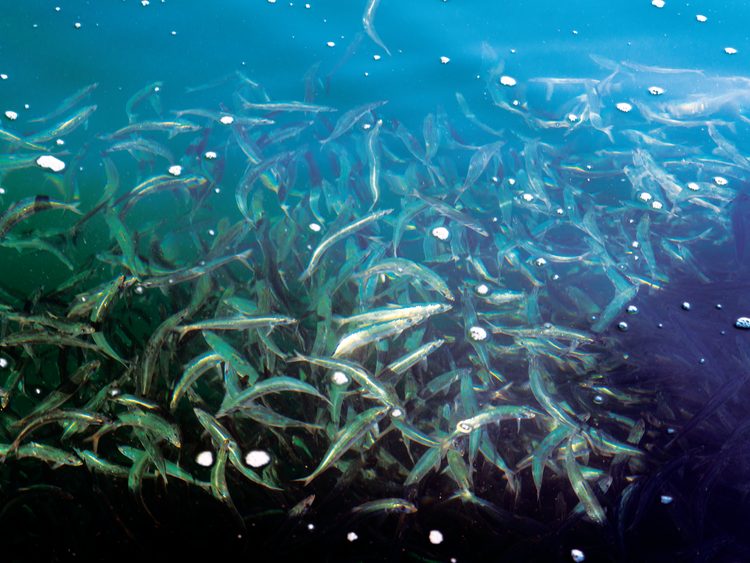
Many natural food sources, such as baitfish, insects, zooplankton and squid, naturally reflect UV light. This organic signature can be mimicked by incorporating UV reflecting and/or emitting elements in lures, making them appear to be living, panicked prey. These UV treatments are usually seen by us as bright fluorescent colours, but others are more subtle and may only be revealed when a UV-active light or torch is shone on them.
How this works for fishing
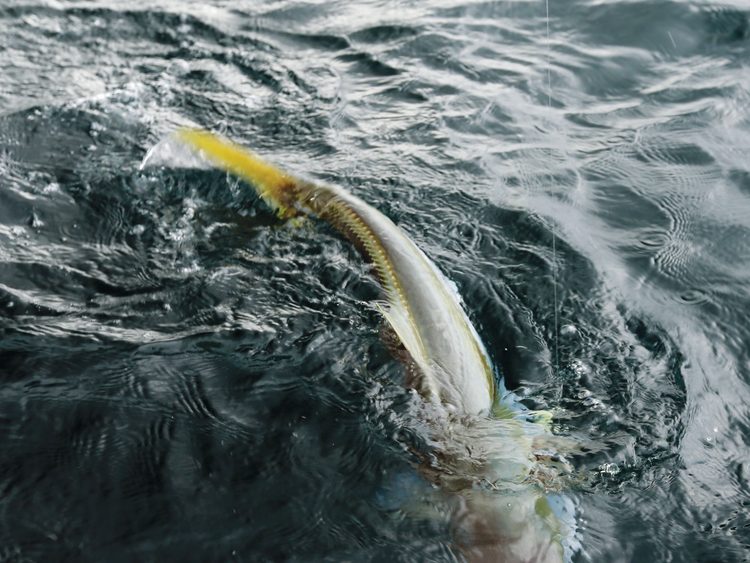
Ultraviolet/fluorescent colours are particularly useful when fishing in murky water, or in dull overcast conditions, with natural UV light helping high-vis lures show up better in depths to 15 metres. However, shining a UV torch on lures that store and slowly emit UV light allows them to be visible at any depth – to fish eyes, anyway!
UV qualities have often proved the difference between significant success and failure while fishing in depths less than 10 metres on dull, cloudy days (fishing alongside anglers without such an advantage). UV-reflective jig-head and/or soft-bait tails show up nicely in dimly lit or murky water and consistently trigger good bites. Meanwhile, anglers fishing ordinary lures often struggle until they change to UV reflective lures (I know this from personal experience!).
Nor should the potential for contrasting colours be underestimated – just ask the many fanatical users of Gulp’s Nuclear Chicken soft-baits, which incorporate bright, fluorescent green and red colours, and which are luminous, too!
Speaking of which, many people get fluorescent and luminous mixed up.
Basically, UV (fluorescent) lures do not glow in the dark on their own; rather, they reflect ambient UV light, meaning they are completely invisible at night unless a UV torch is shone on them. Then they pop with intense, bright colour!
Phosphorescent (luminous) lures are ‘charged’ when light energy is absorbed – usually a torch or some other light source – so they emit their own visible light in the dark. Again, UV torches are the most effective tool, supercharging glowing lures in just a few seconds.
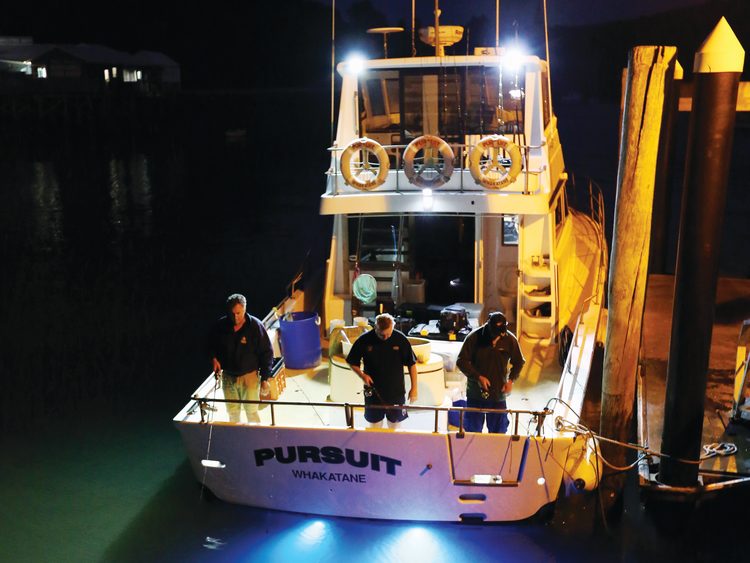
Such qualities are perfect for fishing lures deep down and/or at night, making them popular among anglers targeting hapuku, bass and bluenose, as well as those chasing bluefin tuna at night.
UV torch use
Lure charging: If the lure has glow properties, use the UV torch to ‘charge’ it just before deploying. The resulting sustained glow makes it much more visible, making it more likely to attract predatory fish. Even baitfish flies (sabikis) can benefit from a luminous charge at night, although the amount of brightness can be important, with a dull shine sometimes outperforming a brighter luminescence.
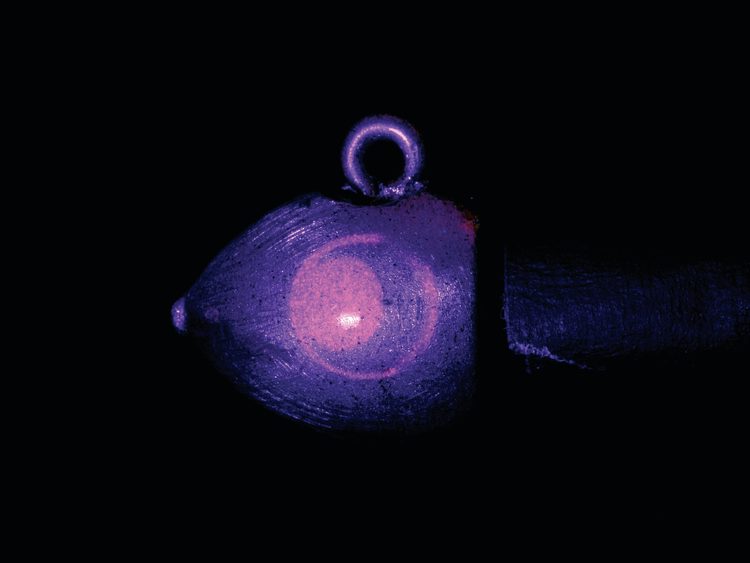
Wavelength matters: For the best fluorescence and fastest charging, use a high-quality UV torch operating in the 365nm wavelength range. Cheaper torches (around 395nm – 400nm) emit more visible (purple) light, which creates unwanted glare.
Safety: Never look directly into a UV torch beam or shine it at the water’s surface for long periods, as this can cause eye strain or damage, especially when your eyes have adjusted to the dark.
So, while lure colour choice, as well as incorporating UV and fluorescent properties, are important qualities that attract bites, on some days it really doesn’t matter what lure colour you choose, because every offering getting smashed!