Queensland-based multihull builder, designer and free-thinker Rob Denney has never been scared to go where others are afraid to. For him, the ‘impossible’ is just another design challenge.
That his address is Shearwater Esplanade, Runaway Bay is entirely appropriate.
So he’s worked on catamarans that could go directly into the wind with a windmill rig.
But he’s also been at the avant-garde of more mainstream yachting. A New Zealander originally (and still in his heart) he started sailing when was four and has been invested in boats, all kinds of boats, ever since.

He’s sailed in seven Sydney Hobarts (and taken fastest elapsed time), six Brisbane-Gladstone Races (including a fastest elapsed time and race record).
He’s worked as a professional skipper, raced and cruised a lot and designed and built some very radical sailing machines.
These have included a precursor of the Formula 40 class and an ultra-light 12m catamaran with independently pitching hulls, variable beam and unstayed rig(!) He’s an expert in modern composite materials.
And he built his first proa in 1995 and has been building, sailing and experimenting with them ever since. They go by the brand identity of HarryProas; and more recently with the addition of the Cargo Proa. More on that later.
For proas are possibly the oldest sailing boats around, being the most natural development of a dug-out canoe with a sail. And they have evolved – in both hemispheres – to be among the most innovative and fastest sailboats anywhere. They also present a whole new set of engineering and design dynamics in the world of sailboats. Read on.
Why proas?
Well, for a start, the fastest sailboat in the world is a proa – sort of.
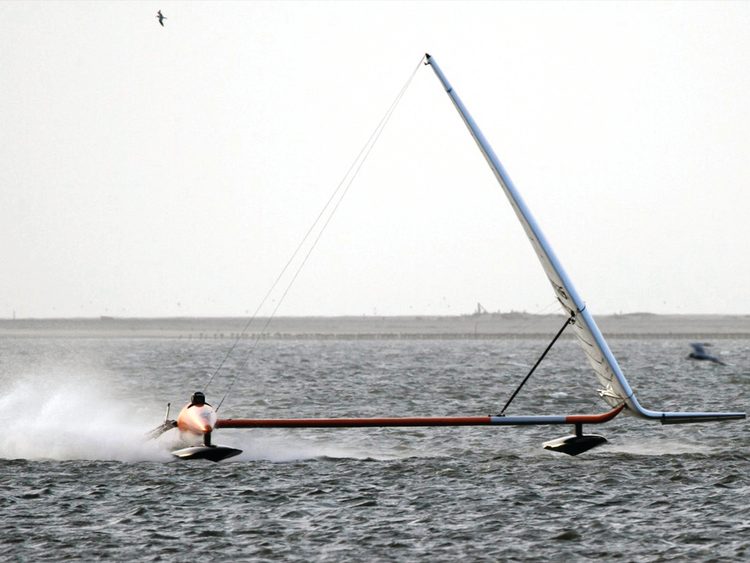
The world sailing speed-record proa, Vestas Sailrocket, was last seen blasting across the sheltered waters of Walvis Bay, Namibia in 2012 did too; with many runs in excess of 55kts and peaking at 68kts.
But only on one tack. Still, it was a world sailing speed record, that still stands, despite all the hype recently about the America’s Cup foiling yachts.
Rob is humble too: And he tells it like it is: “The first Harry was an experimental boat built in my garage and assembled on a mudflat. It proved the concept worked, but was, to say the least, somewhat rough.”
The provocative journalist in me tempted a question.
“Why proas?”
Rob’s answer is full of seemingly irrefutable optimism and confidence. “Quite simply,” he asserts, “proas are the best possible boats for their speed, weight, cost, building time or accommodation.”
He continues: “For example one of my boats, Harrigami, in sailing trim weighs 550kg, contains $20,000 worth of materials, was built in a leisurely 450 hours, and has room for comfortable weekend cruising with reasonable amenities.
“With 31 m² (334 ft²) of sail, it easily achieves parity with wind speed up to 16kts of breeze.”
How is this possible? Simple, says Rob. It’s because “Harry Proas have the minimum possible amount of structure.
Cats and tris and all other sailboats tack. Therefore they see loads from both directions, and have to be built to withstand these. On any given tack, both are carting around a lot of extra boat, solely so that, on the other tack, they will work and not fall apart. Eliminating all the extra bits of boat results in a substantial weight loss. This means that a proa can have a far smaller rig for a given power to weight ratio, which further reduces the loads.” Funny how a new perspective can remove impediments to thinking.
Proas: a brief history
But. There’s always a ‘but’ in radical thinking (though in this case, it’s also aeons-old traditional Polynesian practise). It’s the usual problem with looking outside of one’s frame of reference.
Rob explains further. “Western sailors have been slow to adopt proas. This is partly because until now they were difficult to manoeuvre, and partly, I suspect, because many people are unhappy with boats which are not symmetric fore and aft.”
Going back a bit further, Rob says, “Proas were probably the first improvement made to a floating log by early sailors. A second, smaller log was lashed to a cross-beam to stop the main log capsizing. Rigs were added later when technology allowed. These boats have been scattered through the Pacific and Indian Oceans, where they have been undergoing development for hundreds of years.
“Consequently, they are very highly developed for their conditions of use, and the materials they are built from. They sail in generally warm, trade wind conditions with crew who are not only fit and agile, but are superb seamen.
“They range in size from small models ballasted by baby coconuts up to large ocean-crossing vessels capable of carrying a dozen people and their supplies for many weeks at sea.”
However, Rob continues with some truisms. “They are by no means the end of the story. Our ancient Polynesian cousins had no access to epoxy, fibreglass and carbon. Plus they seldom had to sail upwind in less than idyllic conditions crewed by the wife and kids and driven by the need to be back at work by Monday morning. If they had, then their boats would be far different to what they are.”
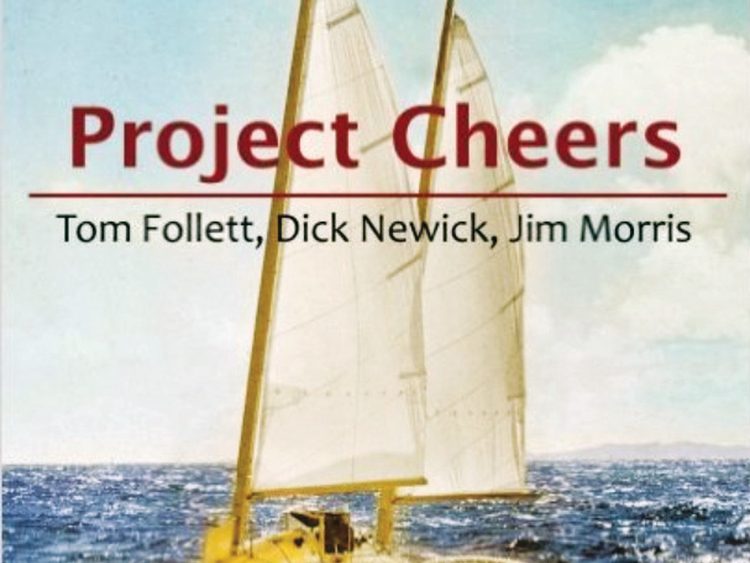
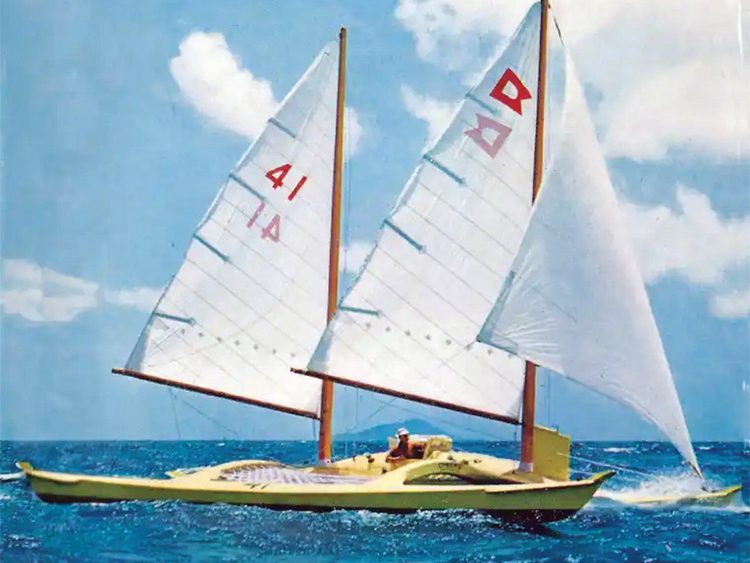
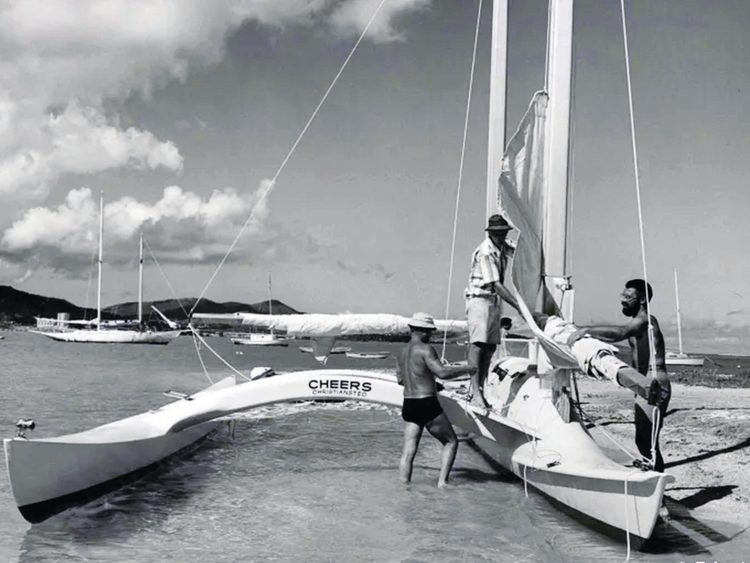
Proas did enjoy a brief burst of publicity after the 1968 Singlehanded Trans-Atlantic Race (OSTAR) when the 12m (40ft) proa Cheers achieved third place across the line. She could easily have been second. It’s just that her skipper, Tom Follett, hove-to the night before entering the channel to the finish (he was unsure of how to navigate it), allowing the 15m (50ft) monohull ketch Voortrekker to overtake him.
“Cheers was designed by the legendary Dick Newick and was a masterpiece of elegant simplicity. It was sailed by Tom Follett, arguably the best, if not the highest achieving, yachtsman of his time.
Now, here’s the important breakthrough: “Cheers was different to traditional proas. It had the rig, rudders and accommodation in the windward hull and looked like a double-ended trimaran with the windward float missing. The benefits of this set up are reduced weight, windage and stress of a second set of beams and a third hull and the weight of the rig and foils are all in the best place to enhance righting moment.”
To differentiate between traditional and Cheers type proas, Newick coined the term ‘Atlantic Proa’ for proas with rigs, rudders and accommodation in the windward hull.
By default, traditional proas – with the accommodation and rig in the leeward hull – scored the prefix ‘Pacific proa’.
But things were still relatively primitive then. Cheers was rigged as a schooner and carried heavy, wooden, unstayed masts. Also, Cheers was narrow by today’s multihull standards at 4m beam, and had a conservative sail area.
Moreover, she “was a pig to shunt [more later on this term]. She also had inadequate freeboard at the bow, making for dangerous running in big seas or strong wind. Despite these faults, Cheers showed what could be done and started a rush of proas, mainly by the French single-handed crowd.”
The dangers of fast-and-dirty development soon became apparent: “These second generation boats suffered a rash of misfortunes, mostly caused by sailors running before they could walk. After numerous capsizes and DNFs, they were banned from short-handed yacht races in Europe.”
This was similar to the experiences of early cats and tris, although compressed into a much shorter time period, and with the added pressure of very rapid development of other multihulls making the proas look relatively slow.
An exception to this was Crossbow, the 18m (60ft) proa which held the world speed sailing title of 31 knots in 1975. And yes, Crossbow was very specialised. It only sailed in one direction and had to be towed back after each high-speed run.
There was also an 18m (60ft) long by 24m (80ft) wide aluminium proa built for the Route de Rhum singlehanded transatlantic race in 1982 . This boat had a single beam supporting a water-ballasted windward hull. The beam could be raked aft to keep the bows up in hard reaching conditions.
The maiden voyage was out to the race start, and the skipper inadvertently (possibly with an eye on the gales forecast for the first night) released the rope which held the beam in place. It folded in against the lee hull and the boat capsized. Oops.
Cheers is now sailing again, after having been restored by two doctors Vincent and Nélie Besin with funding from the French government. They declared Cheers a ‘monument historique’, the only multihull given this honour.
As for Crossbow, it has been preserved by one of its original sailors, British businessman Sir Timothy Colman, and is still in England.
“The French monster has, unfortunately, probably been melted down for scrap.”
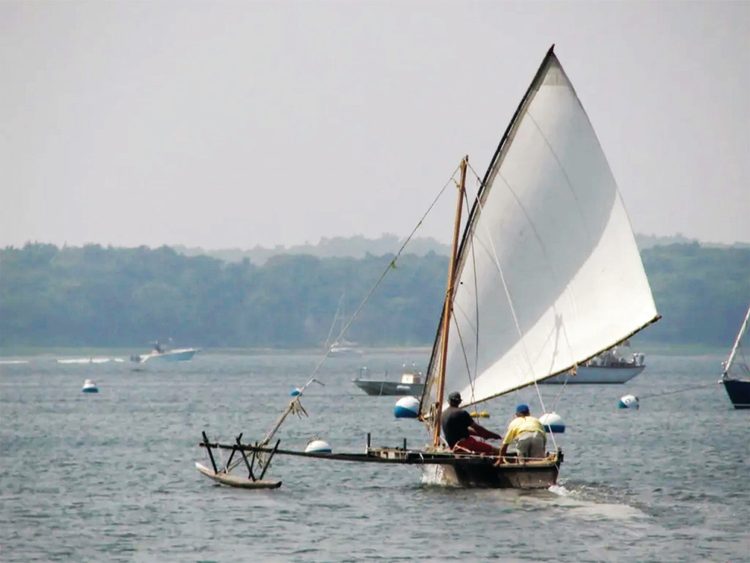
Rob’s fascinating recent history of proas continues: “After the ban, interest in proas died out apart from the Pacific Islands where life carried on much as before, although outboard motors replaced sails on a lot of boats. Recently however, there has been an upsurge in interest, mostly people building replicas of traditional proas using modern materials. These tend to be more efficient than the traditional boats, but still have many of their shortcomings. They lack righting moment without large crews, their crabclaw sails tend to be lousy upwind, and because the masts need to be moved from one end to the other, they are slow, cumbersome and dangerous to shunt.”
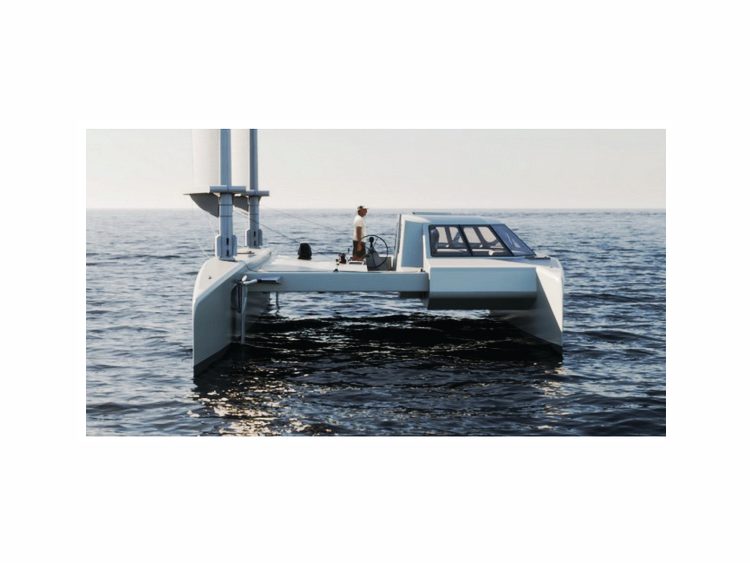
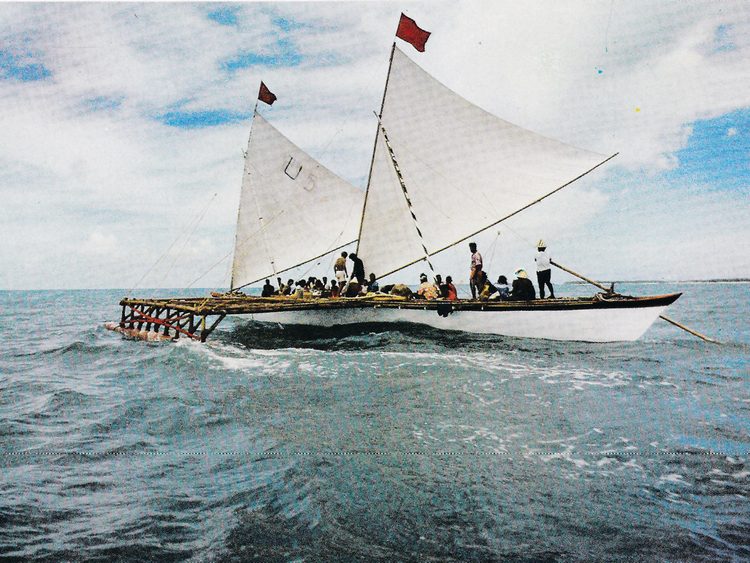
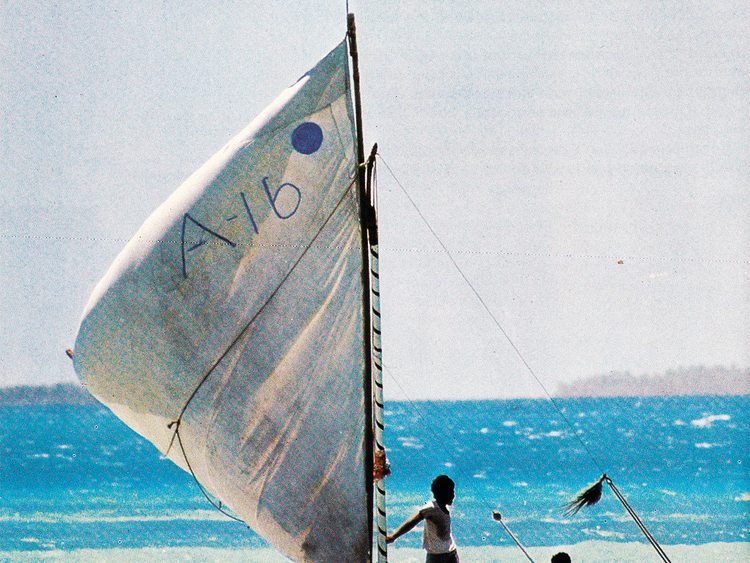
The New Zealand adventurer James Spiers built two traditional Gilbert Islands proas (or baurua), both named Taratai.
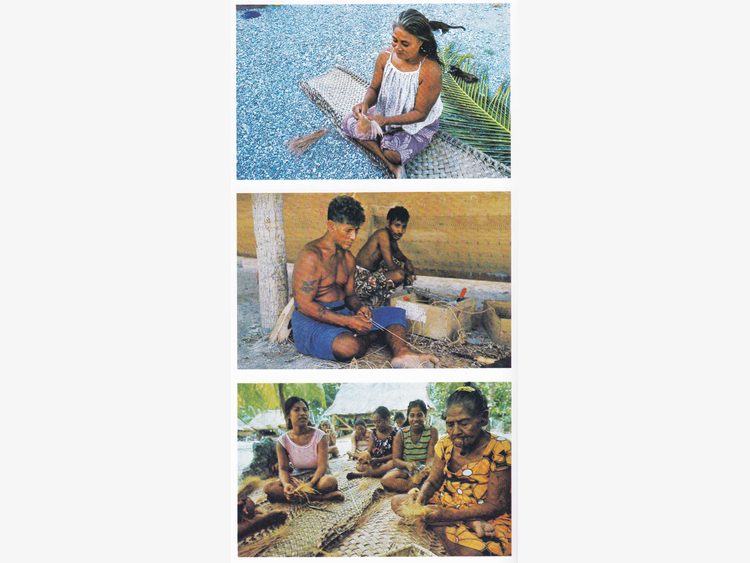
The first was built by islanders under the direction of Teauba Teakei, entirely in the customary way – a planked hull, sewn together with hand-made ropes of coconut fibre. Yes, she did leak. Quite a bit.
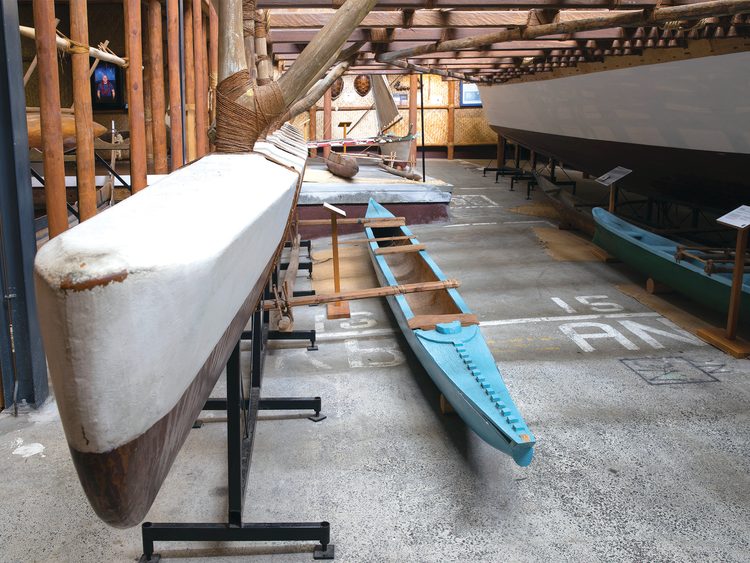
She made a voyage to Fiji, but Spiers was concerned that the builders had not adequately beefed-up design scantling, being more recently used to making much smaller craft (their ocean-going baurua had died out by the 1920s). So Spiers built a second Taratai, but that one capsized in a storm 180nm east of Nuie, after voyaging from Fiji, via Tonga. A cross-beam broke, something Spiers attributes to his rushed (non-traditional) building schedule using the wrong (they knew it was wrong) and unseasoned timber. The first Taratai is now in the Auckland Maritime Museum (opening photo).
So proas remain something of a specialist niche, Rob observes. “A few people have appreciated and used the reduced stress and materials inherent in proas to build and cruise cheaply. Among them are a couple of French cruising proas sighted in various locations around the tropics, but information on them is hard to come by.
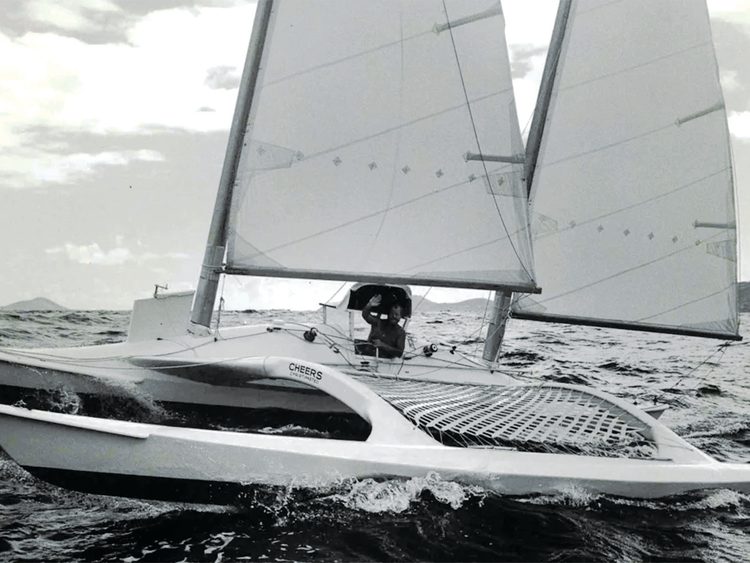
“Russ Brown (son of Jim Brown, of Searunner trimaran fame) has designed, built, and cruised extensively in Pacific proas, although he is loathe to sell plans or to encourage others, perhaps less skilled, to follow in his footsteps. His current boat, Jzerro spent a winter in Brisbane after being cruised from Seattle via Tahiti and Noumea. It was then shipped back to Seattle.”
“One of the most well-travelled proas is Australian. Designed and built by Blaz Kokor in 1980, About Face, cruised the east coast of Australia, before being bought by its current owner, Ted Lamont, who cruised, frequently singlehanded, from Tasmania to Perth, a journey of 5,500nm.”
Then things began to get a bit more technical, and modern proas started getting the attention they deserve. “One of the theorists who appreciated the advantages of a proa was Joe Norwood, who wrote about them in his book High Speed Sailing,” says Rob.
“Norwood appreciated that Atlantic proas placed relatively high stresses on both the masts and the beams, and that these stresses could be reduced by placing these components in the lee hull, as in the Pacific proas. Unfortunately, he confused the issue by adding the complications of hydrofoils which worked in both directions, and the theoretically impressive, but practically very draggy, pyramid rig.”
But none of his proas were built. They remained theoretical – even if impressively so.
There was a further realworld handicap, says Rob. “What all these (cruising) proas had in common was that they were slow (frequently built to trimaran specs, not appreciating that loads on a proa are much lower), and had rigs and steering which made shunting far slower than tacking on a conventional craft. Until these obstacles were overcome, proas were never going to be taken seriously.”
The Harryproa
Enter Rob Denney. And the history of proas was changed forever.
But, perhaps uncharacteristically, he started modestly. “I built my first proa in 1992 using stitch-and-glue ply, an alloy mast and a bewildering variety of steering combinations. At 5m (16ft) long, this was competitive with Lasers and slow beach cats, and taught me many lessons about sailing proas.
This working model, was followed by U, a 7m (24ft) proa with carbon-foam hulls, carbon mast and beams “and again, a bewildering variety of steering combinations.” Weighing only 150kg (330 lbs) in sailing trim, Rob says “U was quick, but was never developed anywhere near its potential as I kept experimenting with different ideas. U suffered from three different rigs, three beam arrangements, two windward hulls and a chopped-down leeward hull, none of which were ever seriously optimised.”
Both the 5m prototype and U used a free-standing Ballestron rig, which has a boom extended forward of the mast and the jib tacked to its forward end and sheeted to a track just in front of the mast.
Now we’re cooking! “The forces of the jib and the main balance each other out, resulting in a rig whose angle of incidence is adjusted by one lightly loaded sheet. Known as the AeroRig in the UK and USA and the EasyRig in Australasia, this rig is excellent for any boat, but for a proa is the difference between a two-minute shunt with lots of hard work and an almost effortless 10-second one.”
Then Rob had to do some sharp thinking. “The steering/leeway reduction conundrum was far harder to solve, but eventually simplicity prevailed, and two balanced rudders were used, of a size which eliminated the need for centreboards. They have very low steering loads, and can be used individually or together.”
Practicality once again intervened. “These boats were both Pacific proas, and sailing them required a fair bit of body movement to keep the windward hull just airborne for maximum speed. This was obviously not the answer for a cruising proa. But then, nor was an Atlantic proa with a highly loaded rig and beams the answer for a lightweight, cheap, easily built boat.
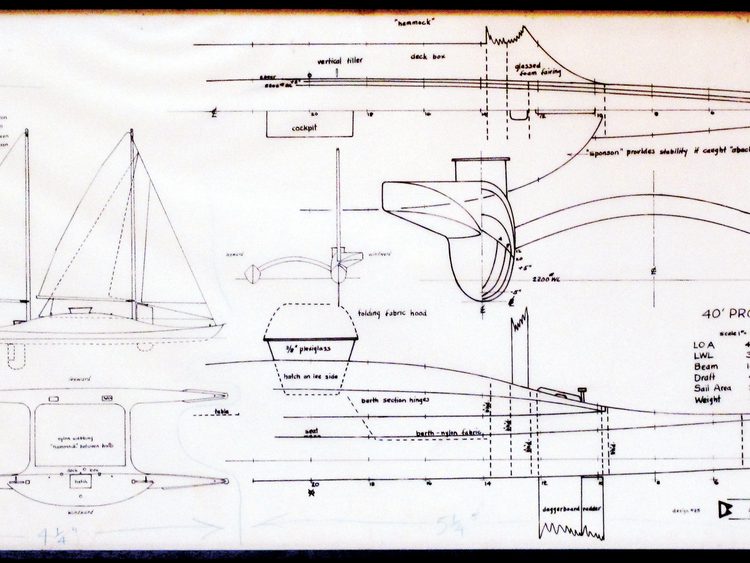
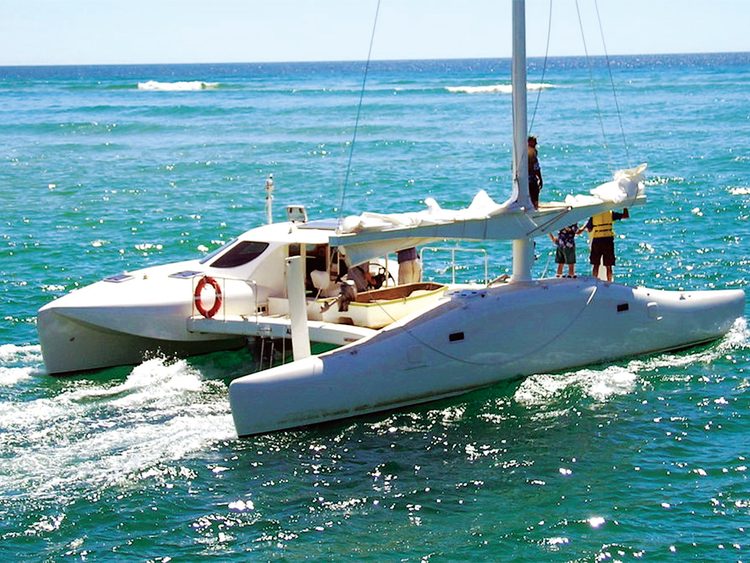
“The solution had to be a combination, by placing the rigs and rudders in the lee hull, and the accommodation in the windward one. The masts could then be stayed to the ends of the beams, thus reducing the bending loads in both, the lee hull could be as long, low and narrow as possible, and the windward hull could be, within limits, whatever size and shape was required to fit the accommodation. Thus evolved the HarryProa, after a lot of sometimes heated discussion with traditional proa aficionados who wanted nothing to do with boats which were ballasted to windward by anything other than crew!”
This perfectly logical solution was undoubtedly thought of by many people, says Rob. But it was “never tried, mainly because of a conviction that the added weight in the windward hull would cause the boat to luff head to wind as soon as it started to move.
“This has not happened, a trait I attribute to the two large rudders, the hull shapes and the balanced rig. Even under main alone, all my boats have been able to shunt and sail successfully.”