


For any boat builder, especially a GRP production boat manufacturer, releasing three new models in as many years is rare, but that’s what Rayglass Boats successfully achieved with the release of its new Rayglass 2400 in June 2026.
Completing a three-year new model run that includes the Rayglass 3000 and Rayglass 2700, the new Rayglass 2400 shares a common styling language with its larger siblings, along with many identical modular components, and powerplants, too. This rationalisation in design and manufacturing, along with considerably parts commonality, has in great part allowed such remarkably quick new model development.
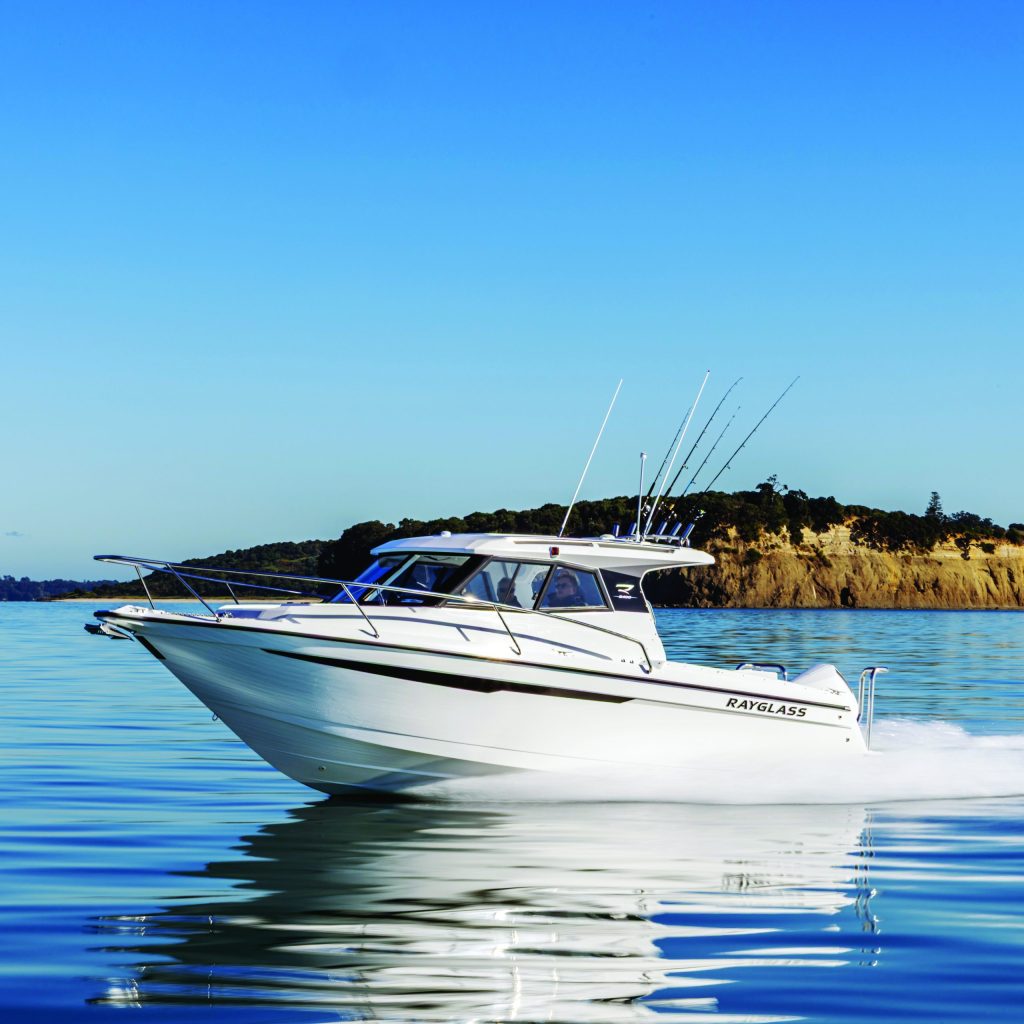
Worthy successor
The Rayglass 2400 is the spiritual and physical successor to Rayglass’s long running and hugely successful Legend 2350. Like its predecessor, it’s an easily trailerable, bluewater-capable, deep-vee cabin cruiser available in outboard (single or twin) and inboard petrol or diesel sterndrive configurations.
Sticking with what already works, Rayglass has retained the 2350’s hull, but completely redesigned the decks and superstructure to create a boat that’s 300mm longer overall, carries its maximum beam further forward, has more flare and buoyancy in the bow, more internal volume, and a flatter, more workable foredeck while retaining the same 2.5m beam. Foredeck options now include cushions for sun lounging, as well as a stainless-steel leaner and higher bow rails for safer casting from the foredeck.
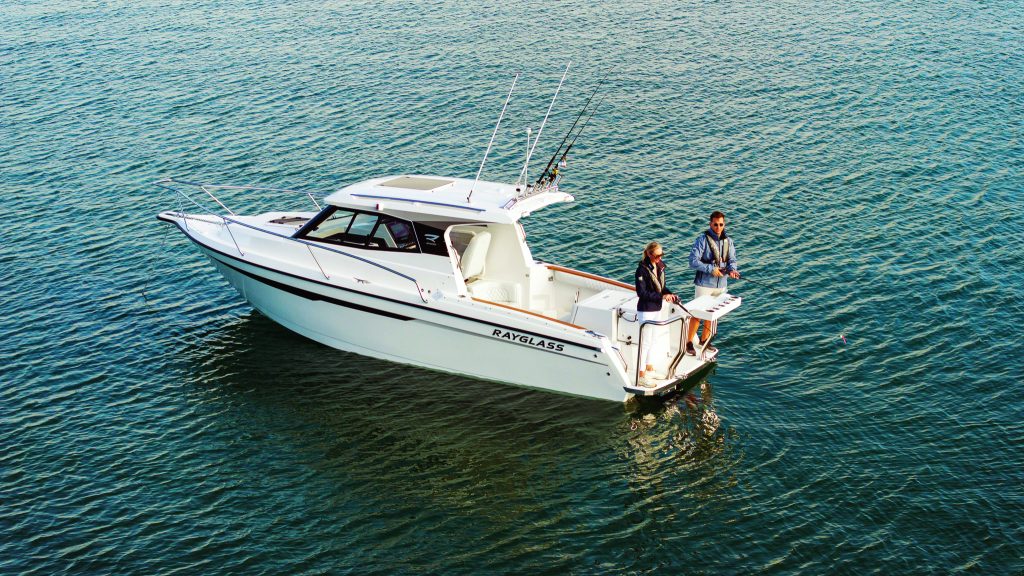
The hardtop is shared with the Rayglass 3000 and 2700 and extends far enough back to provide good protection for the cockpit. Side curtains are also available. It’s the same hardtop Rayglass uses in its Protector range – which greatly contributes to the three models’ familial look. There’s no mistaking them for anything other than a Rayglass.
Bigger inside
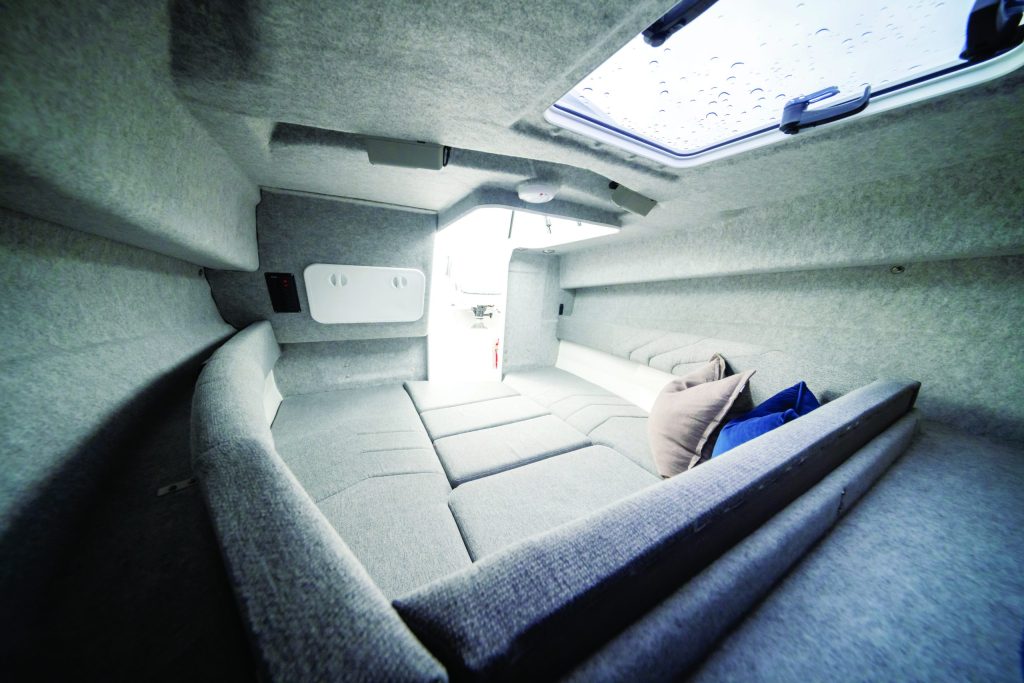
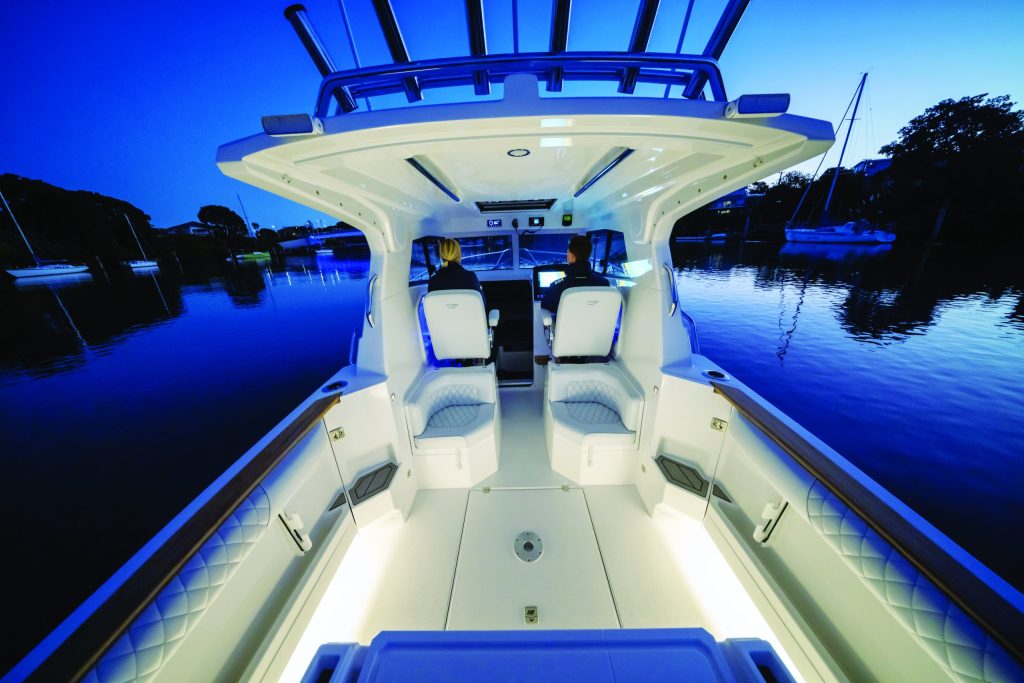
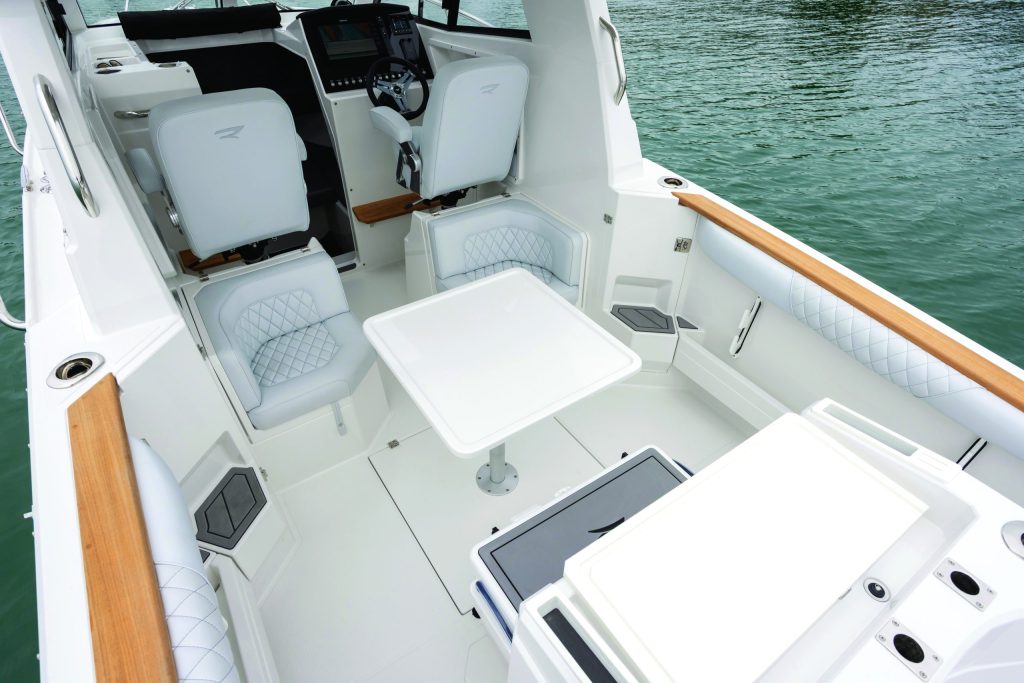
The 2400 certainly feels like a bigger boat on the inside. This is especially true for the forward cabin with its wide-open bulkhead that allows you to stand in the companionway. The cabin is light and airy with longer v-berths than the old model could offer. Seated headroom is also better, and you can drop in a table (which also serves the cockpit) to create a social hub indoors.
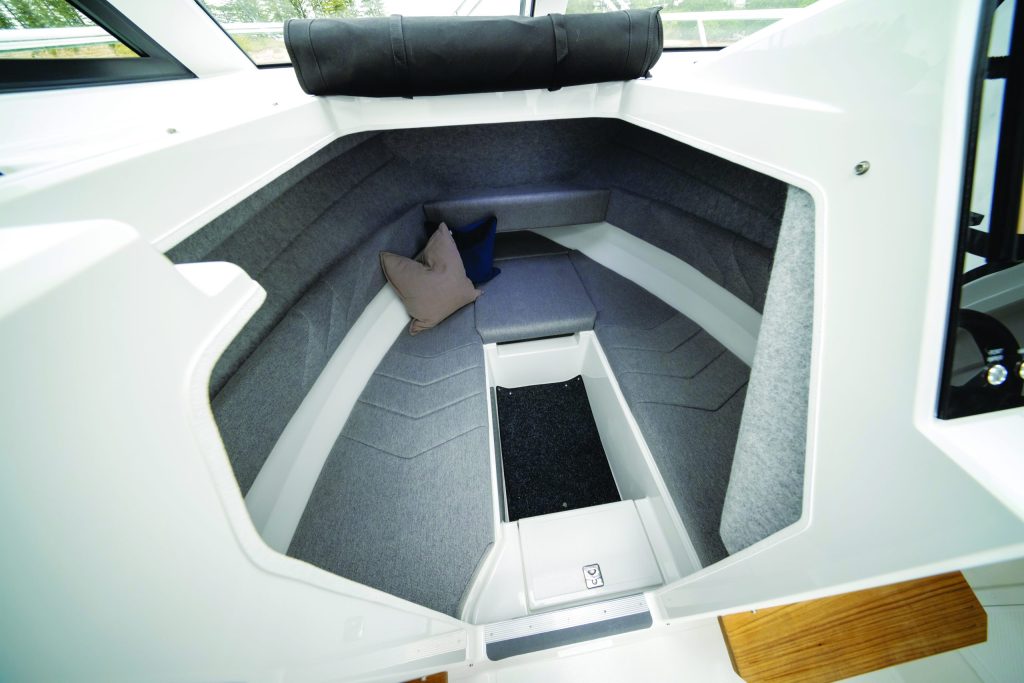
There’s storage under the squabs and in side-shelves, an infill to turn the v-berths into a good-sized double berth, and provision for a toilet under the squab in the bow. A shelf across the forward bulkhead is wide enough to accommodate a 60-litre portable electric fridge – or sleep an infant – and the step down into the cabin hinges up to reveal either useful storage or somewhere to house the battery for an electric bow motor.
There’s more space inside the hardtop, too. All the different elements – the seats, seat bases with their generous storage, helm console, lockable rod and fender storage extending under the side decks on both sides, windscreens, two-way sliding side windows, large sliding skylight, extended hardtop roof with moulded mounts for aerials, radar, spotlights and more – are modular, shared across the three models.
The helm station is ergonomically laid out and admirably uncluttered. The console accommodates a 1216-inch Simrad NSS4 MFD, the latest Mercury digital display, a Scanstrut wireless phone charger and a row of simple push-button switches that light up when on. The Simrad VHF radio, Fusion sound system head unit and Maxwell anchor controls are positioned overhead above the windscreen, while trim tab controls (where fitted) are located to the side close to the throttle and shift lever. There is provision to stow smaller items – keys, wallets, phones etc – in cubbies beside the helm seats with USB charging and plenty of cupholders as well. It’s all very tidy and everything is easy to see, reach and operate.
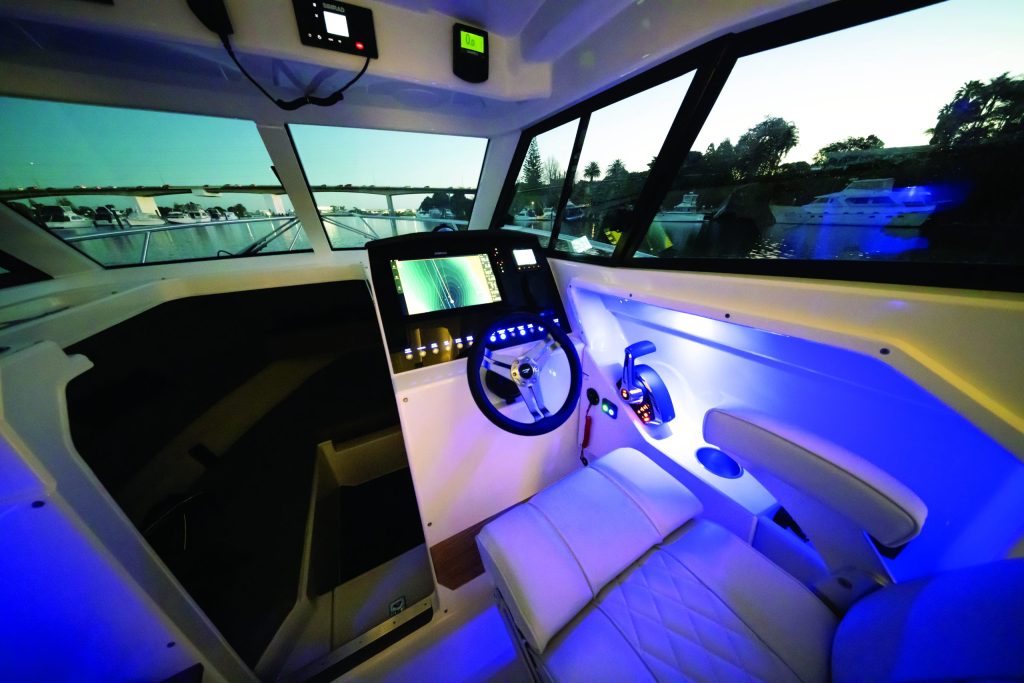
In contrast to the model it replaces, the 2400’s windscreen now has flat glass and fibreglass mullions which are stronger and stiffer than aluminium framing. This is the same framing as Rayglass uses on its Protector models, as are the sliding side windows that open both ways.
Outboard and sterndrive
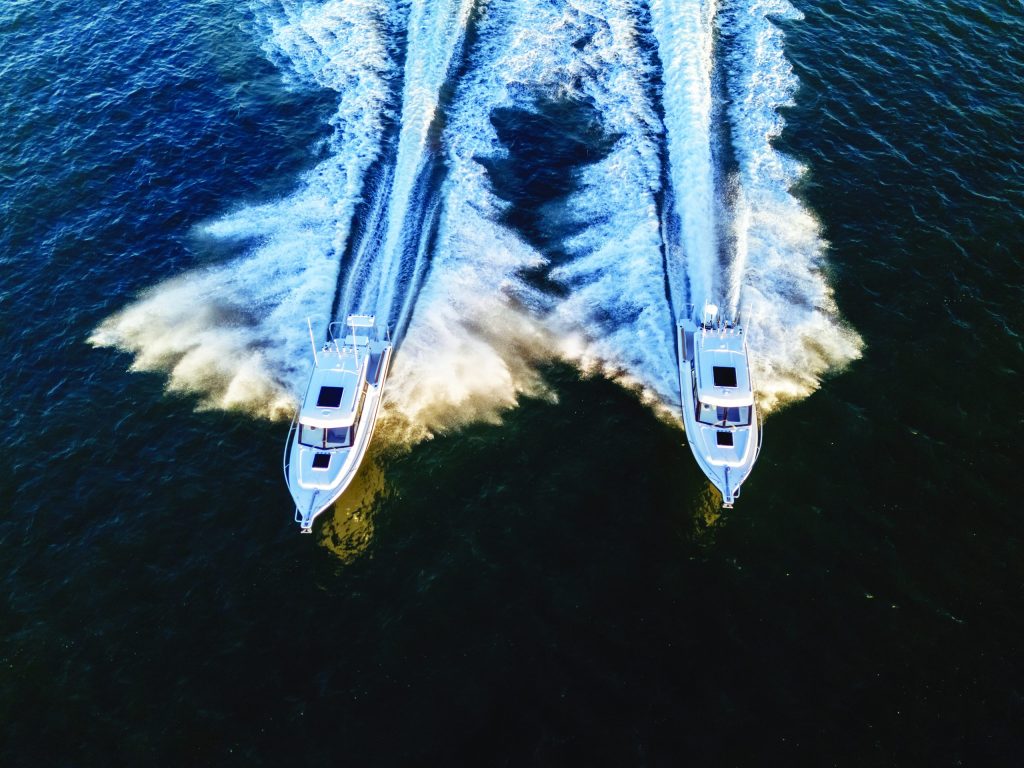
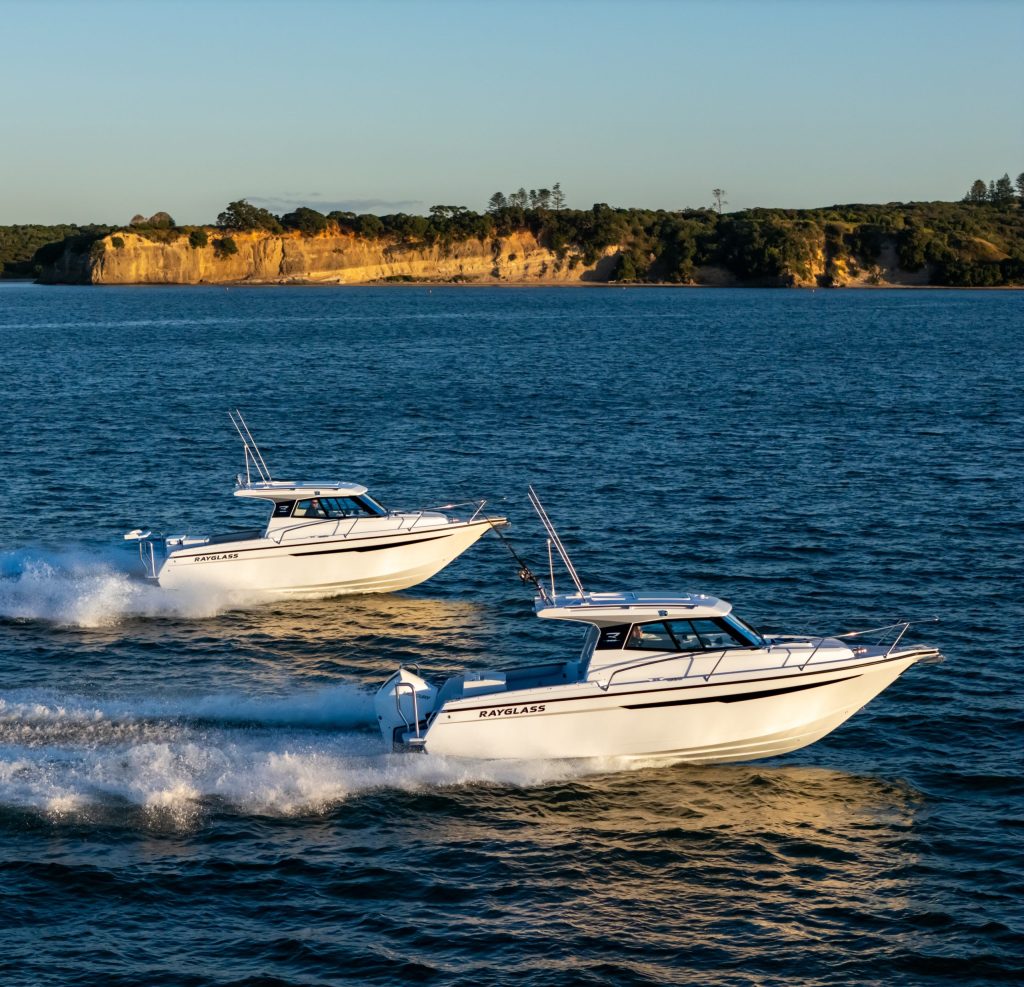
We got to experience two versions of the new 2400 for this story. The boats are identical from the hardtop forward, but the transom arrangement differs between outboard and inboard versions (and between twin and single outboards). We drove a 2400 with a single Mercury Verado 300hp V8 and another 2400 with Mercury’s 3.0-litre 270hp diesel sterndrive. Power options include Mercury 250hp V8 O/B, twin 200hp or 225hp V6 O/B or 350-425hp V10, as well as petrol sterndrive. According to Rayglass Sales Manager Matt Flanagan, forward orders suggest the 350hp V10 with the smaller V8 bottom end hits the sweet spot with customers, offering strong performance with decent fuel efficiency.
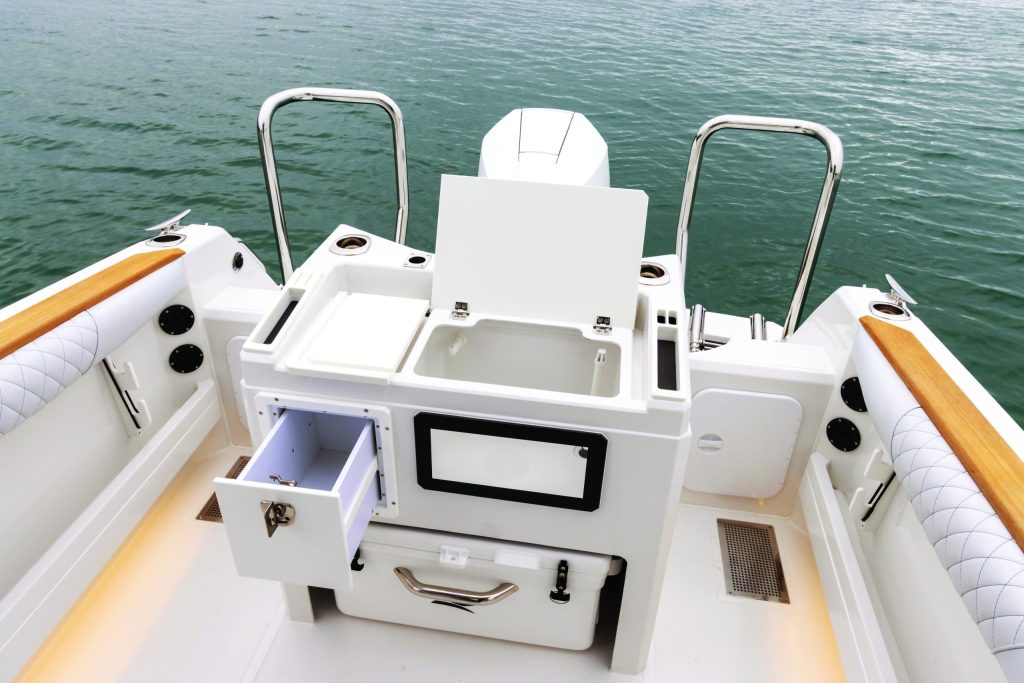
The outboard versions feature a new transom design which provides an extra 300mm of cockpit deck space. Like the rest of the boat, the transom module is both functional and stylish, offering a large plumbed bait station with a replaceable Starboard cutting surface, tool and knife slots, a cockpit shower, a 55-litre live well under the bait board, a large tackle/gear drawer, and a pullout 60-litre Icey-Tek fish bin (can double as a seat) that slides under the transom island, leaving the cockpit clear. The washdown outlet is on the starboard side aft, cockpit shower on the lefthand side of the bait station (hot water optional), with the new telescopic boarding ladder on the port side. The single outboard version features a swim step on either side of the engine plenty large enough to fish from, with drop-in stainless-steel leaners fitted with this in mind. Outboard models can also be specified with a different transom module that includes a ski pole and forward-facing bench seat.
The Mercruiser 3.0-litre 270hp diesel inboard-powered 2400 has a different transom again to accommodate the engine box. It takes up a bit of space in the cockpit, but the engine is set low inside the hull and the engine box with its Starboard plastic worktop serves as a useful work area. There’s a bench style seat moulded into the engine box facing forward while the whole engine box assembly is hinged at the rear and electrically raised to access the engine. There’s a modest-sized live well and sink under the worktop and hot water for the pullout cockpit shower is engine heated.
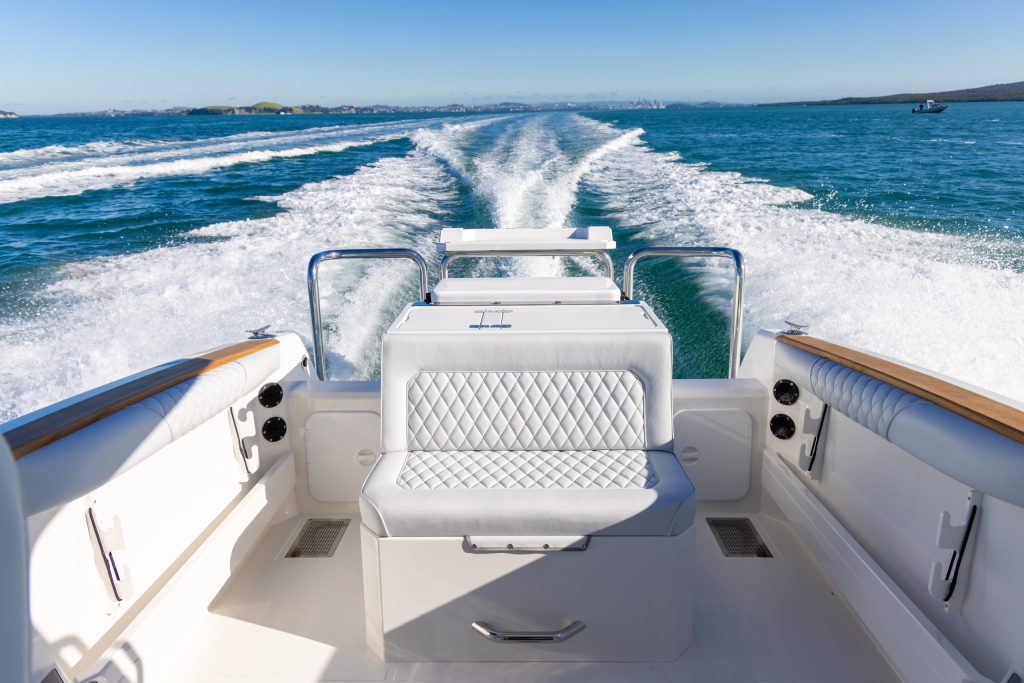
Since there are no outboards on the transom, Rayglass has been able to incorporate a full-width duckboard with a combination bait board-dinghy davit, and stainless-steel railings all round. Accessible via transom walkthroughs on both sides, and with a large aft facing chilly bin within easy reach, it’s a perfect set up for fishers. The transom arrangement is identical for diesel and petrol sterndrive versions.
Another much loved Rayglass feature retained in this latest model is underfloor storage. Lifting the lid on the deck hatch just aft of the rear seats reveals a massive lift-out plastic bin suitable for wet or dry storage. But that’s not all: pull it clear and there’s another bin behind it, slid up under the floor – the storage locker extends all the way between the seats to the cabin bulkhead.
Underway
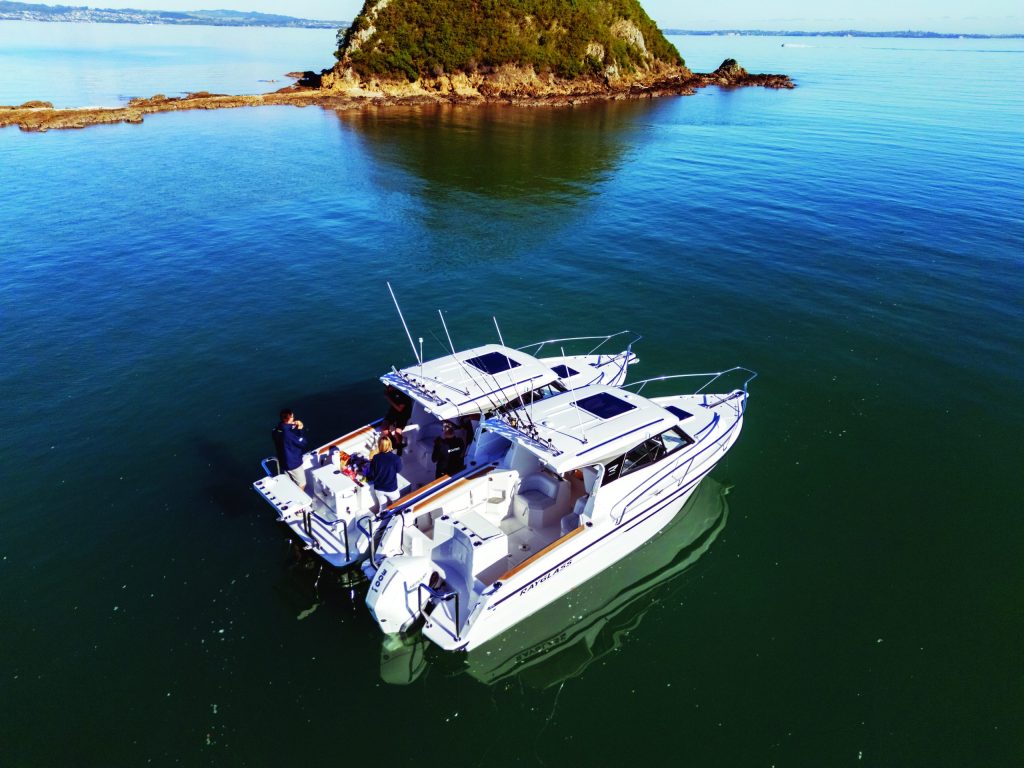
The proof of the pudding is in the eating, so we took both boats for a run, stopping for a leisurely lunch rafted up at Waiheke Island. I drove the outboard model on the way there and the diesel sterndrive on the way back. It was a gorgeous winter’s day with hardly a breath of wind, so no opportunity to assess the boats’ rough weather performance, but since this is essentially the same hull as the 2350, there are no concerns on that front. And just to confirm the new 2400 is at least as capable as the model it replaces, Matt showed us video of the Rayglass team putting the outboard 2400 through its paces in Motuihe Channel in 20-plus knots of wind against tide. The boat’s occupants both looked and sounded comfortable, the 2400 with 24-degrees deadrise at the transom seeming to handle the conditions with ease.
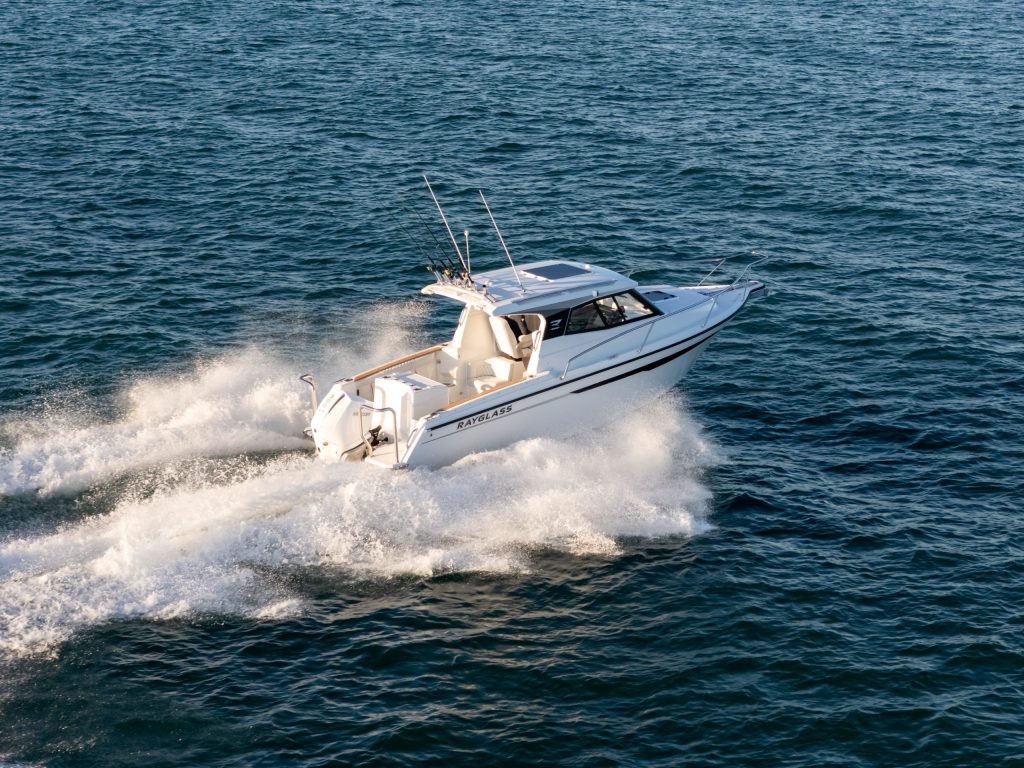
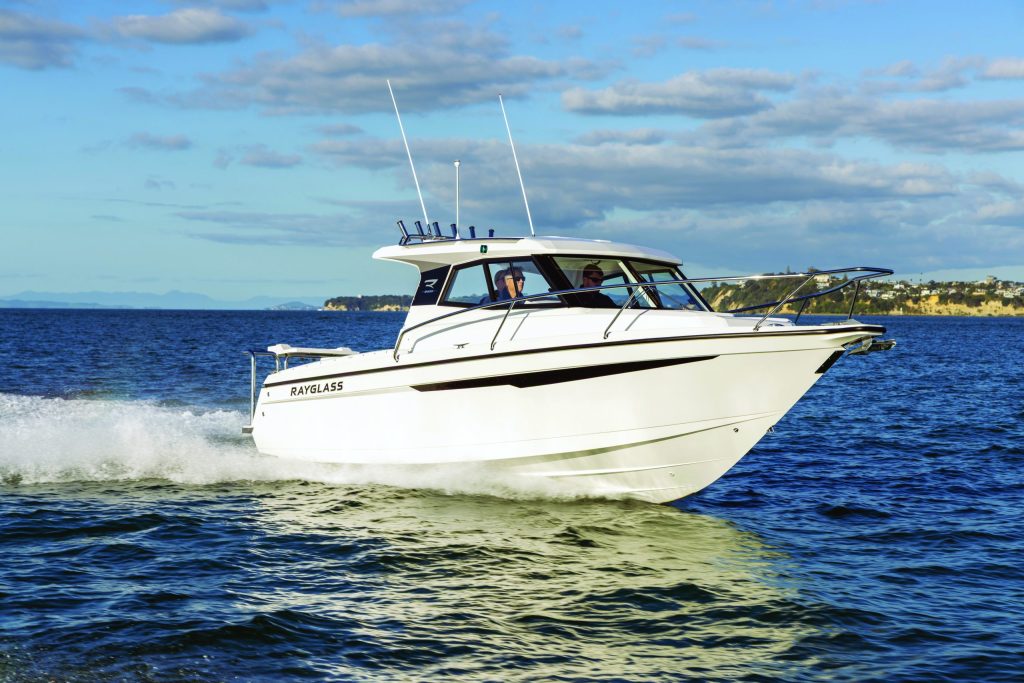
We cruised to Waiheke at a comfortable 28 knots, burning 51 litre per hour. There was a little bit of chop to contend with in places and inevitable ferry wakes, but the ride was generally smooth and quiet – foam-filled construction helps here, as do supportive bucket seats on gas pedestals.
Mercury’s automatic engine trim combined with the optional Seakeeper Ride stabilisation system took care of everything except operating the throttle lever and steering the boat (effortless, thanks to Mercury’s electric steering). The Seakeeper seamlessly controls pitch and roll to ensure optimum ride and fuel efficiency while Mercury outboards with electric steering also provide integrated autopilot functionality – a real bonus.
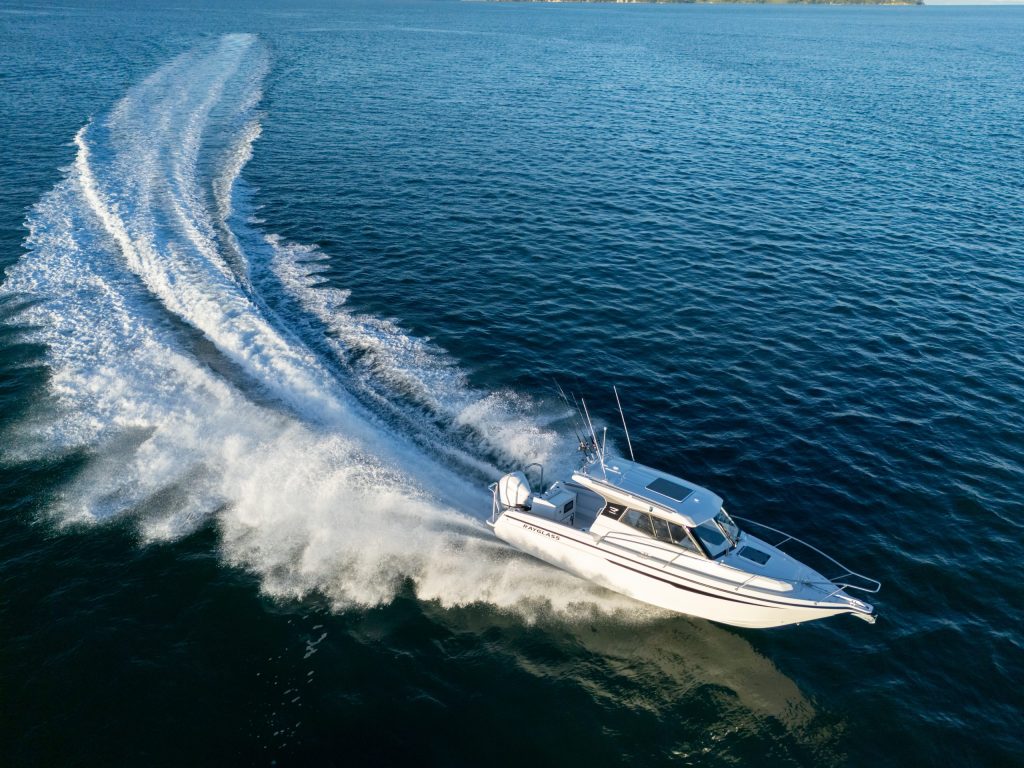
Throwing the boat hard into a turn at speed demonstrated impeccable manners with no tendency to slip or broach. Just like its predecessor – and the other new models in the Rayglass range – the 2400’s handling is predictable and safe. The 300hp V8 feels responsive and propels the 2400 to 42 knots top speed, but more horsepower is available if customers want it.
On the way back, the diesel 2400 afforded a similarly comfortable ride, if a little noisier. That said, the 3.0-litre 270hp is quieter than older Mercruiser diesels and engine noise was never intrusive. Turbo whine is quite subdued too, which is nice.
Hydraulic steering was positive with good feedback, and with plenty of torque on tap, hole shots are snappy. Lenco Pro Control Auto Trim Tabs kept the boat on an even keel – these are available across the model range – while the rest of this boat’s controls and instruments are the same as the other boat.
The weight distribution between outboard and inboard models is slightly different, and the inboard version is slightly heavier as well, which (along with the horsepower deficit) somewhat blunts overall performance. However, the 2400’s deep vee hull feels even more assured with inboard power and top speed is still over 32 knots. Fuel capacity across the range is an impressive 320 litres.
Which version?
So which version should you choose? Well, that depends on your priorities. Some customers will doubtless opt for inboards, seeking better fuel economy or preferring the fisher-friendly transom setup. But I’m guessing most punters are likely to opt for one of the outboard powered 2400s, especially since the new transom layout gives little away in terms of fishing utility. They will choose in favour of performance, cockpit space and easier servicing.
Either way, whichever the version of the Rayglass 2400, customers can be confident they’re getting a worthy successor to a Legend, updated, enlarged and better than ever.
