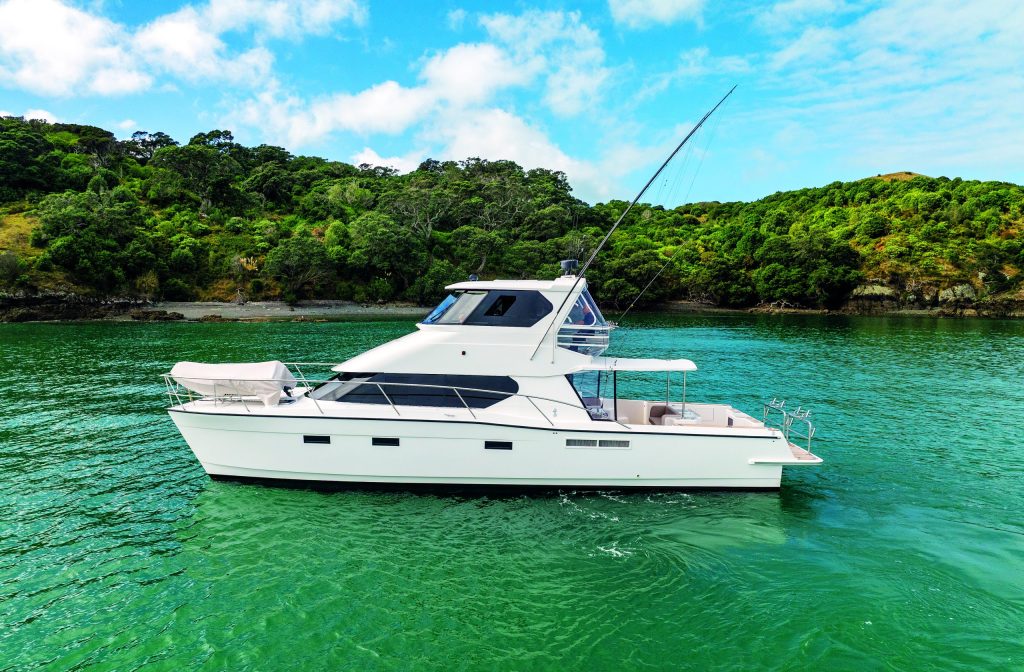
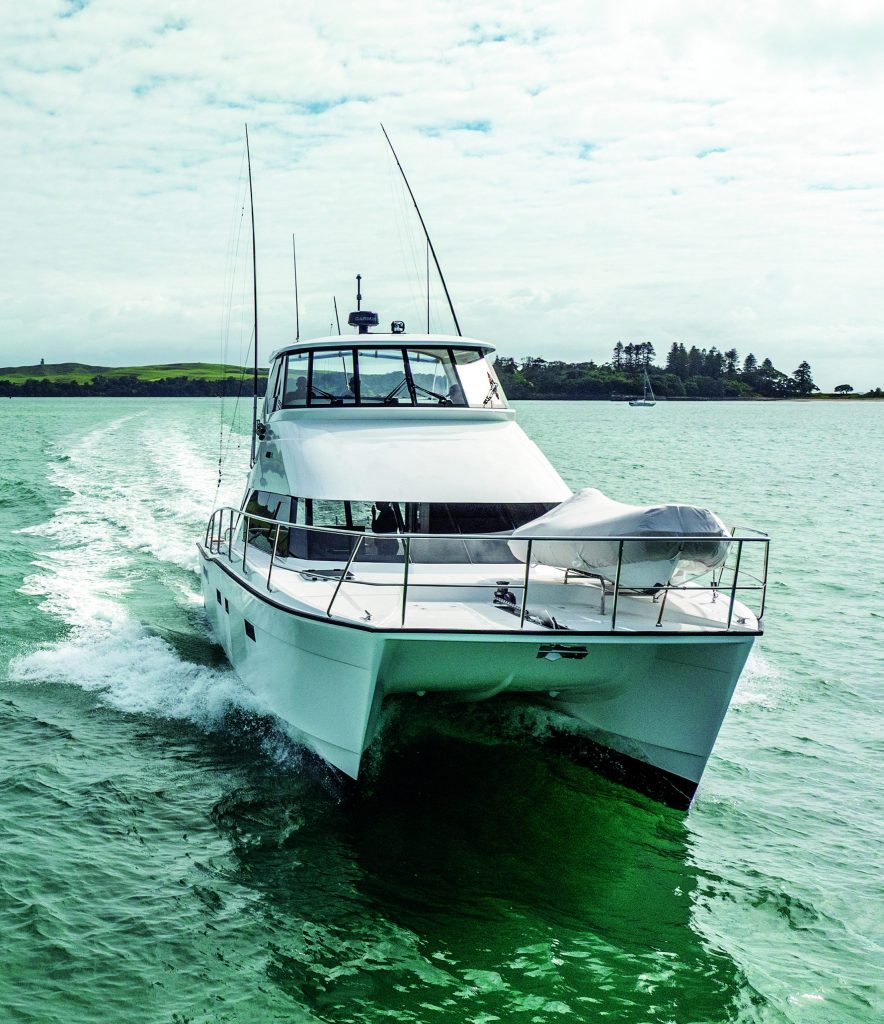
Father and son team Kelvin and Amos Kay have built six Wright 15m powercats, originally designed by Alan Wright as a photography platform for the America’s Cup. Stable and fast enough to comfortably run rings around the non-foiling AC boats of the day, the type has proven its versatility in both recreational and commercial applications.
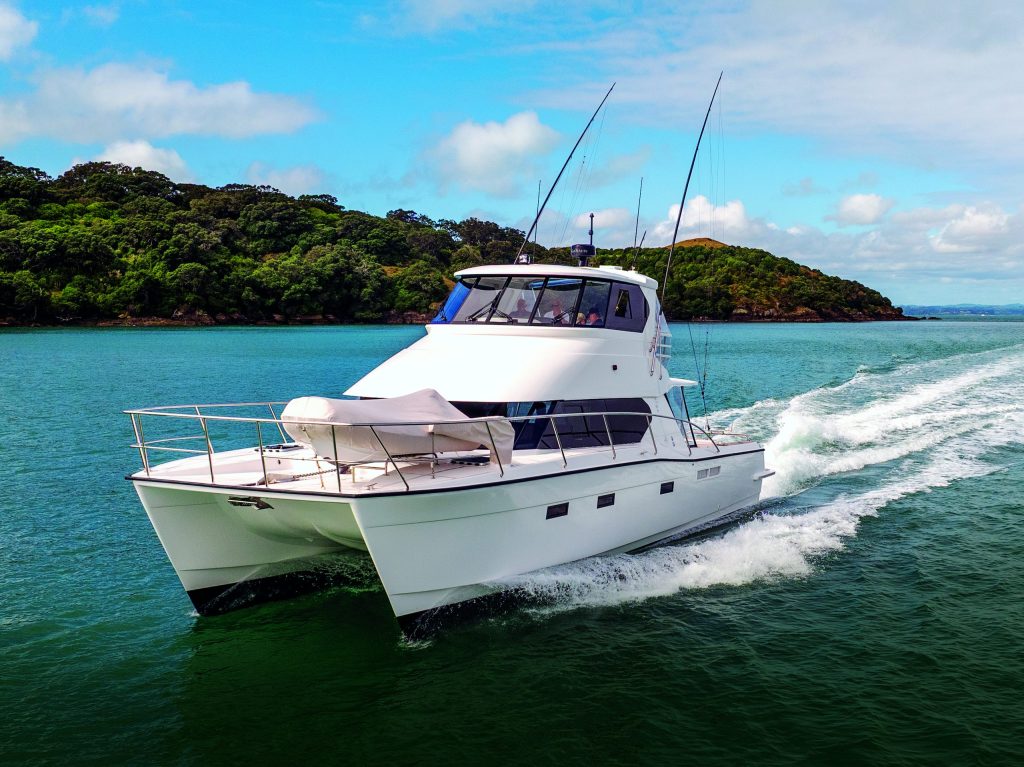
Catfish adds an Alan Wright-designed flybridge to the existing sedan model, along with other modifications. Sedan-style motor yachts are popular in New Zealand, but this boat is destined for Australia –the Whitsunday Islands in northern Queensland – where its main role will be game fishing, along with some family cruising. Her owner is an accomplished tournament angler, and his input is clearly evident in the boat’s sportfishing setup.
Construction on the boat, originally meant for the Kay’s own use, began some time ago, alongside a customer’s boat. But in a tightening market, and with the boat only partially completed, the Kays reluctantly decided to offer it for sale and complete it to a new owner’s specification. In this case, an Australian buyer wanted a high-spec vessel with a flybridge, a high-quality interior, teak decks, and an extensive extras list, in keeping with the vessel’s intended use in North Queensland’s tropical climate.
That’s why Catfish has four air-conditioning units, two tucked under the seats in the flybridge and two more built into the saloon, and a large awning over the cockpit, providing sun and rain protection. The cockpit can be fully enclosed with mesh drop covers – insect proof, see-through, and permeable to the breeze. Catfish also has a high-capacity Aquaplumb water maker, a Cummins Onan genset and ample refrigeration onboard. All the ship’s internal systems are monitored and controlled via a CZone system, with easy-to-use touch panels selecting pre-programmed vessel modes.
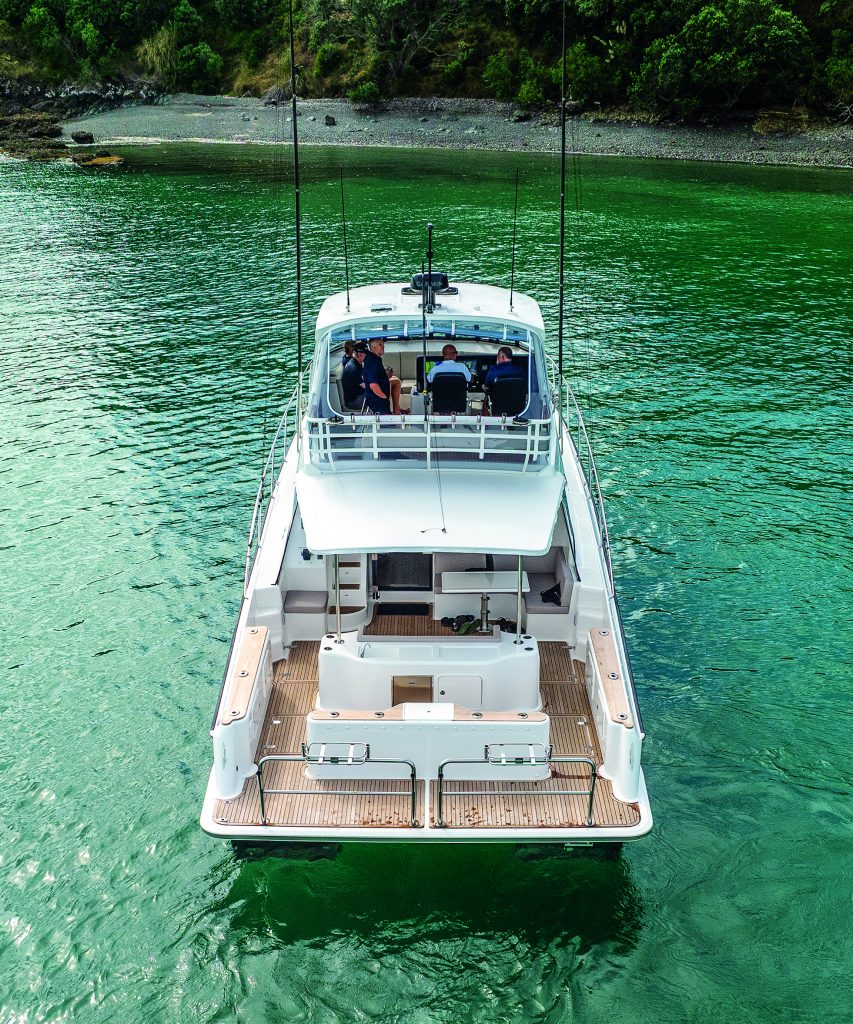
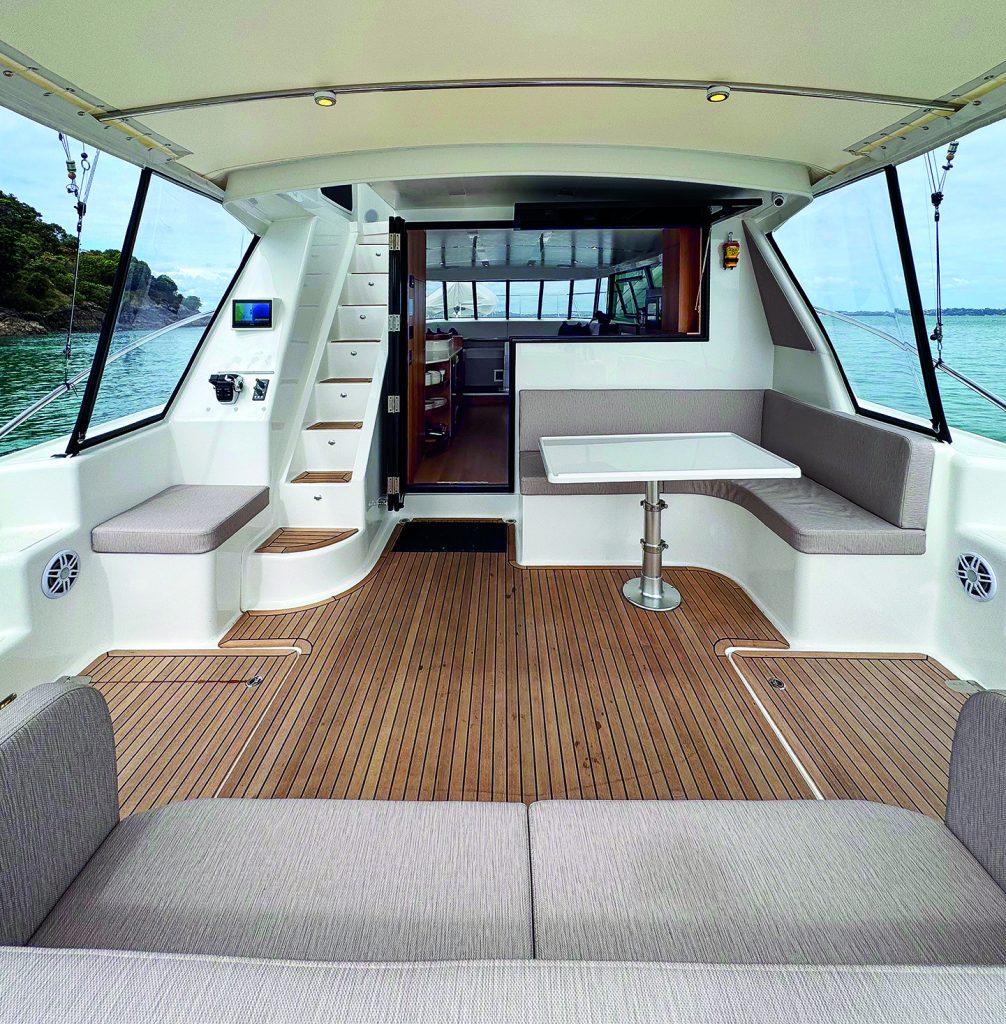
The advantages of a powercat are many, and one of them is deck area. On the Wright 52 Catfish, the cockpit is vast, split into two distinct zones: a social area with two seating zones, a cockpit table, outdoor basin, fridge and food prep area under the awning; and a ‘working’ zone aft with the bait station, live well and extra-wide boarding platform. The after part of the cockpit is for fishing and water-based activities, which are easy to monitor from the flybridge, while the forward section flows nicely into the saloon, connected via a bi-fold door and a huge awning-style window.
This boat has an extended swim platform taking the length out to 16m overall. Stainless steel railings support a pair of removable bait boards, useful when bottom fishing off the back of the boat, but the cockpit is deep enough to fish several anglers from the sides when the boat is drifting – a pair of electric reel outlets accommodate deep-drop fishing of this type – and trolling rod holders are set into the gunwales and across the transom, with a rocket launcher on the flybridge.
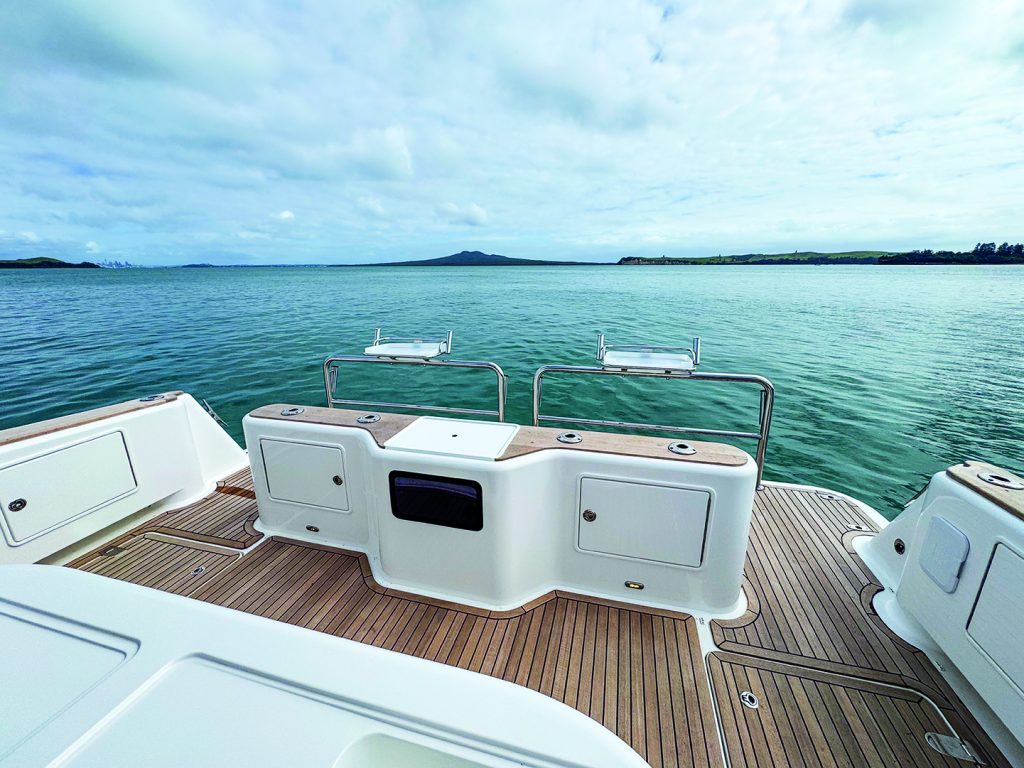
There is also a freshwater cockpit shower and saltwater washdown outlet at the port side aft corner and a second helm station, including bow and stern thruster controls, in the cockpit against the cabin bulkhead on the port side – perfect for conning the boat when there’s a large fish on the line.
The foredeck is equally vast, surrounded by railings for safety. It accommodates a 3m AB RIB tender on a deck cradle, deployed using the 250kg Davco deck crane. Catfish is equipped with decent ground tackle for anchoring overnight and it is also expected that she will be nosed up to one of the Whitsundays famous white sand cays to allow the crew to enjoy a time ashore. While the stern should still be in plenty of water, it’s comforting to know that the hull skegs will protect the propellers and rudder should the vessel take the ground.
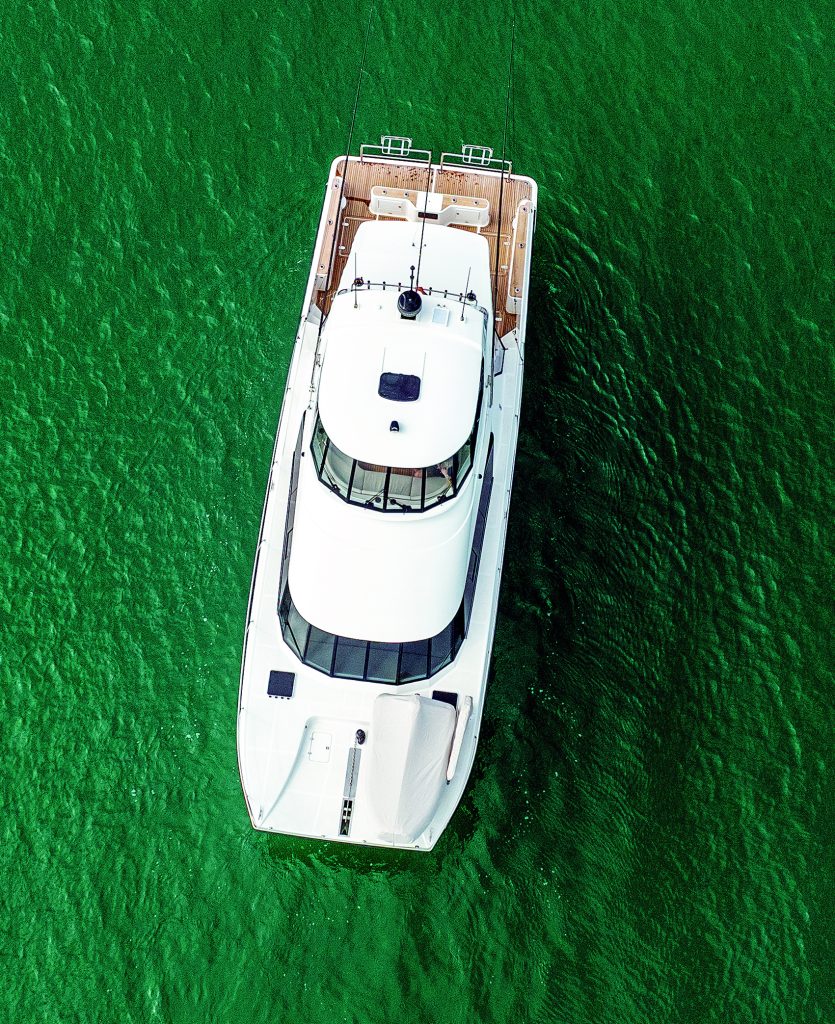
A set of high-tech Kilwell carbon fibre game poles, plus a shotgun pole on the centreline for the stinger lure, ensure a full spread of lures or baits when trolling, with the poles and teaser lines easily deployed from the flybridge.
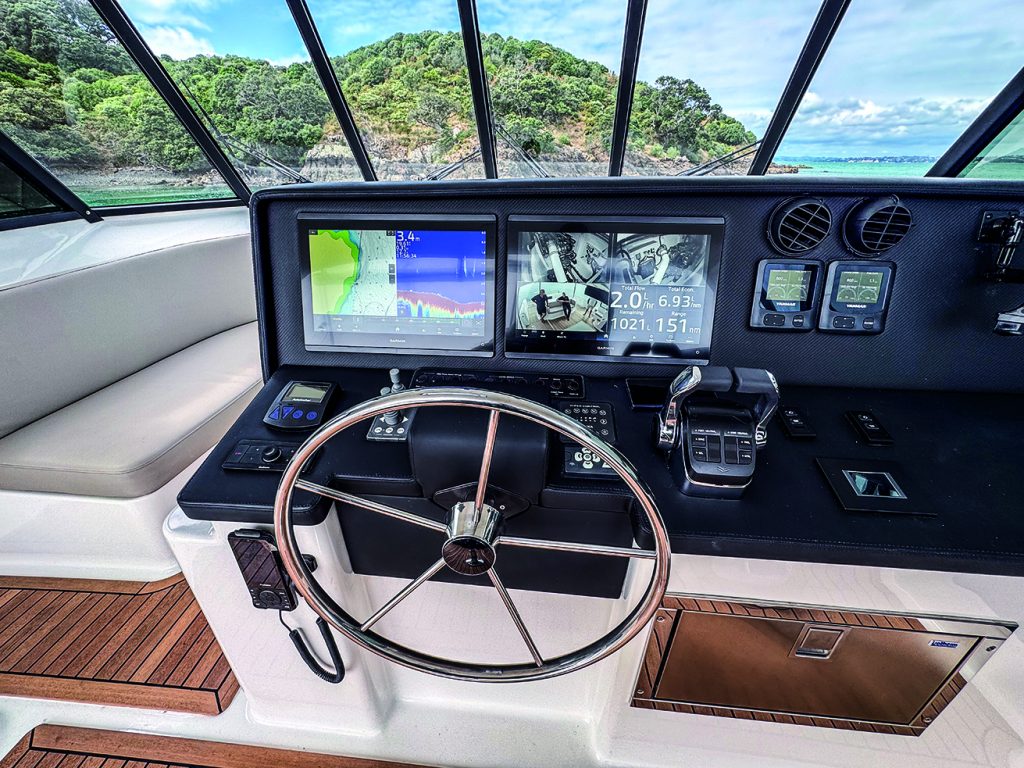
The flybridge is accessed by stairs from the cockpit on the port side, each step LED-lit. Catfish’s flybridge is open to the rear, but with clears to fully enclose it, while still allowing the skipper to monitor lures in the wake and any activity in the cockpit. A cockpit camera serves the same purpose and there are also cameras for both engines with a fourth planned to monitor the anchor. Twin Garmin MFDs can be configured to display camera feeds, radar, navigation data, sounder (1kW transducer) and engine data, also shown on the dedicated digital Yanmar displays. The black vinyl-covered helm console is large enough to seat two behind in comfortable, swivelling gas pedestal helm seats. The autopilot and VHF are also by Garmin.
Although the flybridge is open to the rear, it can be fully enclosed by the clears and a hatch over the cockpit stairs, allowing occupants to take advantage of the air-conditioning. Aside from the two captain’s chairs, there’s lots of seating up top with a full width bench seat aft and a settee that wraps around the front of the flybridge under the windscreen. Upstairs A/C units are housed under these seats and there’s a huge storage area extending under the windscreen and into the flybridge ‘chin’ forward.
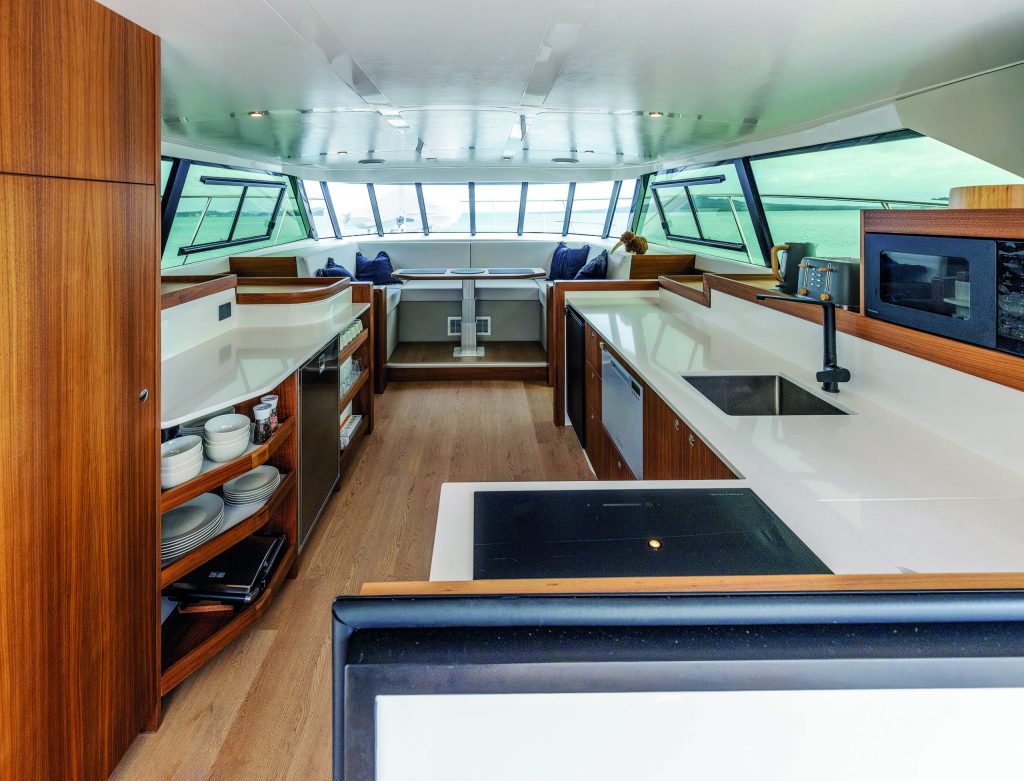
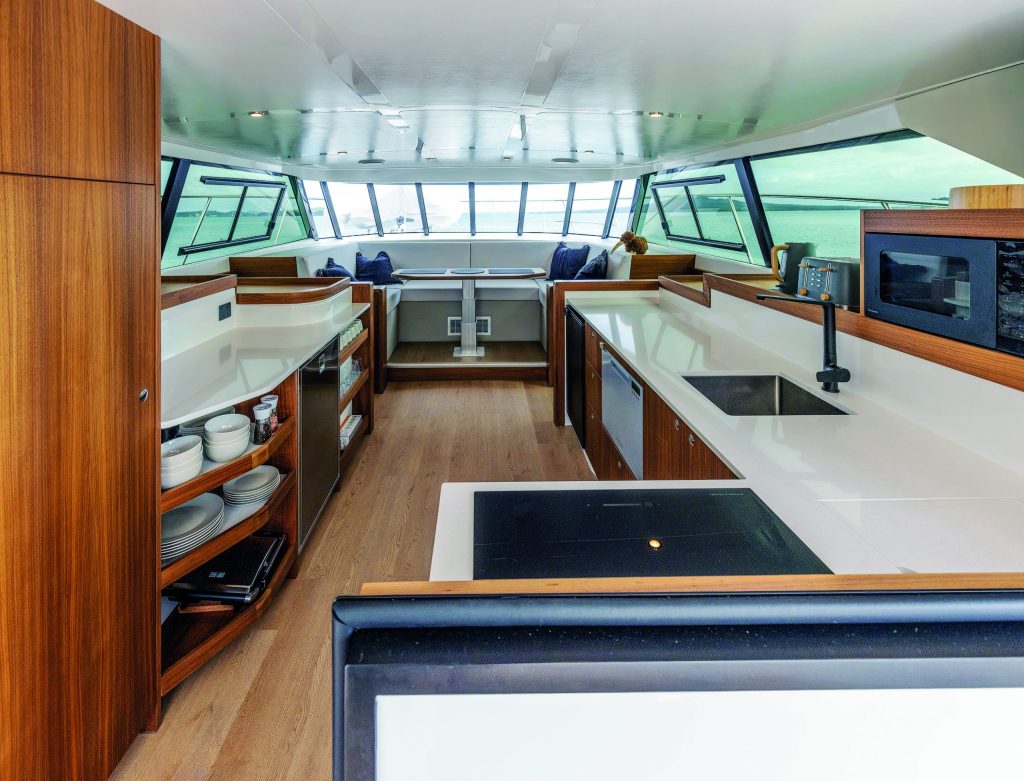
This flybridge version of Wright’s cat design with the helm station up top benefits from extra living space in the saloon. Instead of the helm console dominating the saloon, the builders have instead wrapped a raised seating area around the saloon table under the front windows. This has allowed them to go to town with the galley aft, which spreads along both sides of the saloon as far as the companionway stairs. Finished to a high standard and equipped with domestic appliances, stone-look surfaces, ample refrigeration, and plenty of storage, it creates an impressive food prep and entertaining zone, with easy access to the cockpit area. And because cats are inherently stable, conventional shelving can be used for many everyday objects, which probably only need stowing away on especially rough passages.
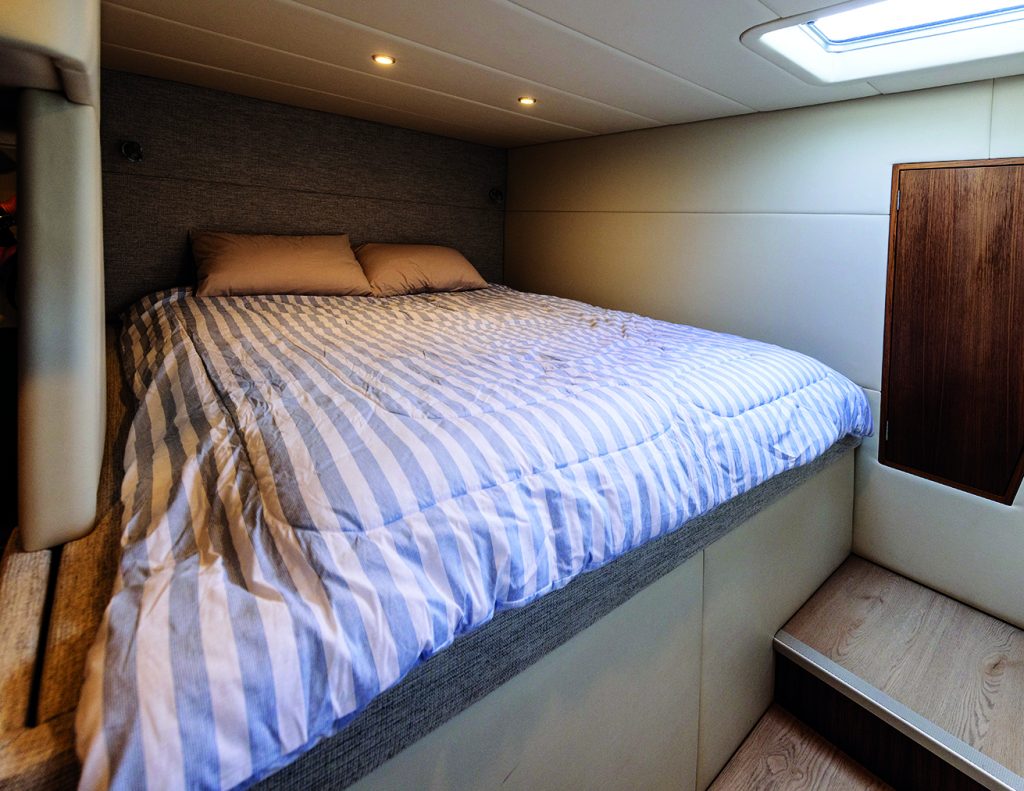
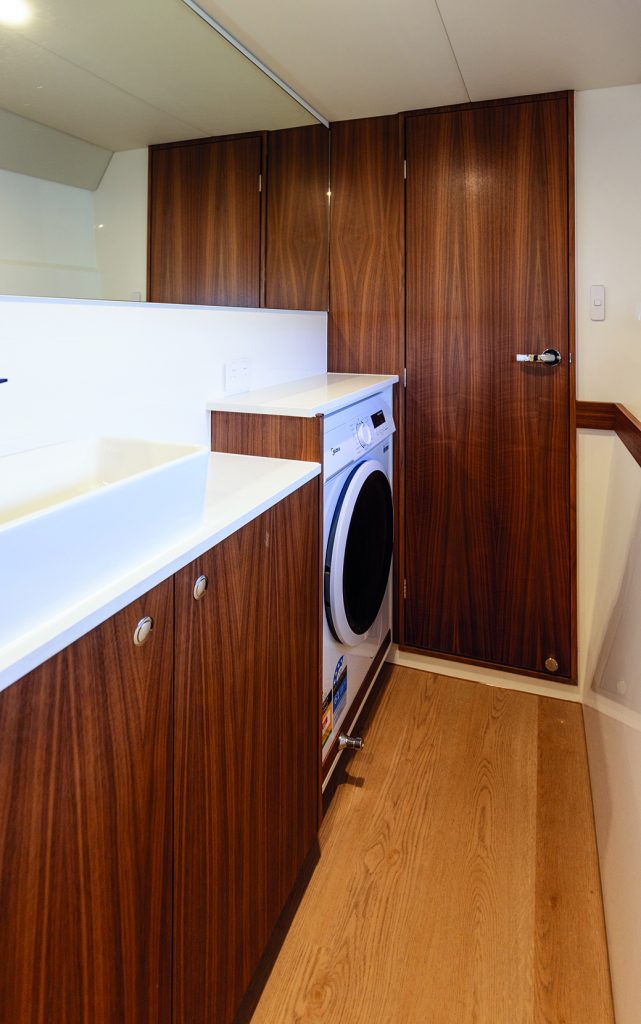
As is usual with powercats, sleeping accommodation is tucked into the hulls, although the electric saloon table drops down to create a large double berth on the bridgedeck for watch keeping or should extra accommodation be required. On Catfish the owner enjoys the whole of the starboard hull for his exclusive use, complete with a king-size berth forward and a small vanity/desk/workspace, a washer-drier amidships, and a luxuriously appointed bathroom with separate shower aft. Skylight hatches and opening port windows provide natural light while the A/C is independently controlled.
In the port hull there’s a double cabin aft, with a double berth and decent storage in hanging lockers, though the berth is not walkaround. A second cabin in the bow features a pair of staggered single berths at different heights with masses of storage under them for ship’s gear and personal items, as well as dedicated hanging lockers. Between the two is a shared bathroom which also serves as the day head. It’s a single space, so no separate shower box, but it is well appointed and practical, although there is a bit of a step down into the shower to ensure sufficient standing headroom.
The engines – one in each hull – are accessed via large deck hatches. A pair of turbocharged 440hp Yanmar 6LY diesels provide a comfortable 18-knot cruise speed and exceptional fuel economy at 8 knots, a speed at which Catfish will spend quite a bit of time when trolling the edges of the Great Barrier reef for black marlin. It’s also the projected speed for the vessel’s delivery voyage, planned for the next weather window after this review was undertaken in early April. The boat will first motor up to New Caledonia, a journey projected to take around four days and nights, and then four days more of non-stop motoring at displacement speed to the Whitsundays in North Queensland.
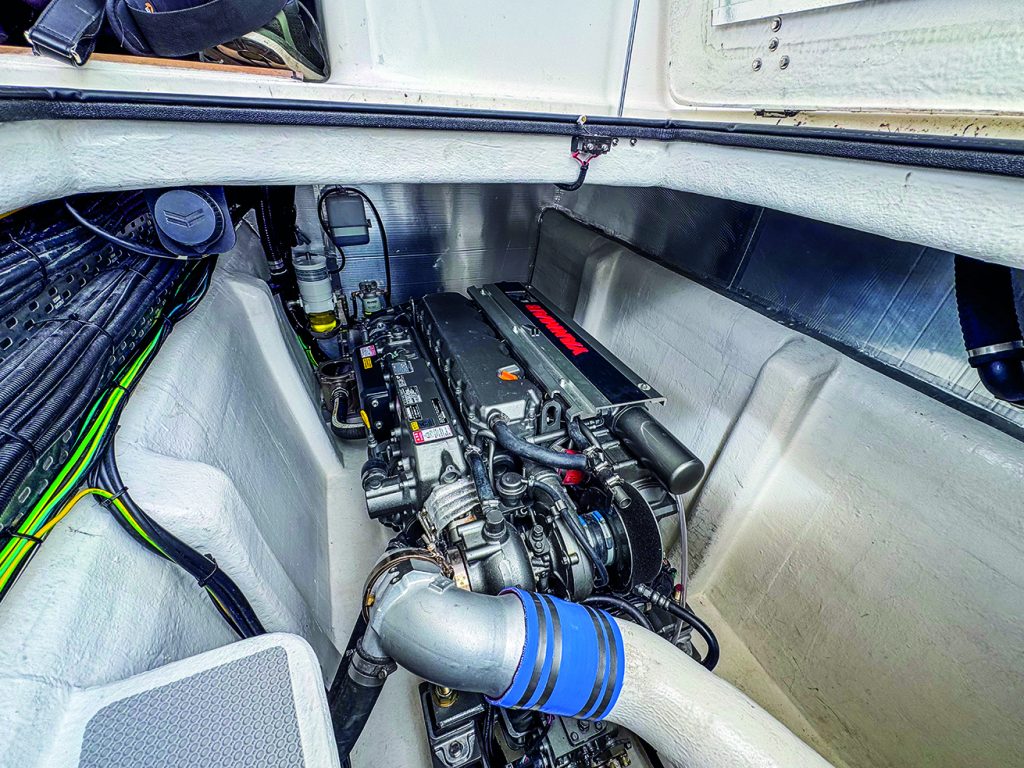
Access to the engines, ship’s systems and associated machinery is excellent. The Yanmars are compact power units, so they drop in through the deck hatches, there’s ample space around them in the engine rooms, and their installation has produced a vessel that’s very quiet when underway, even standing in the cockpit. Additional deck hatches aft access the genset, hot water tank and freshwater filtration system on the port side, with general storage in the starboard hull.
The big Wright cat is easily driven, so smaller engines are a valid choice, but with 880hp on tap Catfish is capable of 28 knots and the engines are not having to work too hard at cruising speed.
Fully laden, Catfish weighs in at around 20 tonnes, but acceleration is smooth and quite rapid once the turbos kick in, with no real sensation of transitioning onto the plane – the whole boat simply lifts and goes quicker, delivering a smooth and assured ride. It’s generally more comfortable at planing speeds; at lower speeds the hulls sit lower in the water, so waves occasionally slap against the underside of the bridgedeck, but a moulded v-section nacelle dampens any wave impact.
This boat was originally designed to chase around all day at 18 knots filming America’s Cup racing yachts, so the hulls are quite efficient, which is reflected in a total fuel burn of 76lph (4.1lpnm) at 18 knots. Fuel capacity is 2400 litres, so the range is considerable, and the boat is clearly capable of offshore passages – previous sedan-style iterations of this design have crossed the Tasman and motored up to the Pacific Islands.
While building this boat the Kays had to overcome some difficulties with a lack of space and difficult transportation from their old factory in Glendene, so they have now moved out of the old premises and amalgamated with Robertsons Boat Yard in Warkworth. With its on water access, travel lift and ample shed space, Roberstons will help build the boats while the Kays concentrate on marketing and sales.
To mark this change and to reflect their export aspirations, the company has rebranded to Wright Catamarans Australasia Ltd. They expect Catfish to turn a few heads in Queensland, where her owner is happy to show her off on their behalf, and she’ll also be going to Sanctuary Cove International Boat Show. The owner spent several weeks in New Zealand getting to know his new vessel. With experience owning both catamaran and monohull vessels, he told Boating NZ that he can’t wait to get his new Wright 52 home and hit the fishing tournament trail.