In early 2013, boating journalist Steve Raea returned to Mexico’s west coast to rejoin a yacht he had purchased the previous year and prepare for another Pacific crossing. More than a decade later, his account provides a fascinating snapshot of offshore cruising before Starlink, before widespread weather-routing apps, and at a time when self-reliance remained one of the most important tools aboard any ocean-going yacht.
Originally published in 2013 and written by Steve Raea.
It is often said real beauty lies within, and this is certainly true of Rarotonga’s Palace burger bar. A dilapidated old wooden structure with a rusted iron roof and a permanent list, piles sinking through age and neglect, the Palace’s single outside lamp had become something of a beacon of hope over the last four days.

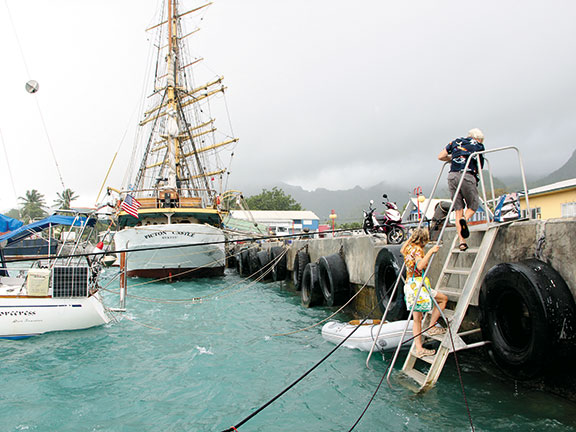
At the edge of Rarotonga’s small and exposed Avatiu Harbour, the comings and goings at the Palace had been a comfort through the long nights Steve sat in the cockpit with the wind shrieking in the rigging, praying the three anchors holding the yacht off the harbour’s merciless concrete seawall would stay.
For almost a week the harbour had been a washing machine, churned up by a north-east swell rolling through the narrow harbour entrance, fuelled by a deep tropical low moving away slowly to the south. Around the island, sections of Rarotonga’s circular road had been closed by rocks and debris hurled ashore by a huge week-old southerly swell coming in over the island’s fringing reef.
A braver soul might have elected to put to sea to escape the harbour and its concrete danger, but the forecast six-metre swell and persistent north-east gales made this a very tough call. At least tethered to terra firma there was the option of scrambling up the seawall and walking across the small gravel car park to the Palace and consoling themselves with a burger and fries if everything came unstuck, even if it were 3am. But out there on the ocean there would be no such comforts.
On our toes
They arrived in Rarotonga on Tuesday, 28 May after a quick passage from Tahiti in fresh 25 to 30-knot south-east trade winds. These came as a bit of a wake-up after the light airs of the North Pacific, and they were kept on their toes for much of the passage.

They were short-handed for this leg, with Steve’s stepdad Geoff joining the boat in Tahiti for the two legs through to Tonga. A veteran circumnavigator, his experience was welcome. Steve couldn’t help but be reminded, though, that the last time they had put to sea together they lost their mast halfway to Fiji during a race. Being an engineer, the challenge of building a jury rig and sailing the boat home had captured Geoff’s imagination. Hopefully, there would be no requirement for his specialist skills this time.
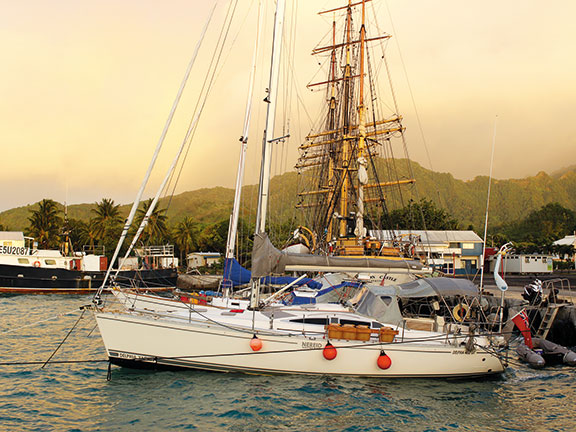
They had timed their arrival at the harbour entrance for first light and found only a single cruising yacht tied to the seawall. This was a blessing because the seawall, the only berthing option for cruising yachts, is often busy, which can result in yachts being separated only by the thickness of their fenders.
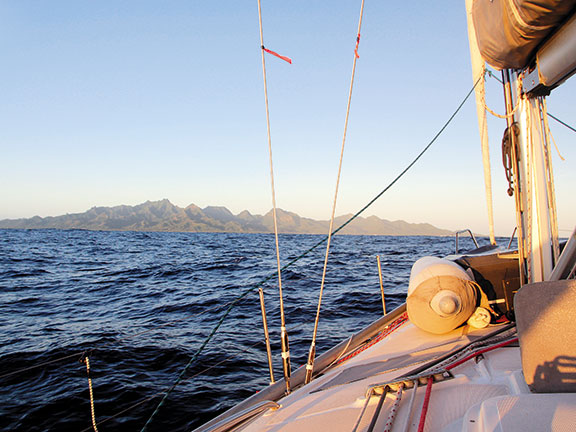
Like Tahiti and Moorea, Rarotonga’s mountainous peaks are often shrouded in low cloud that swirls around and mingles in the tropical valleys, and this tends to give the island a Jurassic look from seaward.
Tahiti
Their stay in Tahiti had been brief at just under a fortnight, which was long enough because the main island has little in itself to offer cruising yachts. Recent changes had made it almost a chore to berth in the inner harbour at the foot of the town.
Five years earlier this had been the place to be, and yachts simply dropped an anchor and backed down onto the town seawall. Getting on and off the yacht was easy and the delights of the town unfolded like a tablecloth. These days you’re required to lie with your stern tied to one of several large steel barges that are so high off the water it’s almost physically impossible to get on and off your yacht unless you’re equipped with a large plank to bridge the gap. This is not something cruisers routinely carry and there’s nothing provided for this purpose. The Tahiti harbour master conceded it was not an ideal arrangement and said visiting yacht numbers had dwindled to such a level that the berthage fees generated were insufficient to maintain the facility.
This only left Taina Marina further around the island, but this was not user-friendly either and was prohibitive, so the only remaining option for yachts was to anchor off the marina in the lagoon or to pick up a mooring buoy for $5 a day. It was a pleasant enough spot with the island of Moorea 10 miles distant, but it was a 30-minute taxi ride back into town or a 40-minute bus ride if you could find a bus and were then lucky enough to be picked up.
Island in turmoil
The charm of Tahiti for cruisers has always been the island of Moorea and the Society Islands, Huahine, Raitia, Tahaa and of course Bora Bora, the jewel of the South Pacific. The Society Islands lie roughly 120 miles due west of Tahiti and provide delightful cruising with sheltered lagoons and tropical bars and restaurants built over the water, which are expert at parting sailors from their cruising funds.
But as for Tahiti proper, it was something of an island in turmoil. The political situation continued to be unstable with ongoing agitation for autonomy from France, yet the French colonials showed no willingness to even consider the prospect. The gap between the colonial haves and the indigenous Tahitians appeared to be widening, and this was now clearly visible with growing signs of poverty and discord. For the first time, Steve felt apprehensive walking about town after dark.
But the French influence had its delights, none more so than fresh baguettes and croissants, espresso coffee, quality red wines and of course the French language, which could make for a challenging time.
The starving flea-ridden dogs, rubbish blowing in the streets, failing infrastructure and obvious tensions, however, had taken some of the shine off what was once a top holiday destination.
Moving on
With work commitments back home looming, their schedule did not allow them to pass through the Societys this time and they sailed direct for Rarotonga. The anticipation of being in a country where English is the primary language and an abacus is not required to determine the value of the Kiwi dollar was appealing. There was also the occasion of a family wedding on Rarotonga and a rendezvous with Steve’s partner Cherie and her extended family to look forward to if they pressed on and made good time.
They arrived two days before the nuptials and 18 hours before the tropical low, which put paid to the couple’s plans for a romantic beach wedding. The wind buffeted the coconut trees and heavy, squally showers washed across the island, but not even this was going to dampen the spirits of the wedding guests who had flown in for the occasion.
Among these were Cherie’s three teenage sons who had, in the time Steve had known them, been something of a magnet for police attention, whether warranted or not. Excitable boys and Rarotonga had the potential to be a volatile mix and the outcome was always going to be interesting.
The boys didn’t let the side down but neither did they end up in jail, the worst being a moderate fine for a traffic violation and a late night ride home by the local constabulary for their own protection. Nevertheless, the relief on their mother’s face was palpable when all three boarded the plane for home.
At a moment’s notice
They spent their days in Rarotonga sampling the hospitality of the many resorts scattered around the island and keeping a weather eye out for rampaging All Blacks running amok at the waterfront bars.
Rarotonga has a special charm and the island residents are friendly and warm. It is not, however, a recommended destination for cruising yachts and the local harbour board showed no signs of encouraging them. Aside from the lack of berthing options and the exposed harbour, there were no facilities for yachts or their crews. There were no anchorages or navigable passes through the outer reef to speak of. Yachts had to be ready to leave at a moment’s notice and this could be quite stressful.
For all of that, Rarotonga’s fees schedule for visiting boats was the highest Steve had struck anywhere. That merciless seawall cost $2.30 per metre of boat length per day. Then there was the $55 departure tax for each crew and the $55 customs charge for accepting the paperwork. All up a cost of $400 for a seven-day visit. His advice: catch a plane.
Next stop was Vava’u, Tonga, a distance of just over 800 nautical miles, and after a week of too much wind it looked like they were in for a period of light easterlies. It was raining again, and the majestic mountains were lost in the drizzle.
The challenge now would be shaking off the harbour seabed from the three anchors that had served them so faithfully.
This is the end of Part 6. Next: Vava’u, Tonga, and the final passage south to New Zealand.