Naval architect Juan Kouyoumdjian, unattached to any team this cycle, explains why the modern AC75 hull is built to serve the sails rather than cut through water.
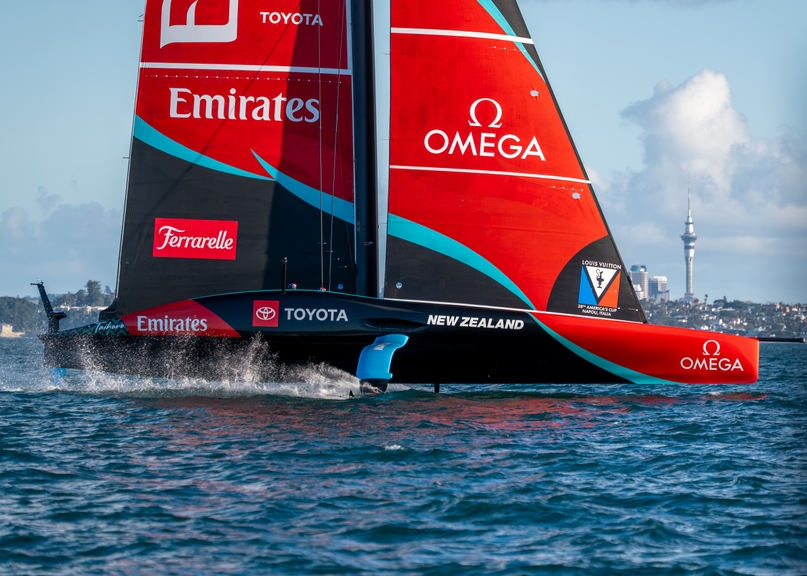
For most of the America’s Cup’s history, a hull was a hull, shaped to move water out of the way as efficiently as possible. That thinking no longer holds. According to naval architect Juan Kouyoumdjian, who has worked on six America’s Cup design campaigns and is currently unattached to any team ahead of Naples 2027, the AC75 hull has effectively become a fuselage, a structure shaped less to part water and more to feed clean air to the sail plan above it.
Speaking candidly on the official Inside America’s Cup interview series with host Niall Myant-Best, a freedom he has precisely because he isn’t contracted to a syndicate this cycle, Kouyoumdjian laid out why hull shape now sits in service of aerodynamics rather than the reverse. With the boats lighter under this cycle’s reused-hull rules and consequently flying on their foils almost continuously, the old hydrodynamic priorities have given way to something closer to aircraft design: managing the gap between sail plan and water, and shaping the deck and topsides to keep the airflow attached and efficient.
New Zealand and Alinghi, he said, share a useful design feature, a bustle extension at the stern that houses the rudder’s upper bearing, one he expects to pay off. Alinghi’s distinctive high-sided cockpit, originally built to accommodate eight crew, may turn into an unexpected asset now the class has moved to a five-sailor crew with a separate guest racer position, since the wetted surface penalty matters less when the boat spends most of its time airborne. American Magic’s hull, designed around a recumbent cyclor arrangement no longer used under the current rule, may benefit most of the fleet from that change, in his estimation, though he was careful to add that no single hull advantage decides a Match on its own. Britain’s boat, by contrast, drew the mildest criticism, a hull he suggested may have been built to sail at too high an angle for the conditions it will actually meet.

The more consequential battleground, he argued, sits in the foils. The rule holds maximum foil span roughly steady even as boats have shed weight, which pushes designers toward thinner, higher aspect ratio foils operating closer to the point of structural failure. How those foils deform under load, he said, is now as important as their shape, and a defining factor of this design cycle. He also flagged newly worded rule language that separates a “rotating surface” from a “deformed surface” on a foil, phrasing he expects more than one team is currently testing the edges of.
None of this technical latitude extends to the boat thinking for itself. The AC75 Class Rule is deliberately written to stop yacht-state data, wind angle, heel, boat speed, from closing an autonomous control loop; a sailor still has to be the one making the sailing decision, even as software manages a genuinely complex chain of onboard systems downstream of that human input. Kouyoumdjian’s own view is that the sport’s real skill gap now lives in how well a crew’s manoeuvre logic, tacks and gybes rather than straight-line speed, has been refined, and in how consistently sailors can execute demanding techniques like a high-exit tack, which he says needs an entirely different sail trim for the first several seconds out of the turn.
Boating NZ readers may already know Kouyoumdjian’s name outside the Cup: his studio did the hull optimisation on the Omikron OT-60, a long-range motoryacht reviewed in these pages, work that sits well beyond raceboats in serious cruising design.

Asked about crew layout under the new five-sailor structure, he said he favours the trimmer-forward, helm-aft arrangement New Zealand and France ran last cycle, arguing it suits how an AC75 is actually flown, by eye, on the relationship between the boat and its leeward foil, rather than by numbers on a screen.
His closing assessment carried the weight of decades in the sport. No single piece of technology, hull, foil or software, will decide Naples on its own. What will, he believes, is which team masters the smallest, most repeatable details most consistently. The full conversation is available on the Inside America’s Cup series on YouTube.
References:
Inside America’s Cup — “The Design Secrets America’s Cup Teams Can’t Share,” interview with Juan Kouyoumdjian, hosted by Niall Myant-Best. https://www.youtube.com/watch?v=4fXb75MC6qA
AC75 Class Rule V3.01, America’s Cup Partnership, 9 September 2025 (used to verify crew structure and control-system provisions). https://www.americascup.com/files/m26296_2025-09-09-AC75-Class-Rule-V301.pdf