A strengthening bevel at the base of one boat’s side pocket was enough to stop a rod rack seating as low as it should. Manly maker Ultimate Rod Racks redesigned its frame around it. Here’s what to check on your own boat.
From the cockpit, a side pocket looks like a simple shelf with a lip on the front. Look down inside it, though, and you may find a strengthening bevel, a rib or a stepped face. Any of them can stop a hook-over rod rack sitting where it should, and a frame that doesn’t seat properly can shift and rattle once the boat is moving. As Rhys Fell puts it, “Even small misfits can become noticeable once you’re underway.”
Fell’s Manly business, Ultimate Rod Racks, found exactly that while testing on one well-known range of aluminium boats. The bevel at the base of the gunnel pocket stopped its original 20mm Hybrid backframe from seating as low as possible, so the company redesigned it as a 34mm frame that sits lower and fits more firmly.
What the rack has to fit
The bevel is only one of several things that vary from boat to boat. A hook-over rack hangs from the front lip of the side pocket, sometimes called a parcel tray, and that lip, or upstand, differs in both thickness and height. The pocket itself may sit high or low above the deck, and its face may be vertical, stepped or angled.

Height catches people out as often as thickness. On one New Zealand-built range, Ultimate Rod Racks says many pocket upstands are under about 50mm high, so its rack for those boats comes with a stabiliser support bracket to keep it level.
Rethinking the frame
Differences like these pushed Ultimate Rod Racks away from a one-size frame. When the company started out, its racks used fixed spacing and set mounting positions, designed to suit a range of popular boat brands. After supplying hundreds of systems, Fell wrote in January, it became clear that “boats may look similar, but their layouts, gunnels, and use cases often differ in meaningful ways.” Beam, gunnel height, side profile and fishing style all affected how a rack should sit.
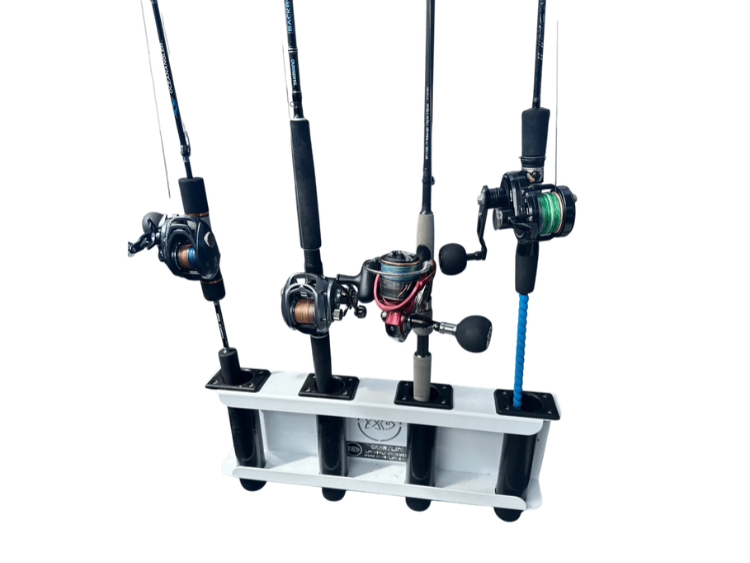
Over four series of racks, the company refined the spacing, mounting depth and alignment. Rather than one frame for every boat, it now matches interchangeable backframes and brackets to the hull, a modular system it calls GunnelCore. The Hybrid frame suits vertical or stepped pockets. The lower-profile SLR frame suits angled or shallow ones, and on some boat models it pairs with an angled bracket that sets the rack’s working angle.
Fell is just as wary of going fully custom. Custom racks can solve the fit problem, he writes, but they usually mean higher costs, longer lead times and less flexibility. “Universal racks aim to suit everything, which often means compromise,” he says. His answer is to configure racks from known measurements and proven setups rather than build each one to order.

In practice, buyers pick their boat on the company’s Shop by Boat page and enter the exact model at checkout, and the rack is set up for that boat before it’s sent out. If a rack needs adjusting once it’s fitted, Fell says the company will help with padding, spacing or alignment, and every system comes with a satisfaction guarantee.
The racks stay removable, and the company says most installations use the existing pockets without drilling. Because the system is modular, the backframe can in many cases be changed to suit a different boat. “Your boat stays original, while your rod storage evolves with your needs,” Fell writes.
What to measure before you buy
Whichever rack you’re considering, the same measurements apply. Start with the pocket’s front lip, then work through the rest:
- Lip thickness and height. This is the upstand the rack hooks over.
- Pocket height above the deck. This decides where the rack, and the rods in it, will end up.
- Pocket angle and obstructions. Note whether the face is vertical, stepped or angled, and look for any bevel, rib or fitting where the frame needs to seat.
- Reel clearance. Try your biggest reel in the rack and check that it clears both the hull and the next outfit.
Ultimate Rod Racks builds its racks with either 100mm or 150mm rod centres, so there’s room to match the spacing to your reels. For bigger outfits, the wider spacing or an empty slot between rods gives each reel extra room. Hull clearance depends on the shape of your boat’s side, which is why it’s worth trying your biggest reel in place.
Holding the rods, not just the rack
Even a rack that fits the pocket snugly can leave long rods room to whip around. In The Catch: Spare the rod, Boating NZ’s Mark Kitteridge wrote that trailer boats and inflatables “often struggle for safe rod storage”. He rated parallel racks along the cockpit sides highly for keeping rods out of the way, but warned that long rods flex and whip into their neighbours in rough weather. On one trip he lost five of eight rods that way. His advice is to leave wider gaps, stagger short and long rods, and keep the tips of the longest rods towards the transom.
Ultimate Rod Racks builds for exactly that kind of spacing. Across its Core Series boat rod racks, the 5 XL sets rods 150mm apart, giving neighbouring outfits more room than the 100mm centres on the standard five-rod rack. Its PVC holders keep rods off bare aluminium, and Fell says the company’s Rod Protection & Stabilisation System takes up play inside the holder, reducing rattle and reel movement underway.
If your boat isn’t on the Shop by Boat list, or it has been modified, the company invites owners to send the boat model or a couple of photos. From there, it works out which frame and brackets suit your pocket, and has the rack set up for your boat before it’s sent out.