


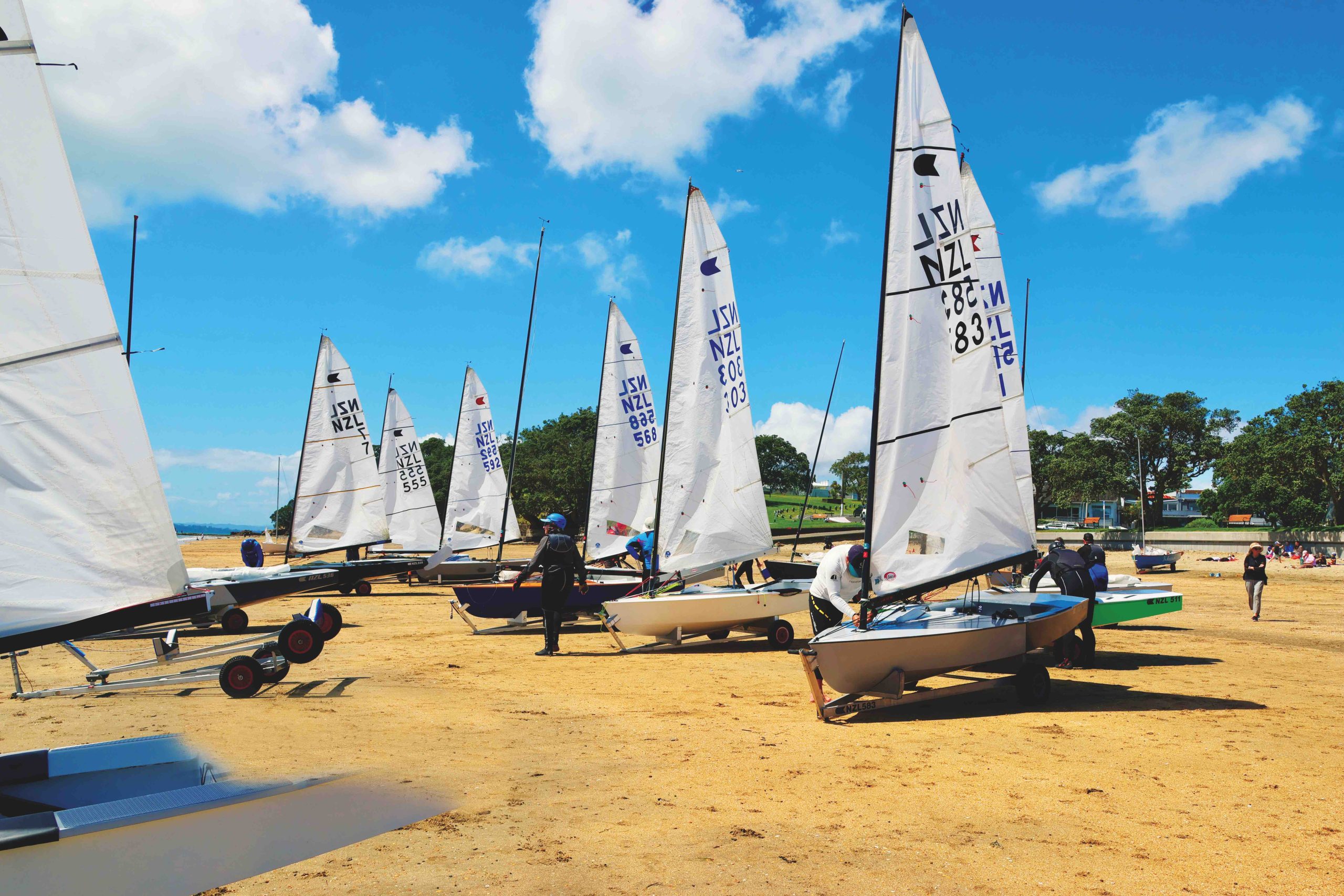
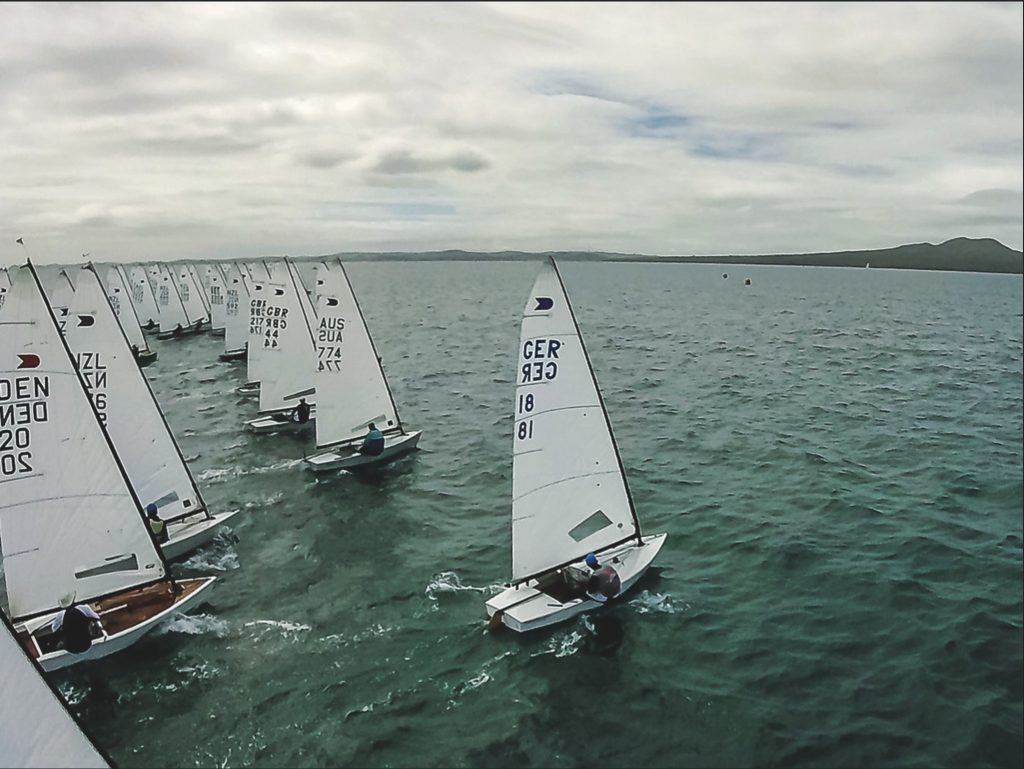
For nearly 70 years, the OK Dinghy has been one of this country’s most popular international classes. New Zealand sailors have an enviable track record in the class – since 1973 our sailors have won the World OK Championship 13 times. This is the story of the OK dinghy in New Zealand.
Danish boatbuilder/designer, the late Knud Olsen (1919 – 2010) designed what would become the OK in 1956. The commission for an inexpensive, lightweight, plywood planing dinghy, came from Danish architect, the late Axel Damgaard Olsen.
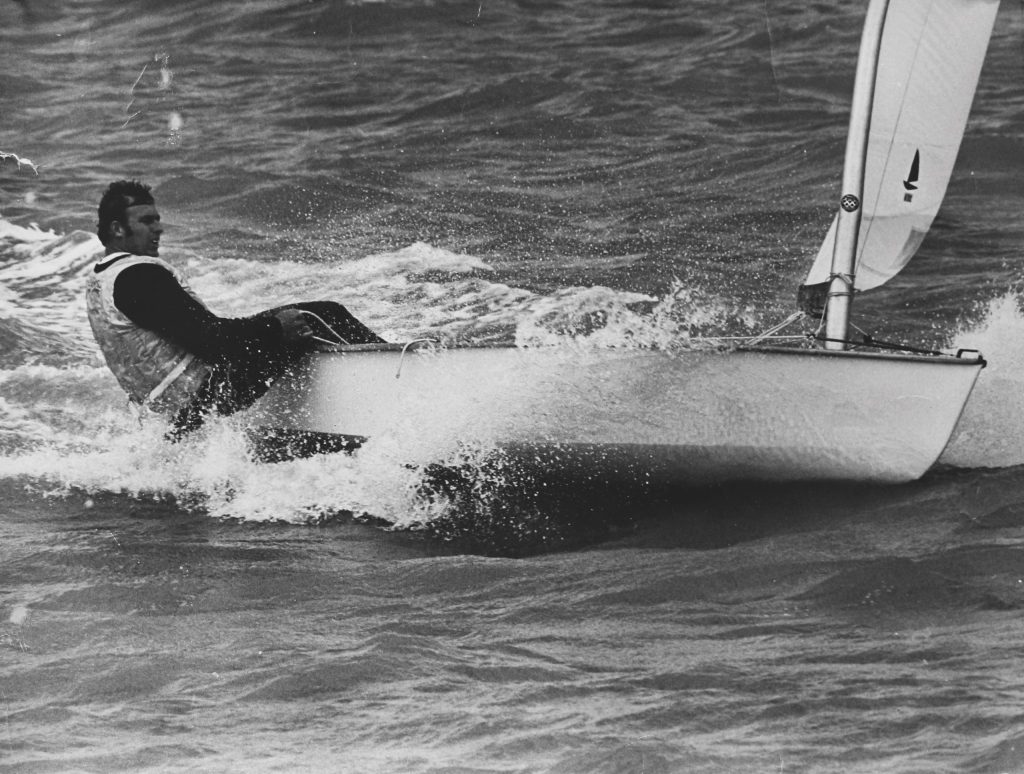
The OK’s great sailing characteristics quickly made it a popular choice in Denmark, Sweden, the USA and, eventually, around the world. Early on, it was realised the OK was the perfect trainer for the Olympic Finn Class, boosting its popularity.
The first two OKs in this country were built in Christchurch by the Oliver brothers in 1961. The Auckland fleet was kickstarted in 1962 by the late Jack Douglas of the Pt. Chevalier Sailing Club, who organised a group of parents to build 17 OKs in several batches under the Pasadena School Hall in Pt. Chevalier.

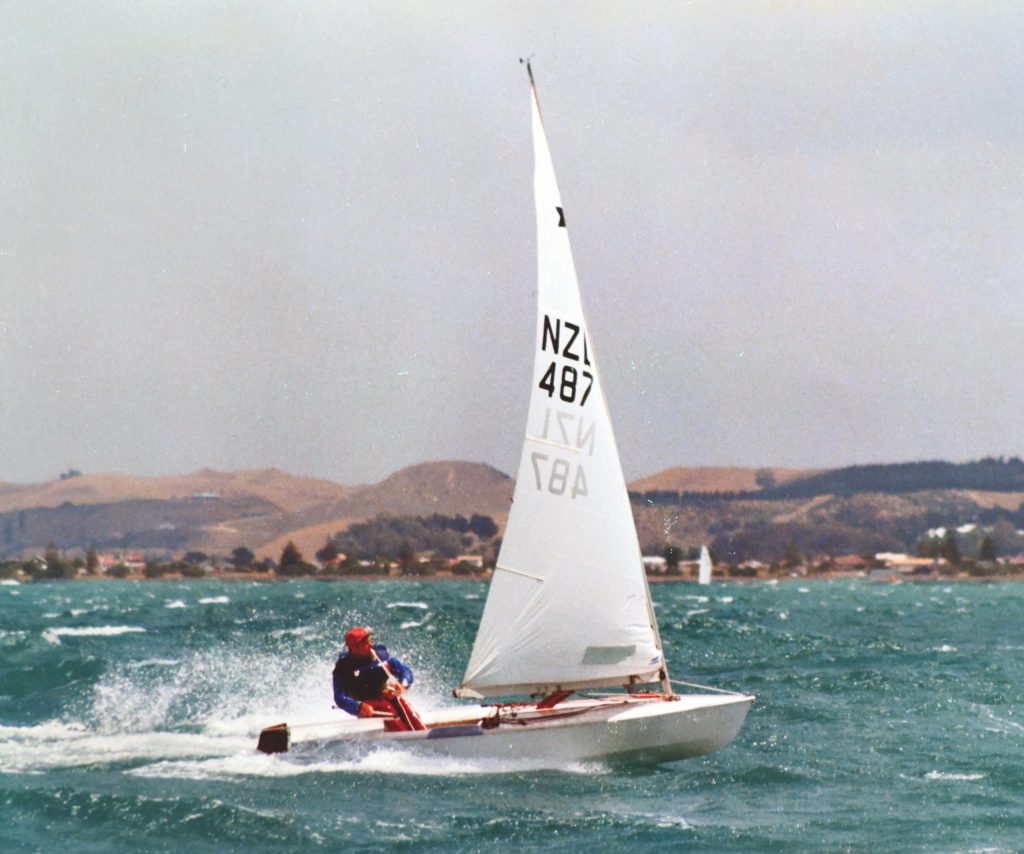
Dave Blundell, who would later build the Davidson 28 and 35 keelers, had one of those first 17 OKs. In 1966 Blundell entered the Australian National OK Championship which, to his amazement, he won.
Retired marine surveyor Mike Menzies was another of those early Auckland OK sailors. He travelled to Canada for the 1967 OK Dinghy Worlds, and three years later came 10th at the 1970 Worlds off Takapuna.
However, it was the late Clive Roberts (1941-1975) who really put the OK on the map and he dominated the class here for many years. Clive had followed his elder brother, the late Ralph Roberts (1935–2023), into the Finn Class in 1960. Despite winning both North Island and Auckland Finn Championships, Clive was too light for the Finn in a breeze and in 1963, he switched to the OK.
In 1964 Ralph and Clive sailed in their first National OK Championships off Kohimarama, with Clive winning and Ralph second. Clive competed in the OK Worlds several times – 1967 (11th place), 1968 (24th), and 1970 (5th), before winning it in 1973. This was the first time an OK Worlds had been won by a non-European sailor.
While Clive only finished sixth at the 1974 OK Worlds, in 1975 he won both the New Zealand Finn and OK National Championships double. In all, Clive won 10 New Zealand OK Championships, with eight of them won consecutively. In 1973 he was elected President of the OK International Association, and in 1975, was awarded New Zealand Yachtsman of the Year. Tragically he was killed in a freak car accident on 10th May, 1975. His widow Bev made a huge contribution off the water to the OK class for many years.
Another well-known OK sailor from early 1970s was the late Graeme Woodroff (1945–2024). Woodroff finished second in the 1972 OK Worlds in France, and third at the 1974 OK Worlds in Australia, which many feel he could have won.
The late Peter Lester (1954–2025) was another successful OK sailor in the mid 1970s. Born in Christchurch, Lester won the Under-19 OK Nationals in 1974, which qualified him for the OK Worlds in Adelaide, where he finished top junior and a credible eighth overall.
The next year Lester came second in the OK Worlds in Finland, and after moving to Auckland in 1976, a year later won the OK Worlds in Takapuna. This was only the second monotype World title won by a New Zealand sailor.
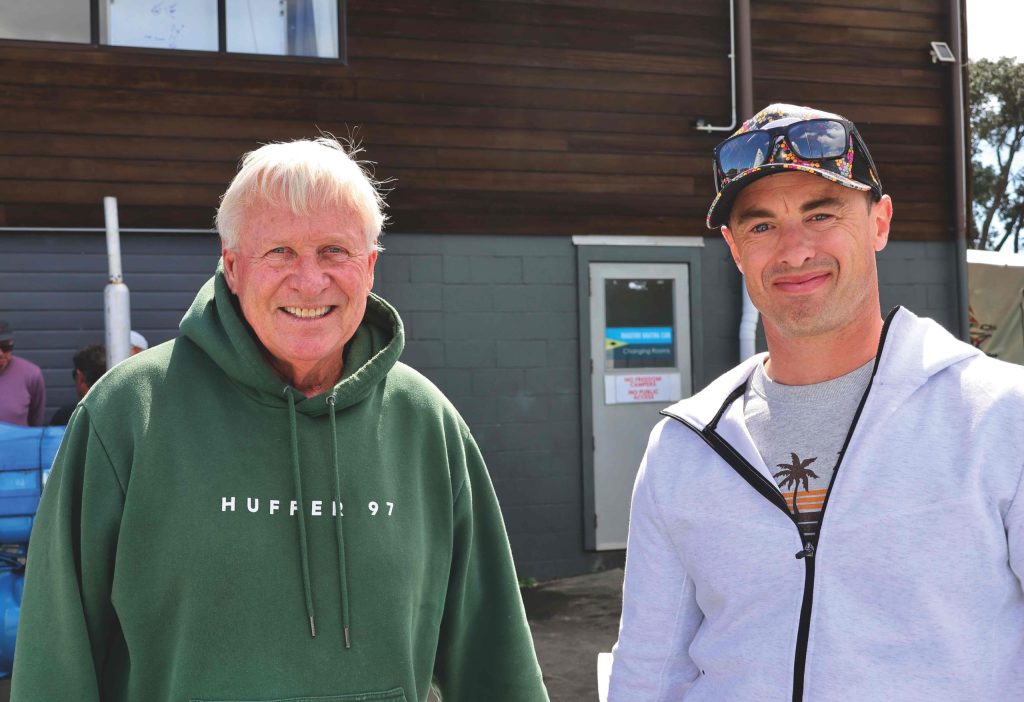
Tom Dobson was another who came into the OK Class via the P Class. One of his first OK regattas was the 1977 OK Worlds, and the following year he came sixth in the 1978 Worlds in Holland. He won National and Interdominion titles during his two years in the OK.
‘Winning four OK Golds is akin to winning four Olympic Golds. You make your own luck at this level.’
His brother Richard, was even more successful in the OK, winning the OK Worlds twice, 1979 and 1982.
Leith Armit, whose father Tony sailed around the world in Marco Polo, has the best track record of any New Zealand OK sailor. Armit went straight from the P Class into OK. He competed in his first OK Worlds in 1977 off Takapuna, then the following year finished second in Worlds in Holland. From here on he was nigh unbeatable; winning four World OK Championships, 1983, 1985, 1990 and 1994, six New Zealand National Championships, and three Interdominion titles.
Impressively, Armit achieved all this as an amateur while holding down a full time boatbuilding job. No surprise, in 1985, Armit was awarded New Zealand Yachting’s Yachtsman of the Year Award. Armit’s notoriously modest, playing his achievements down with comments such as, “Well, I got a few lucky breaks.”
Yeah right. Winning four OK Worlds is akin to winning four Olympic Golds. You make your own luck at this level.
Others were more effusive, pointing to Armit’s disciplined training, impeccable boat handling, ability to shift gears on the trot and technical knowledge. For the record, Armit’s four World OK titles have been equalled by one sailor, Bo-Steffan Andersson (Sweden), and exceeded by one, Nick Craig (UK), who has five OK World titles.
Sailmaker Greg Wilcox started racing OKs in 1979, and won the OK Worlds in Napier in 2002. Consistently ranked among the best in the world, he has finished in the top 10 at the OK Worlds 22 times.
“It’s the friendships that keep me in the class, plus they’re just a great boat to sail,” he said, comments echoed by most OK sailors.
Wilcox now resides in Germany, where he co-owns Turtle Sails, one of the three most popular OK sailmakers, the other two being Norths and Greens.
Engineer Karl Purdie came up through P, Lasers and 470s, before switching to the OK in 2003. One of the big attractions to the OK dinghy for him is the high standard of local competition. Purdie has competed at the OK Worlds five times, finishing fifth, third, second and two wins, in 2008 and 2010. He was also ranked #1 OK sailor in the World for three years straight, a difficult task when based in New Zealand.
Americas Cup sailor Rod Davis, who coaches the TP52 Alegre team, has been a passionate OK sailor for 13 years now.
“I love the OK. Unlike the other racing I’m involved with, which is committee based, if I want to change something or buy a new sail, I just do it.”
Davis has set up his OK meticulously and, thanks to his America’s Cup experiences, spends considerable time off the water dreaming up incremental improvements. Does it work? At the recent OK Worlds at Lake Garda, he finished first in the Grand Master Division for those aged 70-plus.
Two other New Zealanders have won OK Worlds, Matt Stechmann in 2014, and the most recent, Dan Slater in 2019 in Auckland. Incidentially, taking out third place at the 2019 Worlds was Leith Armit’s son, Josh, who has recently joined Team New Zealand. A chip off the old block, eh?
Behind the scenes, a lot of work has gone into keeping the nigh-on-70-year-old class popular and relevant. The depth of experience within the class is impressive.
For example, Russell Page-Wood is the current NZODA Class measurer.
He has a 30-year involvement in the class and has been ranked in the top 10 worldwide several times. Even after this time he remains as remains passionate about the class.
“One of the neat things about the class is we all help each other out to go faster and raise the bar. It’s awesome.”
Another was boatbuilder, designer, trainer and technical advisor, the late Alf Lock (1929–2011). Besides designing a measuring jig the help maintain the OK as a tightly restricted class, Lock also designed the OK Icebreaker hull, which while still measuring within class rules, had a finer entry and flatter aft sections. The Icebreaker hull was built here from plywood and GRP for many years, and is still highly regarded worldwide.
Current New Zealand OK Dinghy Association (NZOKDA) President, Steve McDowell, has been involved with the OK class for over 23 years and, at the time of writing, had just returned from the 2025 OK Worlds in Lake Garda, Italy.
“We had 16 Kiwi boats out of a total of over 200. They had three fleets of around 70 boats each.”
McDowell believes the hardest things for Kiwis to master when competing at the OK Worlds, is learning to race in big fleets. A good start is critical; if caught in the pack it’s very hard to break free.
Like the other Kiwi OK sailors, McDowell is looking forward to the 2029 Worlds, which will be held in Napier.
“We always find when the Worlds are held here that there’s a big jump in numbers and there’s plenty of equipment locally.”
McDowell reports there are 80 active NZOKA members, with active fleets in Auckland, Napier and Wellington, with the South Island OK sailors currently rebuilding their fleet.
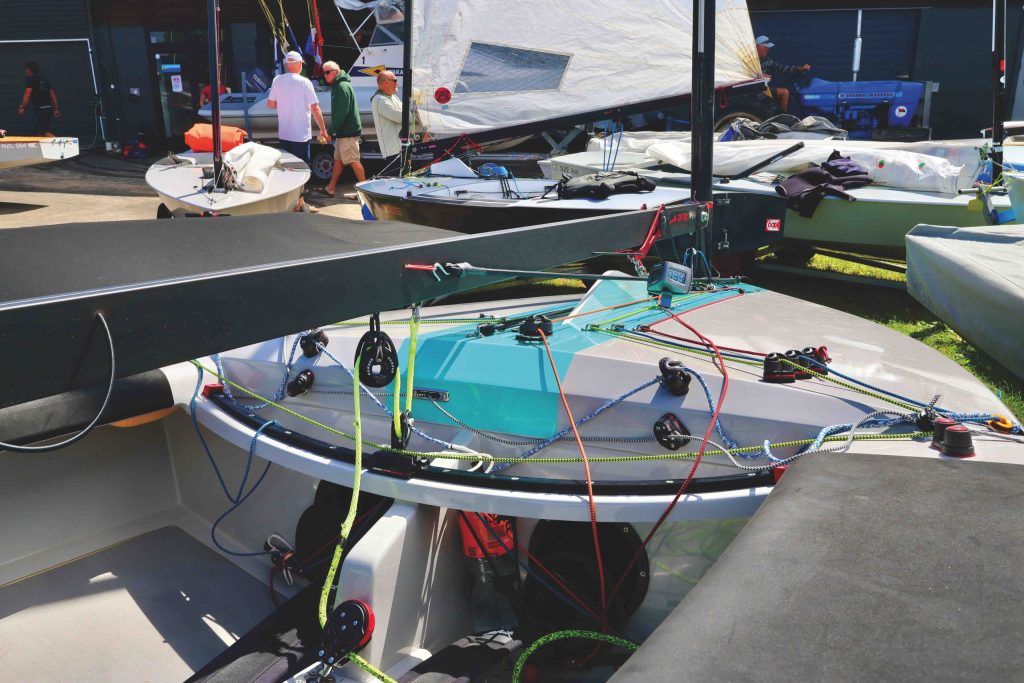
While the OK is one design, there are just enough tolerances with the measurements to tweak the hull shape to personal preferences. The minimum hull weight is 72kg, which means the boats are solidly built and consequently have a healthy lifespan.
Building a plywood OK has always been straightforward, and thanks to CNC-cut plywood kitsets, epoxy resins and fibreglass, nowadays it’s even easier.
In 2012, a group of OK sailors including McDowell, Luke O’Connell, and Stechmann, teamed up with boatbuilder and naval architect Dan Leech to develop CNC plywood kitset OKs, which proved popular in this country and helped revitalise the class. The Leech hull is competitive; Slater won the 2019 Worlds with one.
However, factory finished GRP boats are the most popular way to get a modern OK. The most popular OK builders, Ovington Boats and Synergy Marine, are both in the UK, with other specialist builders scattered around the world.
However, a GRP OK is hardly inexpensive. For example, UK-based Ovington supplies GRP OK dinghies to the minimum weight for $19,700 (hull only) through to complete boats for $41,000. Shipping and GST are additional. The least expensive option for a newcomer to get into an OK would be a good secondhand example, costing around $10,000.
The key to an OK’s performance is its unstayed mast, specifically the flexibility, which must be carefully matched to the sailors weight and sail shape. Originally OK masts were timber, lovingly hand-planed to suit the sailors weight.
Aluminium masts became popular during the late 1970s, however these were harder to adjust. The advent of carbon masts in around 2004 has given new life to the OK class. Carbon masts allow a much greater range of body weights to be competitive across a wider range of conditions. Carbon masts for the OK are built here in New Zealand by CTECH, and also in Europe.
As well as winning 13 OK World Championships, New Zealanders Clive Roberts, Armit, Wilcox, Lock and Alistair Deaves are listed in the OK World of Fame, which acknowledges those who have contributed to the class, on or off the water.
Besides the OK World winners, the numbers of Kiwi OK sailors who have gone on to bigger and better things after earning their spurs in the OK is beyond counting. Master the OK and you’ll likely be welcome anywhere in yacht racing circles.
Long may the deceptively simple yet eminently rewarding OK dinghy continue to weave its magic in New Zealand. BNZ
Why we sail the OK
The enthusiastic group of OK sailors recently interviewed at Wakatere Boating Club were more than capable of talking the hind legs off a donkey about the OK and why they sail them. The following is an extremely brief summary of their enthusiastic comments;
“Fun and exciting to sail”.
“I love sailing and the OK is so responsive.”
“Tweaky in a good way.”
“Fast and exciting.”
“So much you can do to go faster.”
“Very rewarding to sail.”
“Lots of fun.”
“Meeting a whole heap of new people.”
“Racing against my mates.”
“Awesome boat to sail.”
“No need for crew.”
“Suits my body weight.”
“We help each other improve.”
“If you can win in New Zealand, you’ll be competitive overseas.”
“The international competition.”
“Love the hard chine.”
“Keeps me fit.”

Summer of 75 i had OK 438 Clive’s last wooden masted boat. I stropped it and gave it 7 coats of rescue orange two pot and 7 coats od speed wax finely rubbed down. A new adjust able mast seat and scored some great sails North for light and Hood for heavy I sailed from RNZNSC at North Head. Loved it… alas went to sea with naby and sold it to Terry Gillespie.
I was known from the wrong end of a few Ralph Roberts race committee..
Good days!
Was a young navy rating Dan Macmillan then later police regattas etc