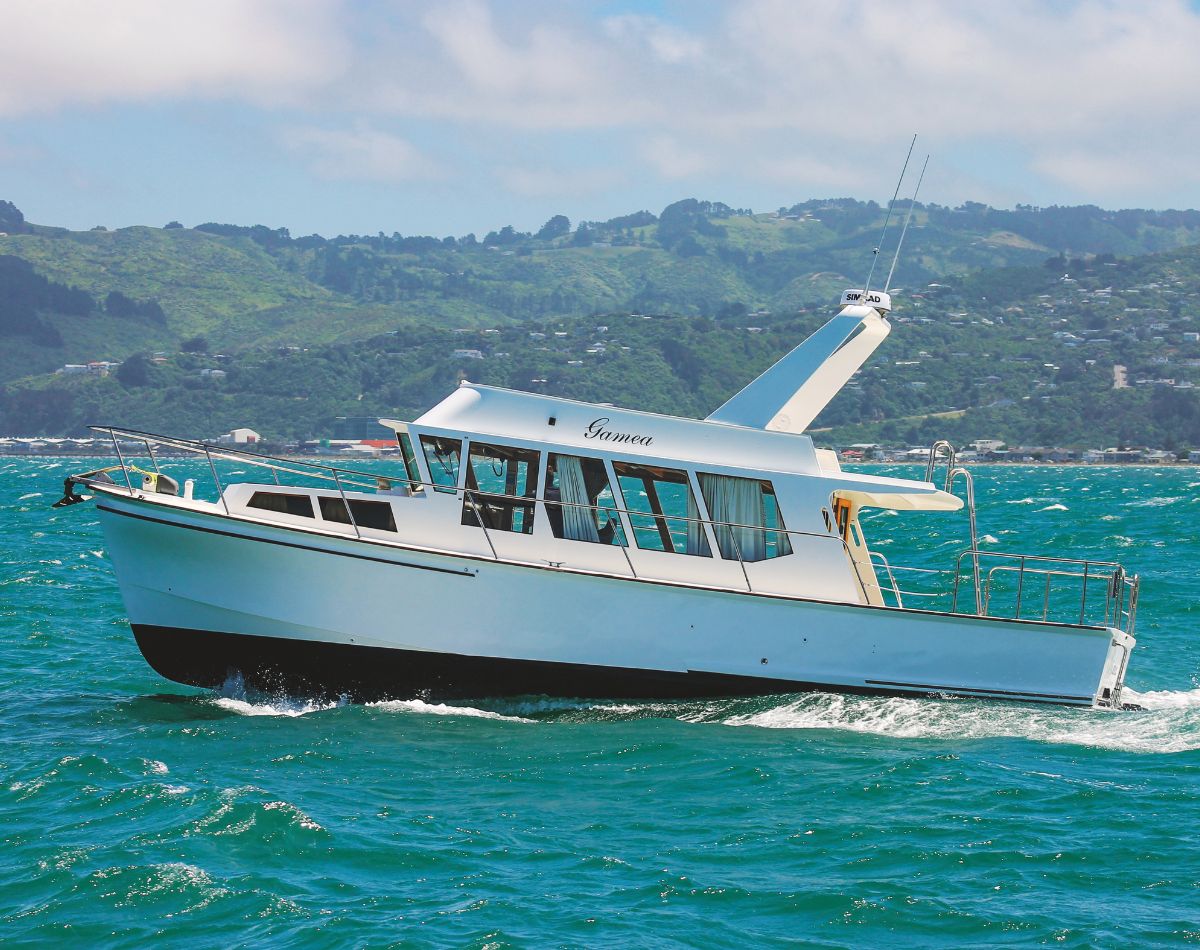
A near-derelict 1980s vintage Fi-Glass crayfishing boat has found new life as a Marlborough Sounds cruiser after a comprehensive refit and refurbishment.
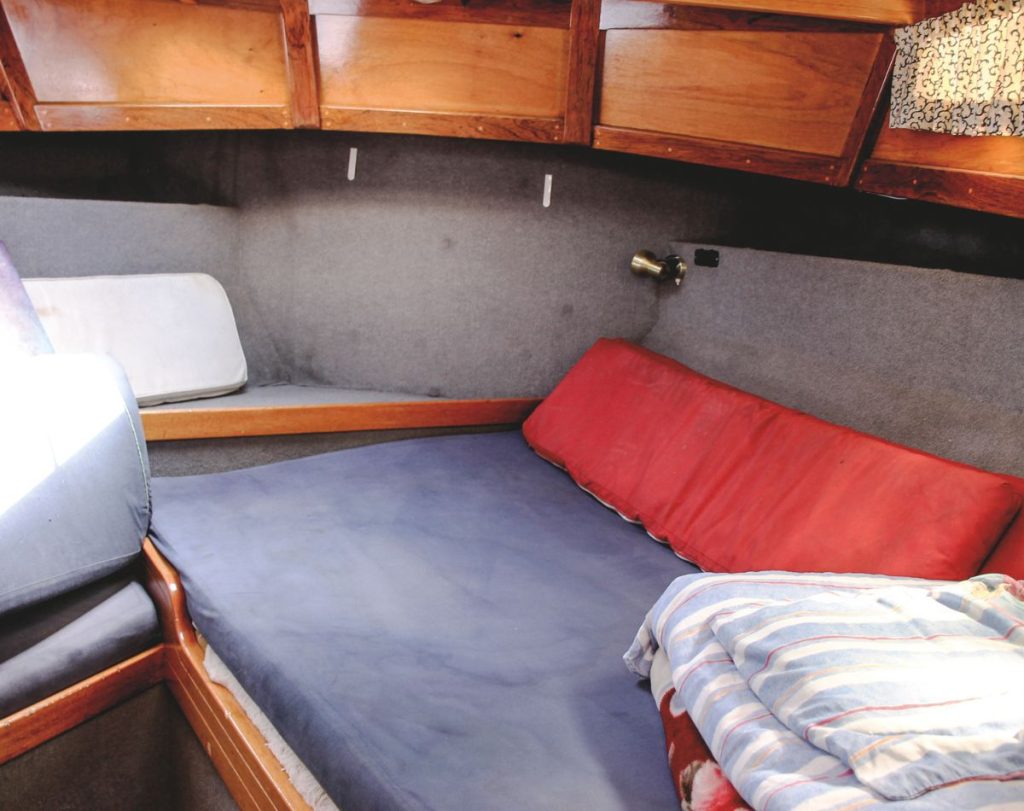
Looking for a Marlborough Sounds cruiser and fishing platform, Alan Wilkinson found it hard to ignore Gamea. A forty foot solid fibreglass hull, ample dinghy storage, large saloon with galley, dining table with comfortable seating, and helmsman’s side door. Up forward she has a double cabin with head and shower. This boat looked like she’d tick all the boxes.
Gamea was one of three cray boats built during the mid-1980s by Fi-Glass Boats in Christchurch. In 1996 her original owner took her to Carey’s Boatyard in Picton for conversion to a Marlborough Sounds cruiser. With a new timber cabin and interior, Gamea cruised the Sounds for many years, changing hands at least once before ending up at Lower Hutt’s Seaview Marina, for sale as part of a deceased estate. Alan Wilkinson spotted her on Trademe. Gamea had potential, but she was nearly derelict. Her engines were badly worn, her stern-drives were threatening to fall off, and her electronics belonged in a museum. A refit was sorely needed.
On the plus side, the interior had been kept dry. There was no sign of mildew or fungus, and the pale kauri timber framing looked as good as new. Alan thought she’d come up good. He entrusted the work to Seaview-based TS Marine, owned and operated by Travis Stoddart. The first step was to arrange a professional survey by Greg Marsden of Marsden Marine Ship Surveyors. After confirming that no major structural work was needed, the team at TS Marine got stuck in, stripping out the old machinery and worn-out equipment. “We filled two skips with surplus gear,” said Travis.


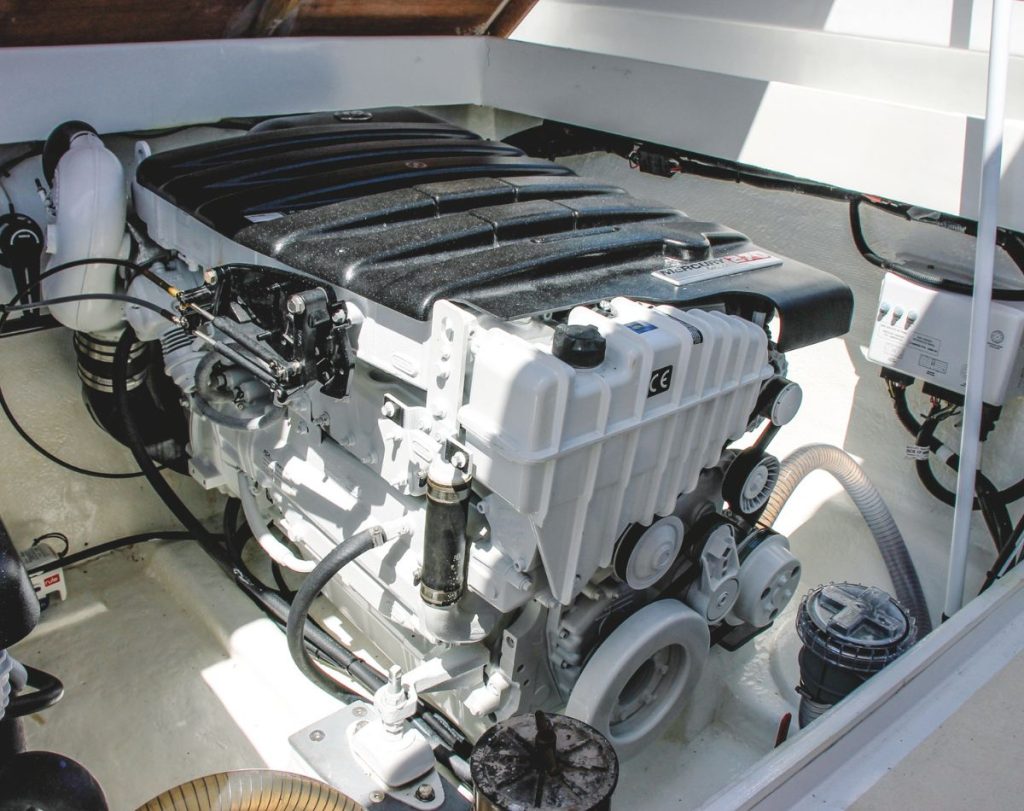
TS Marine came up with several repower options. Alan decided on a pair of Mercury 270hp six-cylinder diesels with Mercruiser Bravo III sterndrives and new hydraulic steering.
Removing the boarding platform, trim tabs, and sterndrives left two very big holes and lots of small ones. Local contractor MG Composites gave Gamea’s transom an extensive makeover, filling the holes with wood and fibreglass to provide a solid, flat surface for the sterndrives. At the forward end of the engine bay, custom-made adaptor plates connect the new engine mounts to the existing fibreglass engine beds. Far more powerful than the original 165hp Volvos, the new engines fit neatly with plenty of room for maintenance and cleaning.
The existing 400 litre fuel tanks and fuel lines looked as good as new, so they were kept, together with the twin Racor fuel filter/water separators. To retain Gamea’s period character, her original ship’s wheel has been fitted to the new hydraulic steering system.
Testing revealed that Gamea’s bow lifted too high at semi-displacement speed. A Zipwake automatic trim control system with three interceptors corrected the problem. “The middle one seems to do all the work,” said Travis. Another late addition is the Sleipnir 80kg bow thruster, with thruster tunnel installed by MG composites.

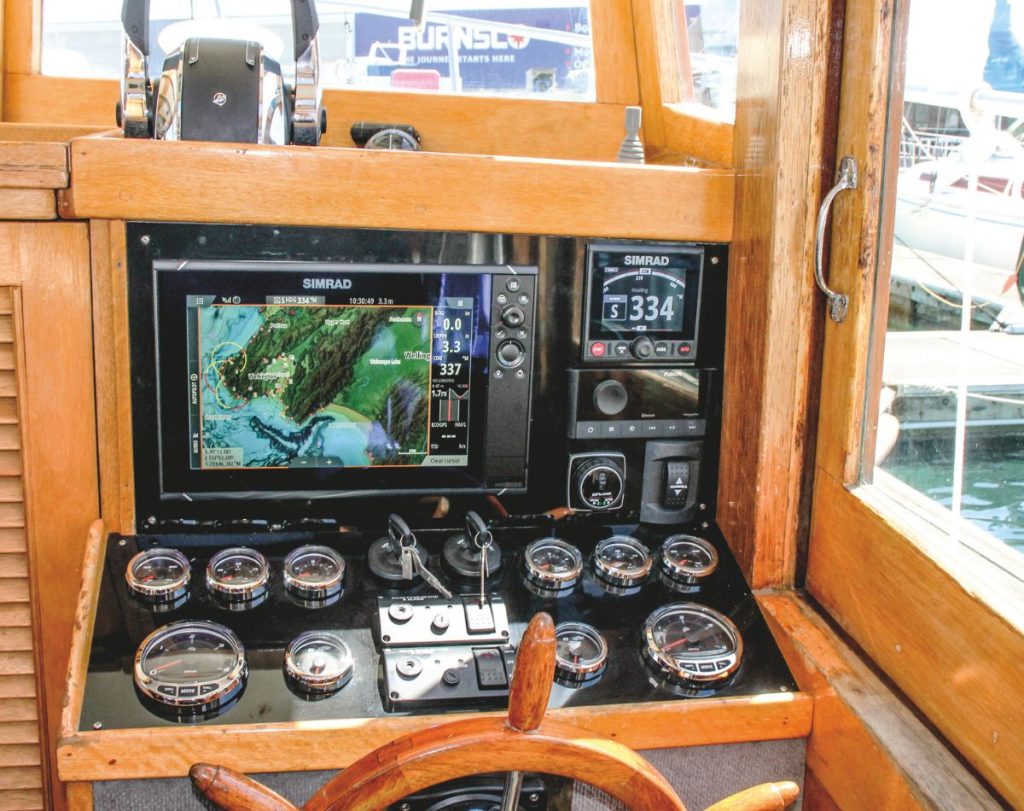
The helm station has been spruced up with new horizontal and vertical instrument panels. The horizontal panel has two sets of engine gauges. A Simrad 12 NSS EVO chart plotter & multi-function display dominates the bulkhead panel. The multi-function display integrates with the autopilot, Simrad Halo radar, and an Airmar SS175 1kW transducer. To starboard, a new Fusion sound system drives a pair of AWA speakers dating from the mid-1990s, still looking good and going strong. Also on the bulkhead panel are controllers for the autopilot, trim control system, and the Maxwell anchor winch.
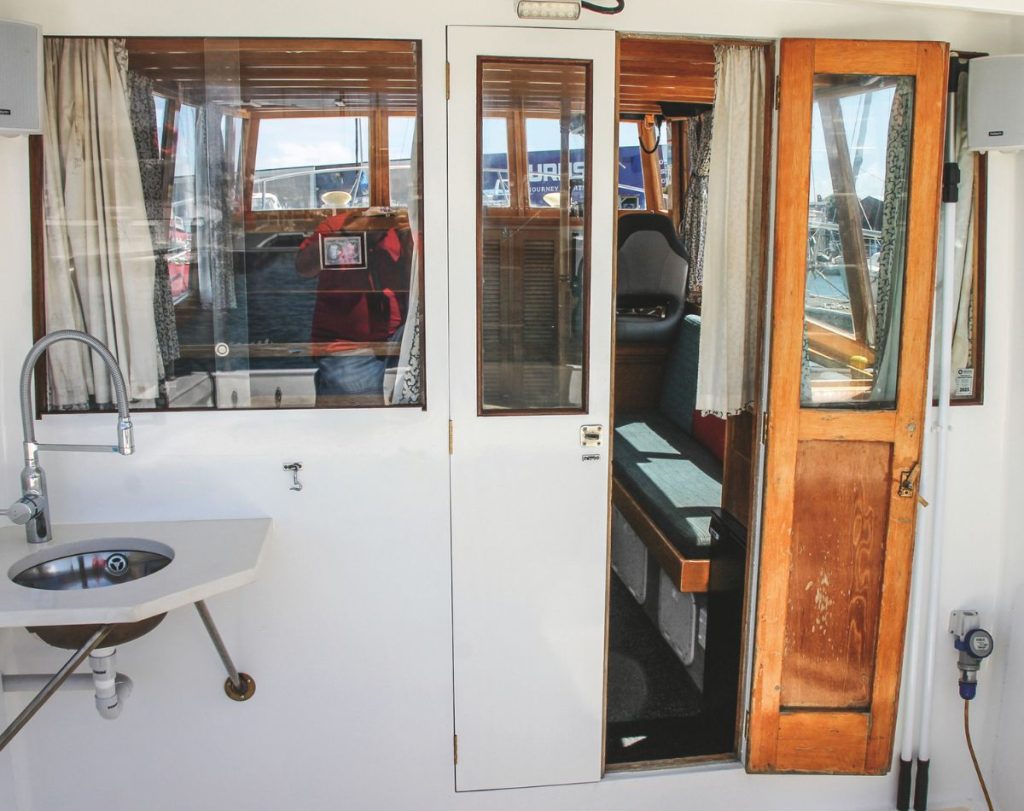
Confirming that Gamea’s interior had been kept dry, most of the house wiring and light fittings were good to go. Some switches and fuseholders needed replacing, but the switch and fuse panel retain the period look and feel. The main updates are LEDs in place of the old-school light bulbs and a new 12-volt fridge.
The all-new shore power system includes a battery charger, electric water heater, and a couple of three-pin power outlets. This boat should never be without hot water, with engine heat exchangers keeping the water hot when shore power isn’t available.
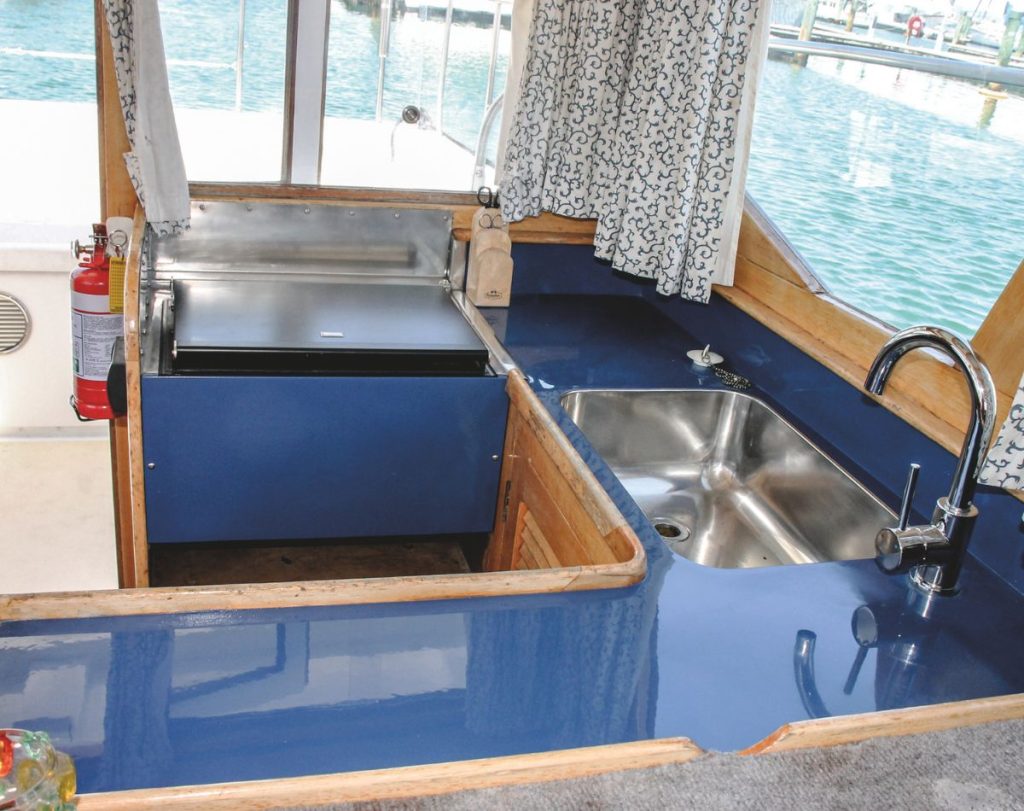
LPG got the heave-ho. Gamea’s new cooktop is a Wallas diesel-powered unit, with a heating attachment warming the saloon in cold weather. The new cooker fits neatly into the original timber surround. The galley worktop has fresh blue paint; hand-sanded, painted, with two coats of clear, it looks brand-new.
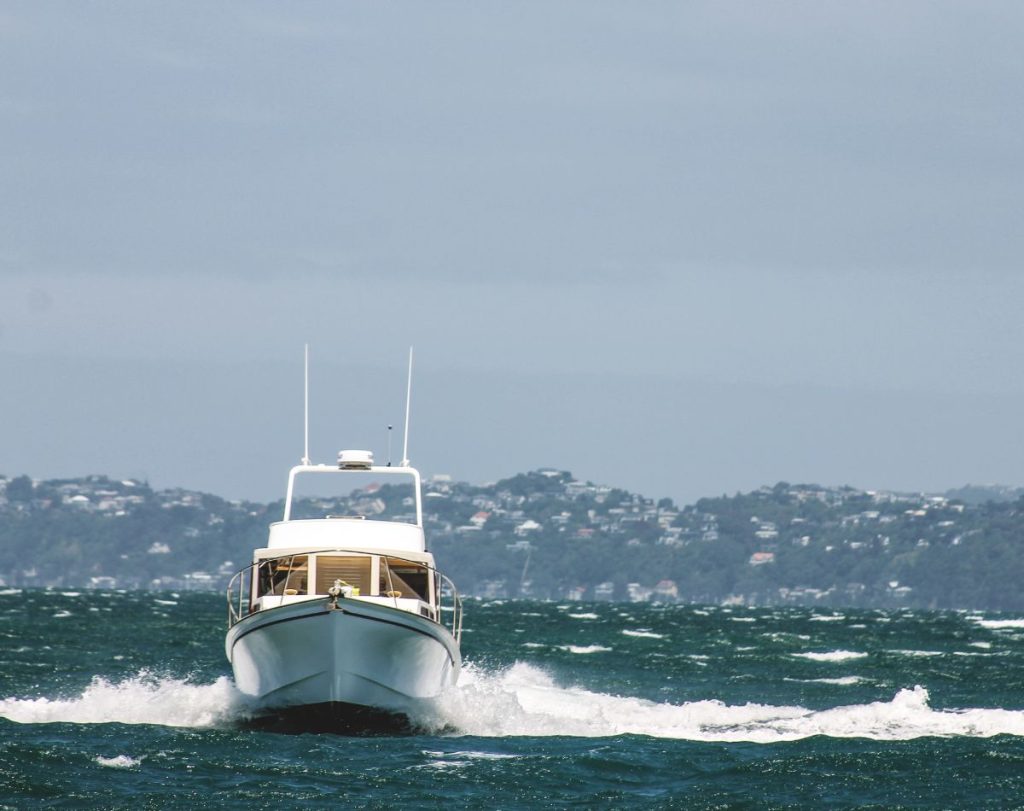
Externally Gamea looks fresh out of Carey’s Boatyard. TS Marine sanded the timber and plywood deck and cabins, repaired damaged areas, and applied traditional Picton colours: cream decks, varnished timber window trims, and white pretty-much everywhere else. They built a new radar arch, and hand-polished the stainless steel rails and other fittings back to as-new condition.
As with any boat, the to-do list is already growing. Come winter, Gamea will get a new boarding platform. New upholstery is another major item on the to-do list.
Mid-December 2025 we went out on Gamea with Travis Stoddart for a spin on Wellington Harbour. There’s not a lot of space between the sterndrives, so although they have big counter-rotating props, I wondered if throttle steering would be viable. The narrow pond just off the powerboat launching ramp at Seaview Marina is the perfect location for testing throttle steering: Only about 60m between jetty and beach. With a 15- to 20-knot southerly blowing almost directly along the channel, Gamea turned end for end in less than two boat lengths, using moderate revs with one engine ahead, and the other astern. Gamea has lots of windage but the southerly was no match for those Mercruisers. Using the bow thruster, she needs even less room: just over one boat length.

Alan chose the twin-engine setup mainly for reliability, but he’s getting a bonus: This boat will come alongside a jetty or pontoon with no hint of drama or frayed nerves, even in the wild and turbulent conditions so common in the Sounds.
Out in the harbour Gamea was comfortable and drama free. In the shallow water around Seaview the breeze kicked up a decent chop but Gamea’s bow slices through waves without banging or thumping. 3,000rpm on both engines is one of her ‘efficient sweet spots,’ giving 27 knots, burning 38 litres per engine per hour. The other sweet spot is 2,500rpm – 17 knots. At that speed, she’ll handle almost anything the Sounds throws at her. At 2,000rpm we were doing about 10 knots with good control. The automatic trim control keeps her bow down enough for great visibility so I’d be happy to steer this boat all day, just watching the spray fly out from under her spray rails.
Back in the marina, with one engine in neutral and the other doing 1,000 rpm we were doing 5 knots.
Alan Wilkinson wanted a Sounds boat. Listening to him talk about Gamea, it was clear he didn’t just mean a lightweight launch that’s easy to nose up to a beach or bring alongside a jetty. He wanted more than a launch with a sliding helmsman’s door and wide side-decks. He is very proud of Gamea’s hand-crafted timber cabin with its period features.
His number one priority is cruising the Marlborough Sounds; with Gamea he’s got that sorted. BNZ