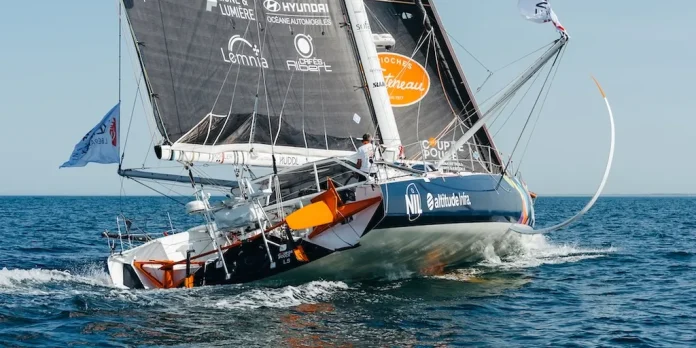
An IMOCA monohull measures exactly 18.28 metres in length, constrained by strict technical rules that govern every dimension of its design. These are the boats that contest the Vendée Globe, the planet’s most demanding solo ocean race, and they have become the standard-bearer of modern offshore racing.
The class emerged in 1986 as the BOC Challenge, a round-the-world race with pit stops. From the outset, boats carried the fundamental proportions still required today: significant beam and length at the waterline to generate speed in extreme conditions. What has changed is everything else. Closed cockpits now protect the helmsman where open decks once exposed him to the elements. Autopilots have evolved from mechanical quirks to systems that can hold a course through a Southern Ocean storm. The speeds have climbed relentlessly upward.
Maximum beam is capped at 4.50 metres, mast height at less than 29 metres. In flat water, these boats touch 40 knots. During the 2024 Vendée Globe, one skipper covered 615.33 nautical miles in 24 hours—a distance of 1,139 kilometres. The fastest boats now complete a circumnavigation at 17 knots average, compared with 8 knots from the first generation four decades ago.

The single greatest revolution came with foils: hydrofoils mounted on either side of the hull that lift the boat clear of the water, slashing drag and unlocking extraordinary acceleration. They allow an IMOCA to literally fly above the surface. At the 2016 Vendée Globe, six boats carried foils. By 2024, thirty did. The class rules grant teams considerable freedom in foil design, making them a permanent hotbed of innovation.

New Zealand audiences know the Vendée Globe intimately. They will recognise that these boats embody an obsession: the pursuit of speed in isolation, thousands of kilometres from the nearest human. Skippers spend weeks alone with their systems, their weather strategems, their fears. An IMOCA must right itself after a capsize without outside help. It must survive when rescue is impossible.
The class now incorporates environmental requirements that tighten annually. As of 2024, any team building a new boat must reduce its environmental footprint by 15 percent, cutting carbon-fibre use in moulds and minimising waste during foil manufacture. Teams have carried bio-sourced and recyclable sails since 2021.
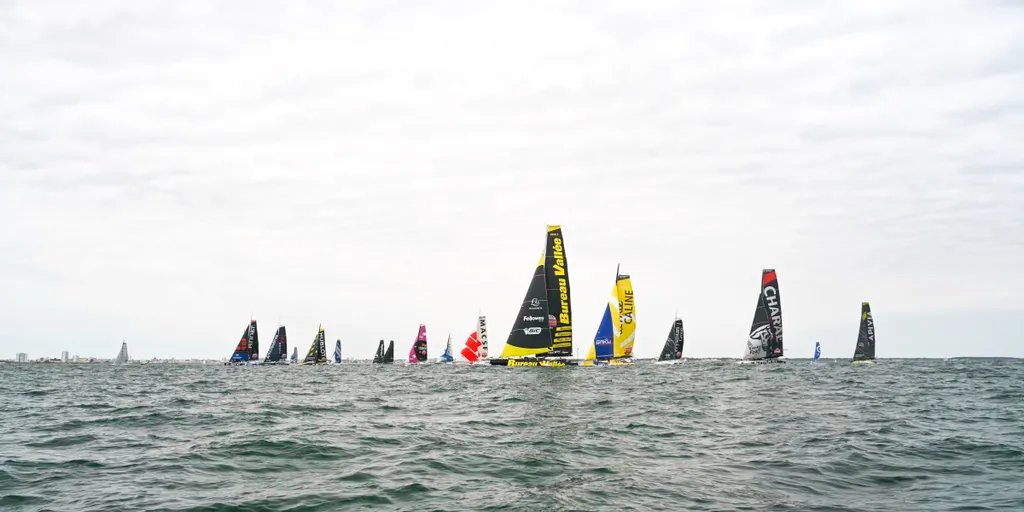
The fleet itself spans generations. François Gabart’s 2012-13 Vendée Globe winner races today as Café Joyeux under Nicolas d’Estais. Alex Thomson’s 2015 design now campaigns as April Marine with Arnaud Boissières. Newer boats from the 2022 and 2024 cycles sail alongside them. Nine fresh IMOCA projects are already underway for the next cycle, evidence of the class’s vitality. In June, the Vendée Arctique will showcase this multigenerational fleet in a single-handed race that departs on 7 June. The event pulls together machines spanning a dozen years of evolution, all competing on equal terms, all pursuing the same brutal standard: cross the finish line fastest, or go home empty.