In early 2013, boating journalist Steve Raea returned to Mexico’s west coast to rejoin a yacht he had purchased the previous year and prepare for another Pacific crossing. More than a decade later, his account provides a fascinating snapshot of offshore cruising before Starlink, before widespread weather-routing apps, and at a time when self-reliance remained one of the most important tools aboard any ocean-going yacht.
Originally published in 2013 and written by Steve Raea.
It’s a cruel twist that, after thirty-something days bobbing along on the North and South Pacific Oceans, arriving in Tahiti on Saturday, 11 May, the swell inside the reef was burying Nereid’s bow making it nigh on impossible to get off the boat.




It was a pretty swell, aqua, warm and tropical, but it was a swell nonetheless and Steve was over swells for the time being. The dinghy was doing cartwheels on its painter tied off the back and any attempt to get into it and run for the nearest bar would end in soggy tears. The saving grace was that the Mexican beer had lasted the passage and was cold in the fridge.
With the arrival of Nereid’s crew from Auckland in early April for the Mexico to Tahiti legs, a distance just shy of 4000 nautical miles, the last few days in Puerto Vallarta had been spent loitering in supermarket aisles trying to decipher Spanish labels on tinned vegetables, fruits, dairy and meats.
Their biggest challenge on the stores front was trying to find cuts of meat that looked, and hopefully tasted, familiar and then having it vacuum packed and frozen before delivering it back to the boat. Sign language goes some way in Spanish, but trying to mime ‘vacuum’ was a step too far and store security was a step away from having them removed.

After three full days under the blazing Mexican sun they had everything they thought they needed on board, including 200 litres of supplementary diesel strapped to the port and starboard rails. They threw their lines off just before nightfall on 10 April.
Cast off
Their course to Hiva Oa in the Marquesas Islands, a distance of 2900 miles, would take them pretty well southwest on a course of 225 degrees, hopefully crossing the equator at about 130 degrees west, after which they would follow the rhumb line direct to the port of Atuona.
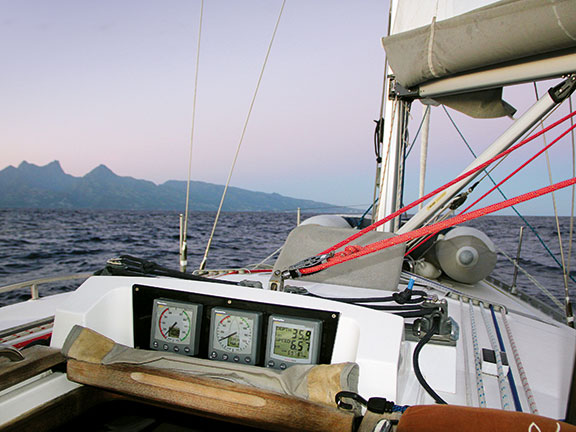
While their departure was not late in the season, they were sailing alone. A group of about 10 yachts had left the week before and a further dozen or so the week before that. Their primary line of communication en route would be the evening SSB radio schedule arranged between the southbound yachts. They had spent several days trying to get their heads around using the SSB Pactor modem that came with the radio and finally mastered it, giving them the ability to download weather grib files and weather faxes directly onto the laptop.
Much of the first week was very light, with north to north-east winds of 8-15 knots. This meant slow progress but they were able to average about 100 miles a day for most of the week and avoid using their diesel, which they’d promised to save for motoring through the Doldrums if need be.
The light weather was a blessing in respects and allowed them to ease into life at sea and settle into a routine that would become familiar over the course of the passage. The most difficult aspect of those first days was adjusting to the heat, which was relentless and only got worse as they progressed south. As dull as it might seem, routine is all important at sea as it is the yardstick of your day. Boredom will turn minutes to hours if you let it, so every task, no matter how minuscule or monotonous, is a godsend.
The daily grind
With a crew of three they worked a two-hour on, four-hour off watch system by night, which ran from 6pm till 8am. Thereafter, things were a bit more casual for the daylight hours. The first task of the new day was breakfast, and despite the heat this was very often cooked. Then there was housekeeping for an hour and a late morning coffee while they downloaded the weather for the next three days.
At midday Steve would squirrel himself away at the chart table and plot their position and noon to noon daily run. This was always met with anticipation but confirmed an annoying and persistent current continuously stripping them of 10 to 20 miles a day.
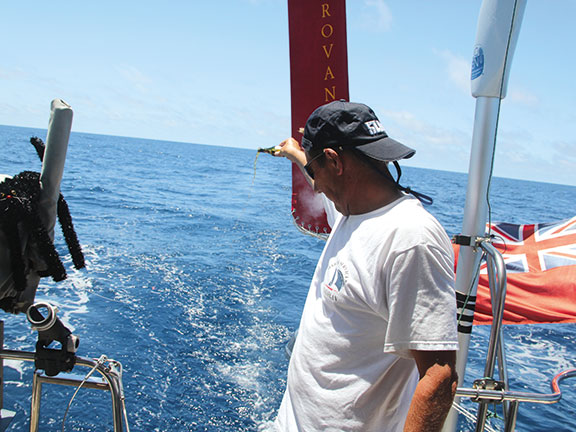





Reading was a big part of the afternoon and occupied their time till happy hour, which was set at 5pm but continually crept forward with each passing day until they finally drew a line at 3.30pm. This was their social time on board and it was eagerly awaited. The evening meal and SSB radio schedule heralded the end of each day and a mode switch for the long night ahead.
One of the more remarkable aspects of sailing in the low-latitude tropics is the lack of any real dawn or dusk. Out there the sun rises and sinks as if on steroids: blink twice and you miss it.
After their first week they’d covered 840 miles, leaving 2060 to go. It wasn’t the 200 miles a day Steve was looking for, but the log entry for 13 April pretty well summed up those early days: “Long night steering by hand to maintain momentum in five to seven knots of wind.” And on April 17: “Gybed to head west at 1800 in search of more wind.”
The second week brought a more favourable wind from the north-east and allowed them to raise their spinnaker for the first time, reeling off several 200-mile plus days, although standing under the relentless sun trimming was overbearing. They were forced back under their canvas covers to settle for a poled-out headsail.
By the end of week two they’d charted off a further 1040 miles leaving just over 1000 miles to run. This was good progress and they’d caught up with half a dozen yachts that had left a week ahead of them. They weren’t racing but neither were they slowing to a crawl at night as Steve suspected others were. For all of that he was challenged for choosing to put a tuck in the main and gather in a bit of headsail for the night watch.
Doldrums
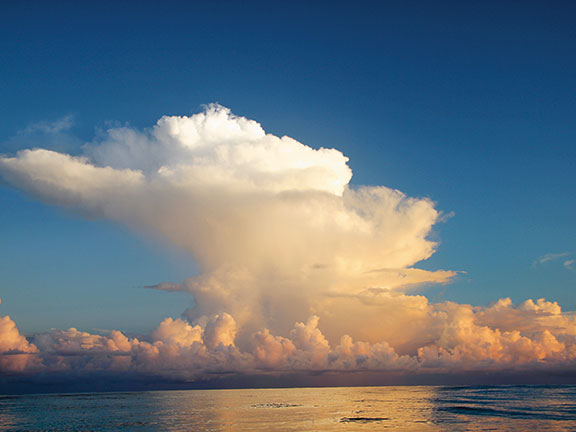
Week three was always going to be the real challenge as they neared the equator and the Inter-Tropical Convergence Zone. Known as the horse latitudes or the Doldrums, this is an area where the prevailing north-east trades in the northern hemisphere meet the south-east trades in the southern hemisphere. This meeting can occur anywhere from five or six degrees north to five degrees south and is usually a band about 200 miles wide. There is no escaping the ITCZ. The trick is to try and cross it at right angles to get through as quickly as possible. Before diesel engines the old wind jammers plying the trades could be stuck in this area for weeks. The horses they carried would die from starvation and be thrown over the side. The crew often went loopy, too.
Their experience was that of most others. They encountered the ITCZ at about five degrees north early into the third week and the 55hp iron spinnaker below the cockpit was pressed into service such that they maintained about five knots until they got clear on the other side.
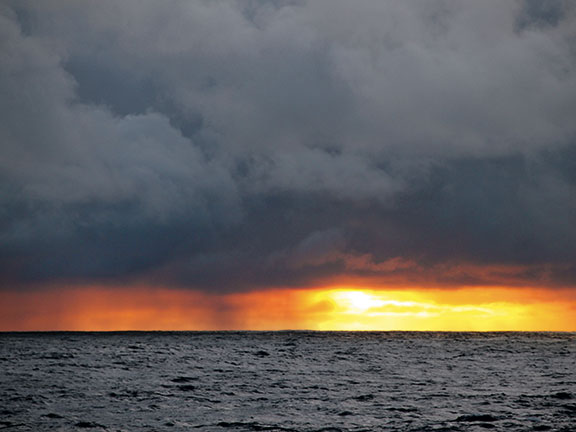
The other ITCZ variable is frequent rain squalls and rain cells. By day you can see these coming and prepare by reefing or skirting around them, but at night they’re a real blight because they come on with little or no warning. In most instances they’re relatively benign, but they encountered several during the night that blew to 35 knots. While generally short-lived, some persisted for three or four hours and threw rain at them so hard the ocean appeared to be smoking.
This period of constant sail changes and reefing was tedious and played on their nerves. While crew morale was generally pretty good, little things began to creep in and nag away at them. A low point was the several bucketfuls of water raining down on Steve through the front hatch as he slept below and the flying fish inviting itself through the mid-cabin hatch and into bed with Brett sleeping in the saloon. They were ready for land.
They crossed the equator shortly after midday on Thursday, 23 April, and toasted Neptune with a quality tequila brought for the purpose, but the idea of dressing up and playing the fool wasn’t really their thing so they carried on, putting the party on hold till their arrival in Hiva Oa.
Land ahoy
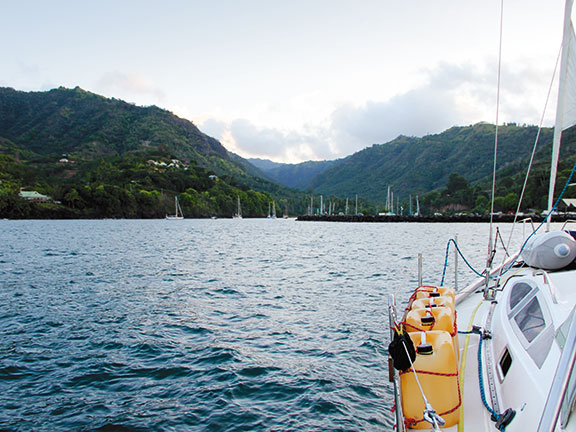
The last week was a mixture of squalls, calms, long periods of motoring and, towards the end, a steady but building south-east trade wind pushing them rapidly toward their destination. They arrived at the entrance to Atuona Harbour in the pre-dawn of 30 April and dropped anchor. They’d been at sea 20 days and some hours and had averaged 5.85 knots for the crossing.
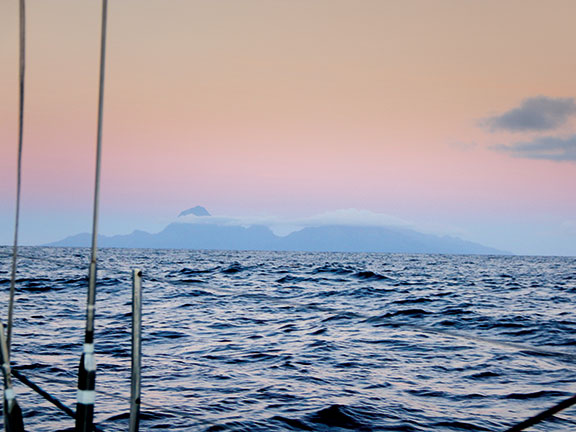
Settled in, they celebrated with tequila shots and beer and watched the sun rise over an island that looked jurassic with its high, rocky cliffs and peaks rising vertically out of the sea. Atuona Harbour is picturesque but too small to accommodate many yachts. There were about a dozen boats lying to bow and stern anchors and it was necessary for them to follow suit. It seemed incongruous that at one of the most isolated islands on the planet they had to parallel park to get inside the breakwater.
With a population of just 2500 permanent residents, Hiva Oa is not much of a flesh pot. There were certainly no brightly coloured ferry lights or music wafting across the harbour from any seaside bar. Still, it was land and they were pleased to see it. The grand tour takes something less than an hour, a good thing as the danger of passing out from heat exhaustion is real. They found the main town restaurant, invited themselves in and sat down. They were quickly informed that day was a public holiday and there would be no beer drunk there till after 6.30pm. Their taxi driver, the only one on the island, picked up on their disappointment and took them to the only hotel 20 minutes out of town. This, she assured them, would be open. It was and the beer was cold.
They’d planned to spend about a week there before making the last push on to Tahiti, but after several days there wasn’t much more to do so they took on what fresh supplies they could find, ferried out duty-free diesel in 20-litre jugs and weighed anchor.
Westward through the Tuamotus
The last leg would take them through the Tuamotu Archipelago, a wide band of very low-lying coral atolls that lie roughly north-south 500 miles south-west of the Marquesas. The Admiralty pilot cautions sailors of what it describes as barometric anomalies in this area, meaning you’re likely to encounter everything from calms to gales.
Picking your way through the Tuamotus requires careful navigation because of strong currents that develop between the many atolls. After six weeks at sea the crew was itching to get to Tahiti and back home to their families, so they skirted the northern side of Rangiroa Atoll and made a direct course for Papeete 200 miles distant.
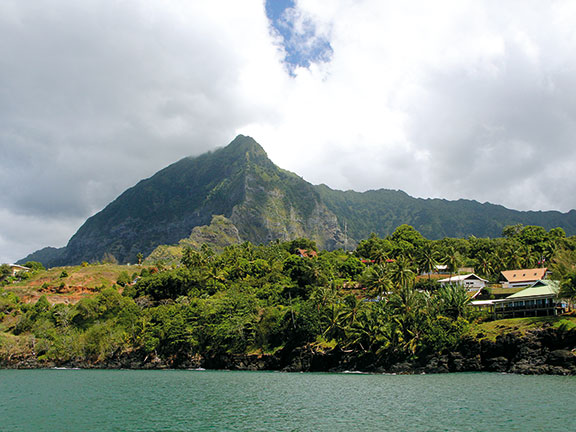
Those last two days were some of their hardest, with fresh to strong south-east trade winds and a following sea that was confused and rolly, but the miles clocked over rapidly and they picked up Tahiti’s Point Venus light early on 11 May. By 10am they had entered the inner harbour at Papeete and tied up alongside floating barges moored for visiting yachts.
There was only one other yacht in the inner harbour and they quickly discovered why: the barges are too high off the water to get safely on and off the yacht. With a leap of faith they scaled the rusting hulk they’d tied to and walked the short distance into downtown Papeete where the crew made a beeline for the nearest airline office, emerging 20 minutes later with tickets to Auckland the next day.
After a leisurely lunch of New Zealand lamb and beer they returned to the yacht and navigated through the inner reef to the main yacht anchorage and marina at Taina on the western side of the island. There Steve sat waiting for conditions to ease so he could get off the boat and get the lay of the land.
His first task was to try and secure a crew for the next leg of the journey through the Society Islands and onwards to Rarotonga and Tonga.
This is the end of Part 5. Next: Rarotonga’s merciless seawall and a harbour that never sleeps.