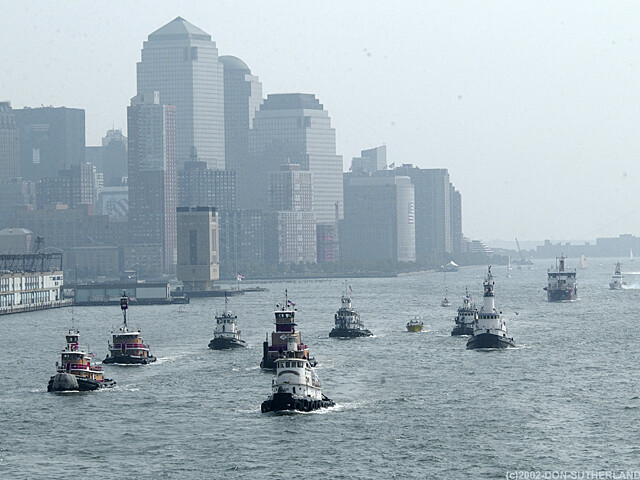
Twenty five years ago, ferries, tugs, fishing boats, fireboats and private vessels converged on Lower Manhattan. With normal routes out of the city disrupted, New York Harbor became an escape route for hundreds of thousands of people.
At 10.45am on September 11, 2001, the US Coast Guard put out a radio call asking for all available boats to help evacuate Lower Manhattan.
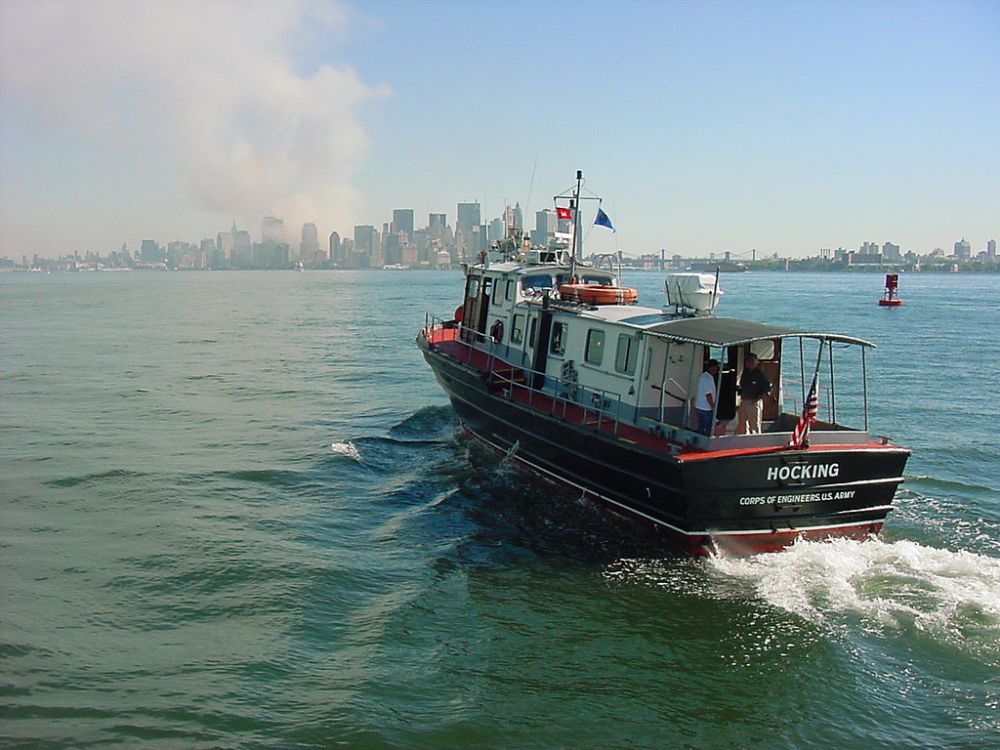
The response came from across New York Harbor. Ferries broke from their normal routes, tugboats left commercial work, sightseeing vessels joined the effort and fishing boats headed towards Manhattan. By the end of the operation, at least 150 vessels and roughly 800 mariners had taken part.
As roads, tunnels, bridges and rail services were disrupted following the attacks on the World Trade Center, people began gathering along Manhattan’s waterfront. Writing for HISTORY ahead of the 25th anniversary, Kieran Mulvaney reported that an unofficial flotilla had been evacuating people for close to two hours before the Coast Guard broadcast its request.

Working boats change jobs
NY Waterway port manager Michael McPhillips took two mechanics as deckhands, commandeered the ferry Frank Sinatra and headed for the World Financial Center. Spirit Cruises operations director Greg Hanchrow borrowed a speedboat to reach his company’s dinner cruise vessels at Chelsea Piers, then put three of them into evacuation service.
Even the retired 1931 fireboat John J. Harvey, by then preserved as a living museum, returned to work. Its volunteer crew used the boat’s pumps to draw water from the Hudson for firefighters ashore.
The fleet ranged from large passenger ferries capable of carrying hundreds to tugs, fishing boats, charter vessels, police launches and private craft. Their crews faced another problem when they reached Manhattan. Much of the waterfront was never intended to load thousands of people at once.
NYPD Harbor Unit senior pilot Tony Sirvent used an aluminium launch and a rope to pull down wooden fencing blocking access to the water. Other barriers were cut through and, with communications badly affected, mariners sometimes used hand signals to coordinate boat movements.

Ferries fill in minutes
Captain Rick Thornton was at the helm of the NY Waterway ferry Henry Hudson when the attacks occurred. After the second aircraft struck the World Trade Center, he turned south towards Lower Manhattan.
Thornton’s crew spotted people swimming in the Hudson and pulled two aboard. He then brought *Henry Hudson* alongside a stone seawall where thousands were waiting. There was no proper ferry terminal, and people climbed over a fence to reach the boat.
Henry Hudson was rated for 399 passengers, but Thornton recalled carrying considerably more during the evacuation. Pete Johanson told ABC News ahead of the 25th anniversary that NY Waterway’s larger ferries could take around 400 people and were sometimes filled in less than two minutes.
They crossed to New Jersey, unloaded and returned for more.
Smoke, ash and debris from the collapse of the towers soon reduced visibility across parts of the harbour to almost nothing. Thornton later recalled watching radar targets converge around Henry Hudson and narrowly avoiding a collision with a police boat.
Still, boats continued arriving.
Captain James Schneider was fishing off Norwalk, Connecticut, aboard James Joseph II when his brother, an NYPD detective, called with news of the attack. Schneider landed his customers, assembled a crew of 13 and headed for New York.
He saw the towers collapse during the journey and spent 17 hours at the helm after joining the evacuation. Among his passengers was a woman eight months pregnant. Years later she recognised James Joseph II at a marina and introduced Schneider to the daughter she had feared losing that day.

Hundreds of thousands evacuated
There was no central passenger count, and estimates still vary. The National September 11 Memorial & Museum puts the number transported to safety by water at between 300,000 and 500,000 in less than nine hours. HISTORY estimates nearly 500,000, while the US Coast Guard records more than 500,000 evacuated in less than eight hours.
The Coast Guard describes it as the largest maritime evacuation in recorded history.
NY Waterway may have carried close to half the total. Johanson estimates its ferries transported between 200,000 and 220,000 people that day, compared with around 33,000 passengers on a normal day. Thornton and Henry Hudson completed about 20 round trips.
The following morning, many of the boats were back on the harbour. This time they were carrying first responders, equipment and supplies towards Manhattan.
Twenty five years later, images of the boatlift show passenger ferries alongside tugs, fishing boats, fireboats and smaller private craft. When the Coast Guard called for all available boats, many of them were already there.