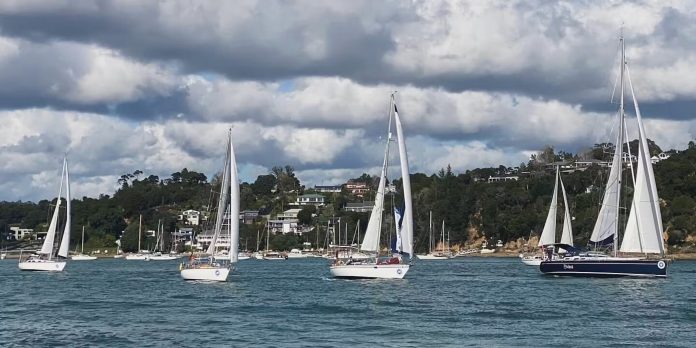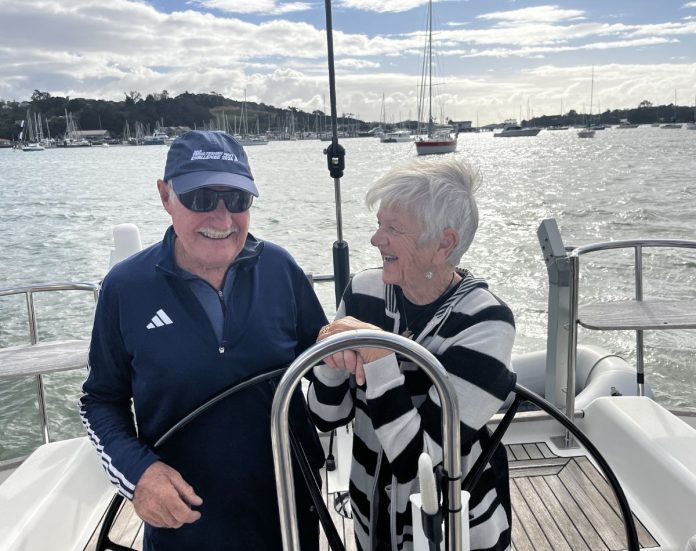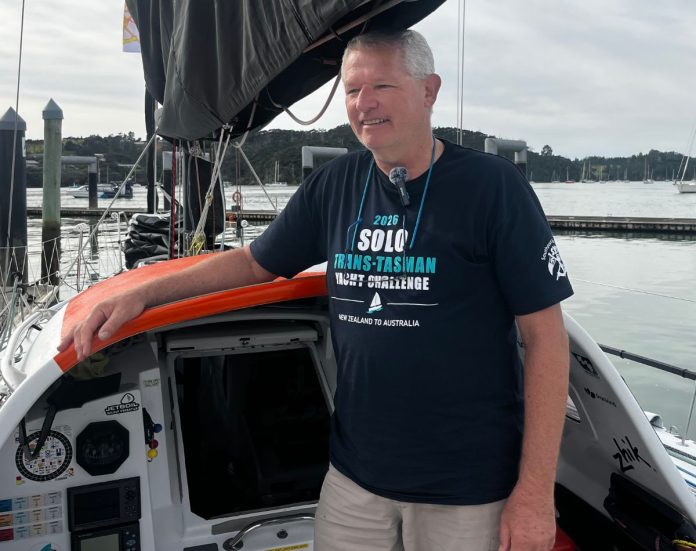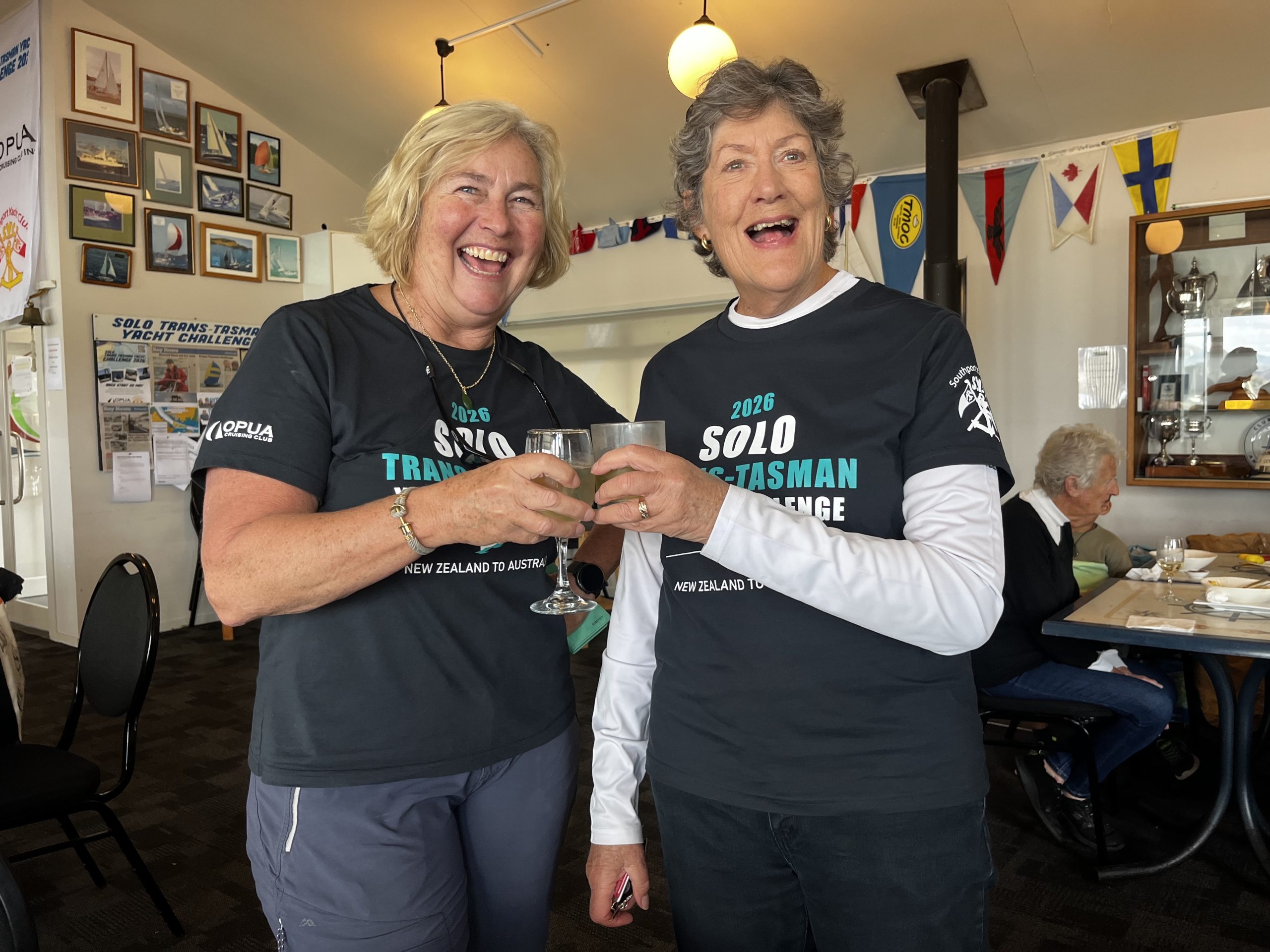
Fifteen boats started. Eleven finished. Four retired, and nearly every one of them was in the room anyway. This afternoon, the Solo Trans-Tasman Yacht Challenge fleet gathered at Southport Yacht Club to close out a race that, by any measure, exceeded what anyone could have hoped for when Opua Cruising Club picked up the mantle earlier this year.
Race Director Julie Kidman did not undersell it. The event’s Facebook page had passed 4,500 followers in the last month alone. “We’ve had little old ladies at the Third Wheel in Paihia taking out their phones and asking the staff, how do I get that tracker thing working? Because I want to follow this yacht race.” People who had never been near a sailing club had spent three weeks following 15 strangers across the Tasman Sea. That is the measure of what this race became.
Southport Yacht Club Commodore Glen Burrett opened proceedings with characteristic dryness. Of the fleet itself: “I think you’re all mad, the competitors that do it, but very brave. You all deserve to be congratulated.”
Before a single trophy was handed out, Kidman acknowledged the four boats that started but did not make Southport.
“All of you sitting in this room know how much work it is to actually get to the start line. Months and months of preparation, investment, sacrifice. As Race Director, I am severely happy that every vessel and every boat is safe and sound.”

Graeme Francis and Robbery came first. On the second night of the race, taking on water north of Cape Reinga, Francis activated his EPIRB. What followed was praised from the stage as an act of seamanship in itself: Francis kept the water under control, a coordinated response was launched through the Rescue Coordination Centre of New Zealand, and Robbery was safely escorted into Mangōnui by Coastguard Houhora. But it was what happened in between that drew the loudest applause of the afternoon. “The Fair Seasons, let’s give a big round of applause for Doug, stood by. And that was huge. In those conditions, to turn your boat around in those conditions, he was also putting himself and his vessel at risk.” Doug Esterman’s detour to stand by a fellow competitor became one of the defining stories of the entire race.
EPIRB activated: rescue operation underway for Graeme Francis on Robbery in the Solo Trans-Tasman
Bill Kidman and Pretty Boy Floyd were next. Kidman had been running second on the water, chasing Sharon Ferris-Choat on Vixen Racing hard, when he made the decision to withdraw. “This one hurts, both personally and as race director,” Julie Kidman said, “but a very hard decision for Bill to pull out, but I’m awfully glad he did. The vessel’s okay, a couple of minor issues, but most importantly Bill’s okay, even though he’s got tingly fingers and he’s still walking.” Bill Kidman went on to spend the rest of the race as an essential part of the Southport finish-line team, a story that came full circle later in the afternoon.
Glen Jeffery and Wave could not make the trip to Southport for the prize-giving, but his race was acknowledged warmly. Jeffery and his family had sailed Wave down from Croatia, and he had spent six months preparing for this race after wanting to do it for years in a smaller boat. He was, in Kidman’s words, “absolutely gutted when he wasn’t able to continue.”

And then there was Kevin Le Poideven on Roaring Forty, whose Lord Howe Island saga had already become the stuff of legend among those following the tracker. “What an effort,” Kidman said. “First of all, Kev had to sail over to New Zealand, and that wasn’t an easy trip… then the race starts, and you were doing so well, and you had a lovely little tussle.” His track around Lord Howe Island, looping up and down as he searched for shelter and a working forestay, was shown on screen to laughter and applause. Le Poideven was presented with a prize for being, unofficially, the winner of the “inaugural Opua to Lord Howe Island race.” His response was pure Kevin: “It was a different race for me. I hate quitting. I’ve even got a quitting last forever sign in the boat that stares at me at the chart table. So it really does hurt to actually quit.” He invited everyone to find him later for the full stories. “Today I’m around all day. Come and listen to some stories, because there’s plenty of them.”
Kevin Le Poidevin’s Solo Trans-Tasman: The $150 mistake and everything that followed
“From 15 starters, we had 11 finishers,” Kidman told the room. “And all of you are winners. Every single person who managed to cross the finish line is a winner today.”
Doug Esterman and Fair Seasons were the last boat home, and the room gave him exactly the reception that crossing matters most. Esterman’s race included turning back on day one to stand by Graeme Francis, a broken autopilot for much of the crossing, and a Starlink lost overboard. His finishing distance was confirmed at 1,367 nautical miles, an elapsed time of 11 days 23 hours 57 minutes and 8 seconds, with 7.2 hours of redress awarded by the protest committee in recognition of the time lost standing by Robbery. Kidman did not mince words: “Seamanship in going back, and seamanship in finishing. Well done.”
Doug Esterman and Fair Seasons: Last to finish the 2026 Solo Trans-Tasman — and first in heart
Peter Nobbs brought Smoko home next, after what he summed up in the driest possible terms. “It wasn’t an enjoyable trip. It was pretty hard. And just to make it worse, you guys know already, it was cold food the whole way.” Kidman’s response drew a laugh: “I’m not sure I would have liked to have done 11 days and not even a cup of hot coffee. Well done.”
From customs officers to Southport, Peter Nobbs and Smoko finish the Solo Trans-Tasman Challenge
Peter Bourke and Diablo, the smallest boat in the fleet, came up to warm applause. Bourke’s connection to this race runs deep. “I’ve been fascinated by this race right from the start, in 1970, and it’s been sort of in my dreams that I might be able to do it, and now it’s become a reality.” Reflecting on the move from New Plymouth to Opua as the race’s new home, he added: “I think this is the start of something that could really start to grow. I think you’ve started a great event.”

Terry Dunn, Commodore of Opua Cruising Club and skipper of Nautilass, was acknowledged for sailing 1,371 nautical miles on a borrowed boat. Speaking as a competitor rather than as commodore, Dunn kept it simple and grateful: thanks to Celia for the tireless SCED follow-ups, and to Julie, “without you doing this, this would never have happened.”
Geoff Thorn and Catnip covered 1,333 nautical miles in his second Solo Trans-Tasman. His reason for returning was as honest as it gets: he had sold his previous boat with a “Solo Tasman” decal on the bow, one of the things he was proudest of, and the only way to get another one was to do the race again. With three days to go, Catnip started taking on water. “After about two days, and I had about a day to go, I thought I probably should do something about this. Then I realised Southport was probably the closest place I could go. I was doing eight or nine knots, I might as well just finish, so I just kept going.” He is now up on the hard getting repaired.
Solo Trans-Tasman 2026: Catnip 90 minutes from the finish line
Ben Ball and Camellia, competitor number 19 (he had to ask Julie for his own race number so he could get shirts printed), summed up his race simply: “This has been on my list since I was a small boy, and I’m so pleased to have finally done it. I love being with so many legends. They’re all so humble, but everyone just jumps in and helps anyone that needs it. It’s awesome.”
The Tasman dream is real, Ben Ball and Camellia cross the finish line
Peter Elkington and Pacman, the only Southport Yacht Club entry, was welcomed home as the local hero. “It’s been brilliant, and it’s up there with any other races I’ve been doing,” he said, before adding with a laugh: “I think I’ve learned that I need to pick a boat” — to more laughter, and Kidman’s response that the race might need a bigger division next time.
Sarau and Pacman cross the line — in the dark, 31 minutes apart
Malcolm Dickson and Sarau received one of the warmest receptions of the day. At his fourth Trans-Tasman and 48 years after first winning the PHRF handicap in 1978, Dickson took it out again. “This seems like a huge privilege to be able to come back 48 years after first doing it and have another go. And I think it’s probably my swan song.” He thanked his wife, who had been there on the start line all those years ago, “and ever since.”
Malcolm Dickson: Solo Trans-Tasman’s oldest finisher bookends career with handicap win at 79
James Foster and Electron, the only catamaran in the fleet, won the inaugural NZ Multihull Handicap. Built for cruising rather than racing, Electron came with solar panels, batteries, and electric blankets that became the envy of the fleet. “No one was more jealous than Sharon when she was shivering in her boat,” Foster said. He thanked his family for five weeks without him, and for putting up with him building the boat in the first place.
James Foster is nearly home: Seven days, 10 hours and one hell of a Tasman
Sharon Ferris-Choat and Vixen Racing were the second boat home overall and the winner of monohull line honours, becoming just the sixth woman in the race’s 56-year history to complete it. She spoke about passing Bill Kidman just 100 metres away, 48 hours into the race, in what could have been an epic battle to the finish had Pretty Boy Floyd continued. “I’m sorry, mate. That could have been an epic battle right to the finish.” On the spirit of the fleet: “The camaraderie within this group of sailors and supporters is absolutely exceptional. I hope we can keep that WhatsApp group going.”
Sharon Ferris-Choat: 1,400 miles alone — first woman to finish the Solo Trans-Tasman in 12 years
And first home, in every sense, was Guy Chester on Oceans Tribute. Chester’s story of how he came to be on the start line, sailing the trimaran back from the Caribbean through the Panama Canal only to learn New Plymouth had cancelled the race, then hearing days later that Opua would run it instead, was one of the highlights of the entire afternoon. “I think the iguanas on Darwin Island heard me with my expletives.” He paid tribute to the boat’s history, built by Grant Wigman in 1991 and refined through several previous owners including past Chichester Trophy holders. And on the records he had just set: “I don’t want to hold this record forever. I don’t want Sharon’s record to be held forever. We want them broken next race, and we want them broken again the race after that.”
Guy Chester takes line honours in the Solo Trans-Tasman Yacht Challenge 2026
The 2026 Solo Trans-Tasman Yacht Challenge awards
Bill Kidman, recovering from a recent neck fusion operation, had spent his enforced downtime carving a navigator’s trophy from a single piece of wood inlaid with pounamu donated by fellow early entrant John Ross. The prize went to the boat whose finish estimate came closest to reality. Across the fleet, the average estimate was out by one day and eight hours. The winner, out by just four hours, was James Foster and Electron.
On the New Zealand Multihull Handicap, Electron took the win.
On PHRF, third went to Peter Elkington on Pacman. Second, in a result that came down to the wire, went to Ben Ball on Camellia. “Thanks to Camellia for putting up with what I put us through. She did us all proud.” And first on PHRF, in his fourth Trans-Tasman and 48 years after his first win, Malcolm Dickson on Sarau.
Multihull line honours went to Oceans Tribute. Monohull line honours went to Sharon Ferris-Choat on Vixen Racing.
And then the trophy that mattered most: the Chichester Trophy, which has been awarded for outright line honours since 1970, presented this year by Terry Dunn. Guy Chester and Oceans Tribute took it out, the latest name on a list of winners stretching back over half a century.
Two random prize draws, open to every boat that made the start line, closed out the formalities. A three-dimensional artwork of the Tasman Sea, complete with Lord Howe Island, went to Camellia. A luxury overnight cruise for two on Fiordland’s Milford Sound, donated by Fiordland Discovery, went to Pretty Boy Floyd — to widespread delight that Bill Kidman, after everything, had won the best prize of the day.
Thanks, and what comes next
Much of the closing half hour was given over to thanks, and rightly so. Julie Kidman thanked the Ministry of Business, Innovation and Employment for major events funding, Bay of Islands Marina for berthing the entire fleet for free, PredictWind, the web team at Riddles, the Rescue Coordination Centre of New Zealand for their work during the Robbery incident, and race officer Celia for her after-hours diligence chasing down every missed check-in.
Southport Yacht Club’s Mike and Kayla were singled out for special mention. Mike had run the finish-line boat for every arrival, including several in the middle of the night, at one point sleeping in his van in the car park to be on station. Bill Kidman, in the days since his own retirement, had been there for every single finisher, a role that Southport’s Wayne Kirby described as capturing exactly what makes this race different from any other: the camaraderie, built over months of preparation and seminars, between sailors who race not as crews but as individuals against the same ocean.
Terry Dunn closed proceedings on behalf of the competitors, reflecting on a journey that began when Julie Kidman first called and asked whether Opua Cruising Club could take on the race. “I think on our Facebook page we had like 2 million hits. All of a sudden everybody knows who Opua is as a club.” Entries for the next edition were already on the table.