What’s the thing with epiphanies. You remember every last little detail.
After decades of sailing everything – tiny dinghies, canoes, trapeze dinghies, beach cats, one-design keelboats, IOR quarter-tonners and ocean-racing yachts – and writing many boat reviews, it finally came to me in a flash.
The boat that did it was a 10m catamaran (a Tennant-designed Tourissimo). We were doing a story for a magazine. The owner said, “Boat review? OK, let’s do it on an evening race to Kawau Island.” So I turn up at the appointed hour at Westhaven Marina. On board are a dinghy (a tinnie with an outboard motor), a family with four kids, their nana (with knitting), and the dog, a dodgy foxy-cross. Sorry – forgotten its name. Anyway, we get to Kawau way ahead of the hot-shot RNZYS keelers. It’s like they’re not even in the same race. For me the race was won – completely – in my mind. This is my kind of sailing! All the while the crews on the keelboats were still sitting out there in the dark, gunwale fodder in the cold salt spray. We’re already safe at anchor. And, later, ignored at the prize-giving. But that mattered naught.
For Lesley, the epiphany came coincidentally also in a night race, Auckland to Kawau. This time a 40ft bridge-deck cat. Lesley is helming, also watching the dolphins in luminous haloes dancing around the bows. The boat’s owner brings up a cold drink. In a stem glass. A glass glass! Sets it down on the coaming by the wheel. Boat doing 15 knots under gennaker. Glass just stays there. Lesley is amazed. She’s experienced clambering along the bench-tops of a yacht’s interior, clutching at hand-holds in the ceiling, while heeled at 45o in a southern oceanic storm. She’s sold on this new scenario!
Since then, we’ve taken these revelations into a rewarding foray within the world of modern sailing catamarans; and have learned much about them in the process.
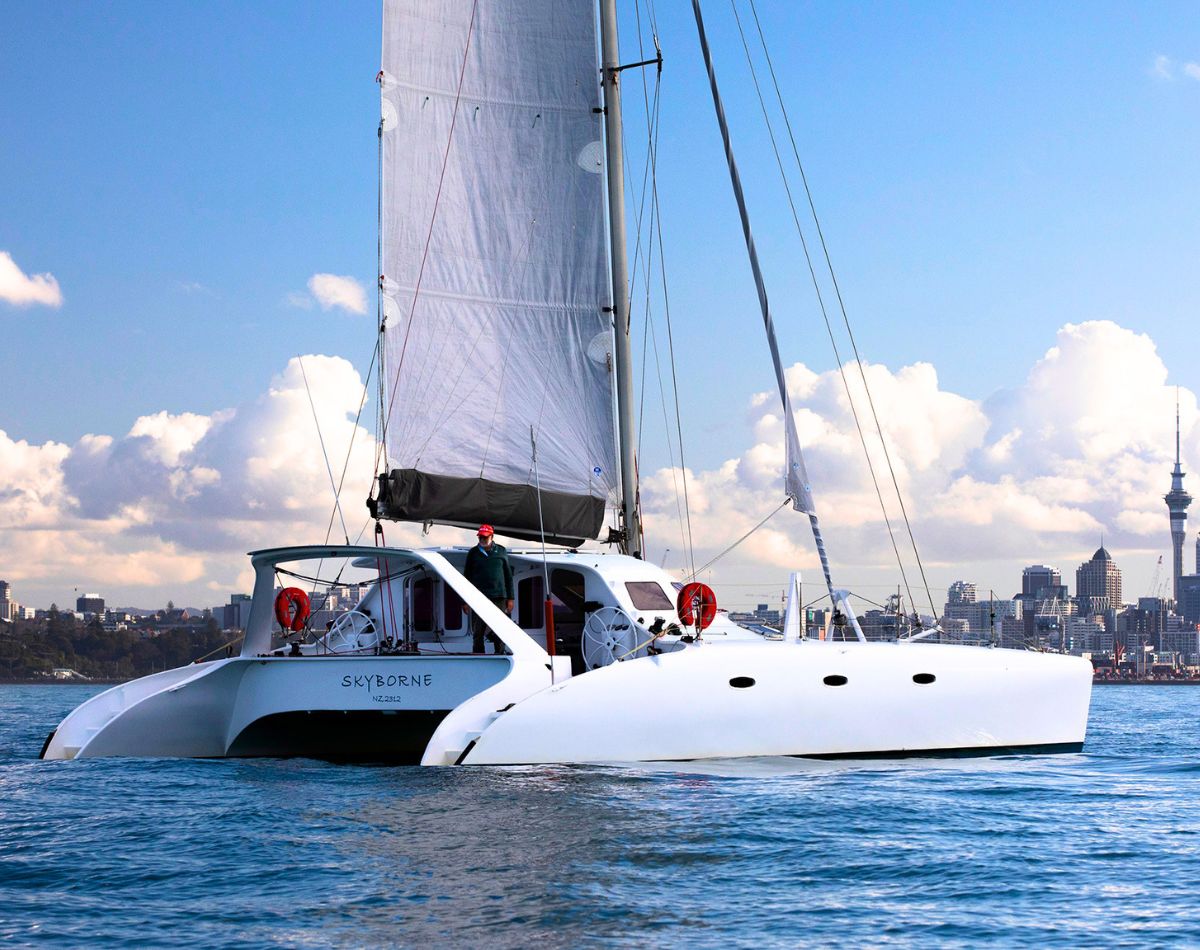
But plans change. Context shifts. Especially around boats. A few medical misadventures (for me), plus the the unlikelihood of caring for a beautiful boat while living on super, has meant that we are selling Skyborne, our Schionning-design 12m cruising cat. We’re looking forward to passing her on to new owners who will appreciate the boat as much as we have.
While adventuring with Skyborne we have seen much of the recent and rapid advancement in sailing catamaran design. We’ve learned how cruising cats have evolved and been refined in just our own sailing lifetimes.
With so many boats that have come before, compromises came in to accommodate perception and purpose. So the majority of cats designed for the charter market in the West Indies and the Med (actually the majority of sailing cats out there) have steadily morphed to be more like floating caravans, than true sailing yachts.
It’s known that to achieve good sailing performance in a catamaran, the beam to length ratio of the hulls at waterline should be at least 1:10. Skyborne has a ratio of 1:13. Take a look at the hulls of some of the charter market cruising cats, and you’ll see ratios of around 1:8, sometimes as tubby as 1:6. This means bigger cabins in the hulls, a greater capacity for payload – but all at the expense of sailing ability, and in some serious ways, of safety. Like the ability to beat away from a lee shore under sail, for instance.
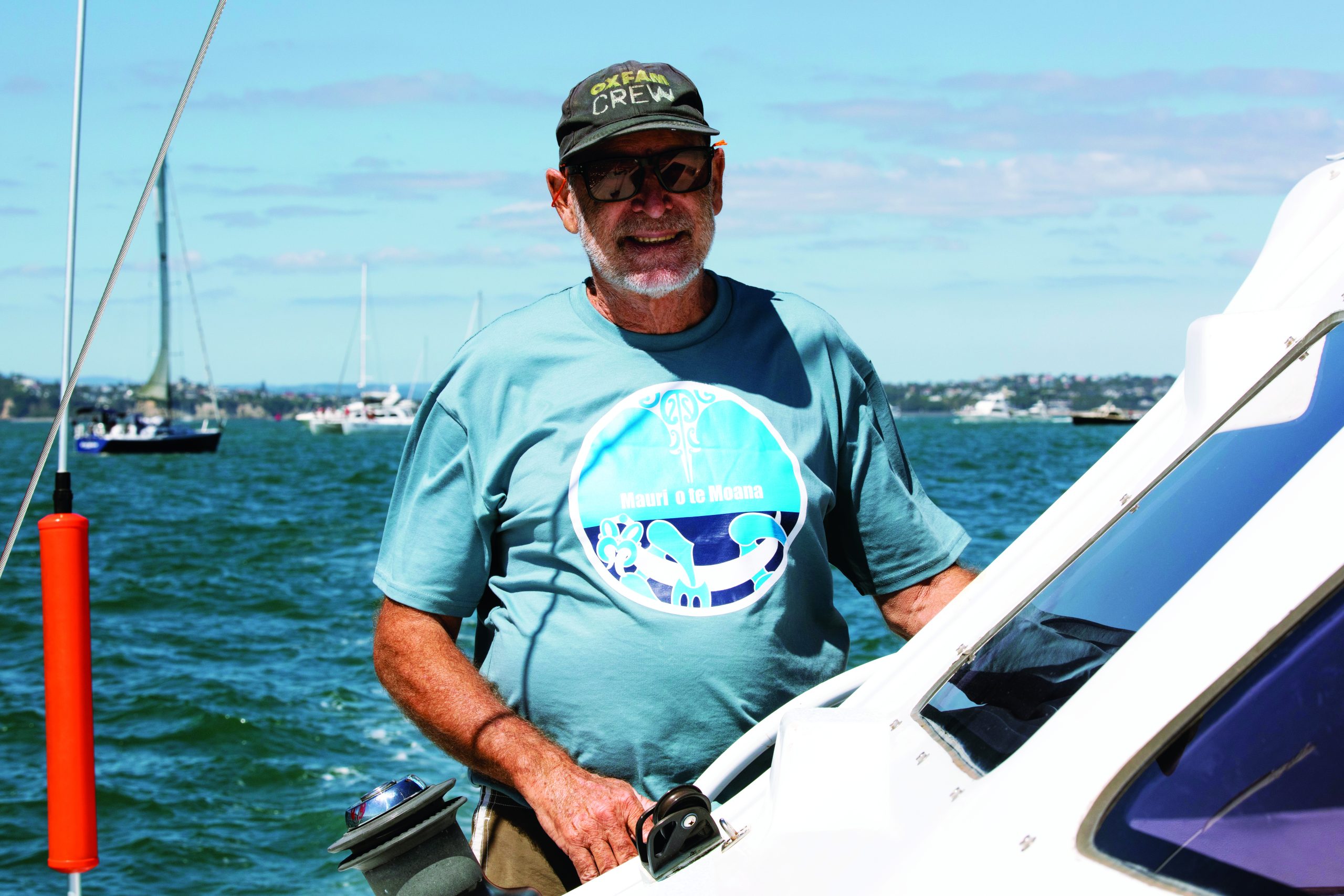
There are other things to look at. Bridge-deck clearance of at least 600mm from static water line, minimises slapping from waves. Cats are wide and two helm positions give good visibility while manoeuvring in tight situations. Foredeck trampolines designed to enable instant draining ability. Buoyancy fore-and-aft is a safety and sailing advantage. Skyborne ticks all these boxes.
And the boat, like other well-designed cats, has maintained its sailing ability. I recently reviewed a brand-new performance cruising cat of almost identical dimensions. While there are modifications in interior space utilisation, the sailing performance of the two boats, 20 years apart, is the same.
“Saying goodbye to Skyborne will have a reflective aspect…”
So, to the blokes who swam out to Skyborne and asked to buy her while at anchor in the Marlborough Sounds, or tied up at a dock, on our exploratory trip around New Zealand, or on the hard in various places – now’s your chance!
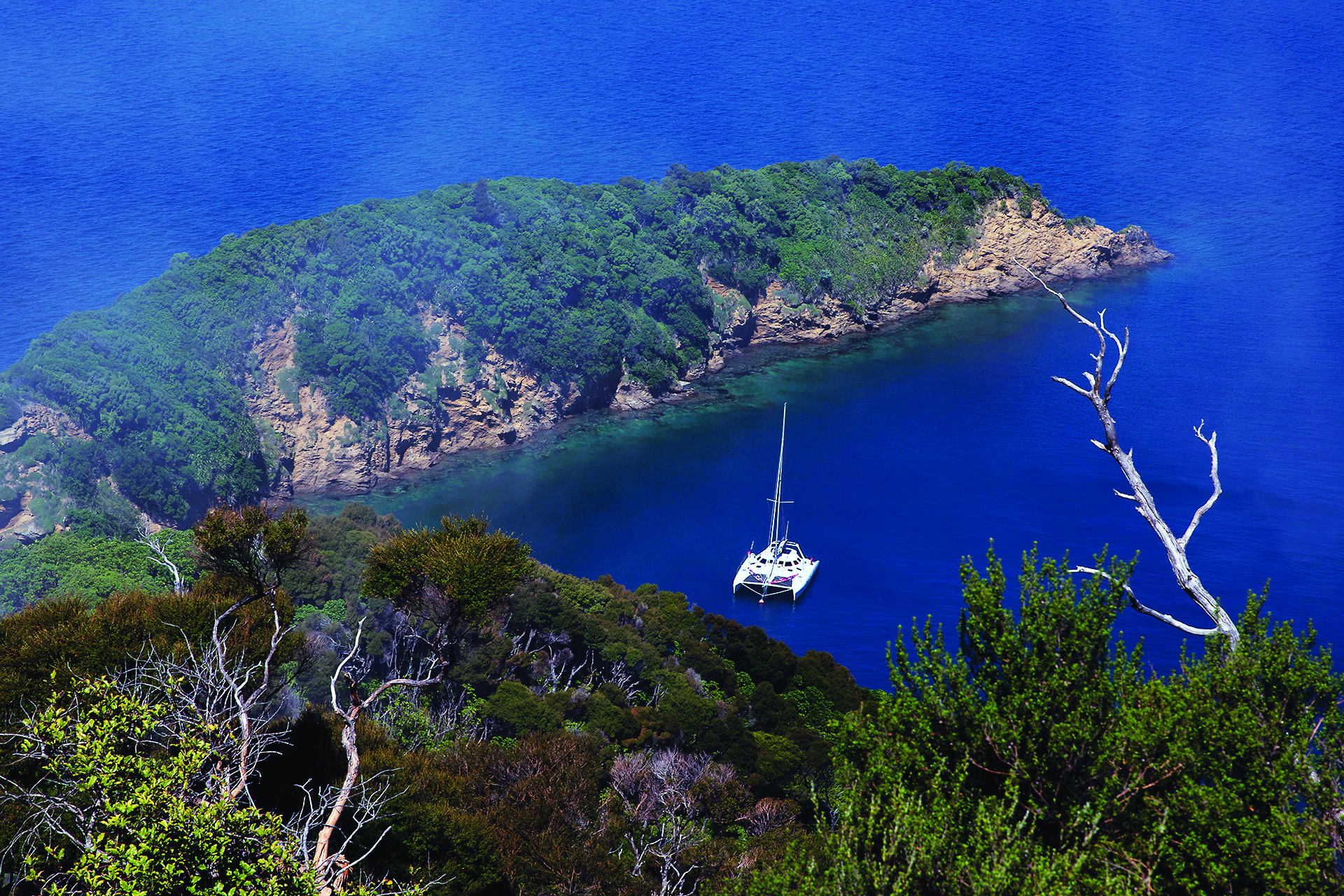
All of this has us reflecting on the nature of our enduring relationship with boats. Which is almost a universal thing. Even far-inland countries have their own distinctive river- and lake boats.
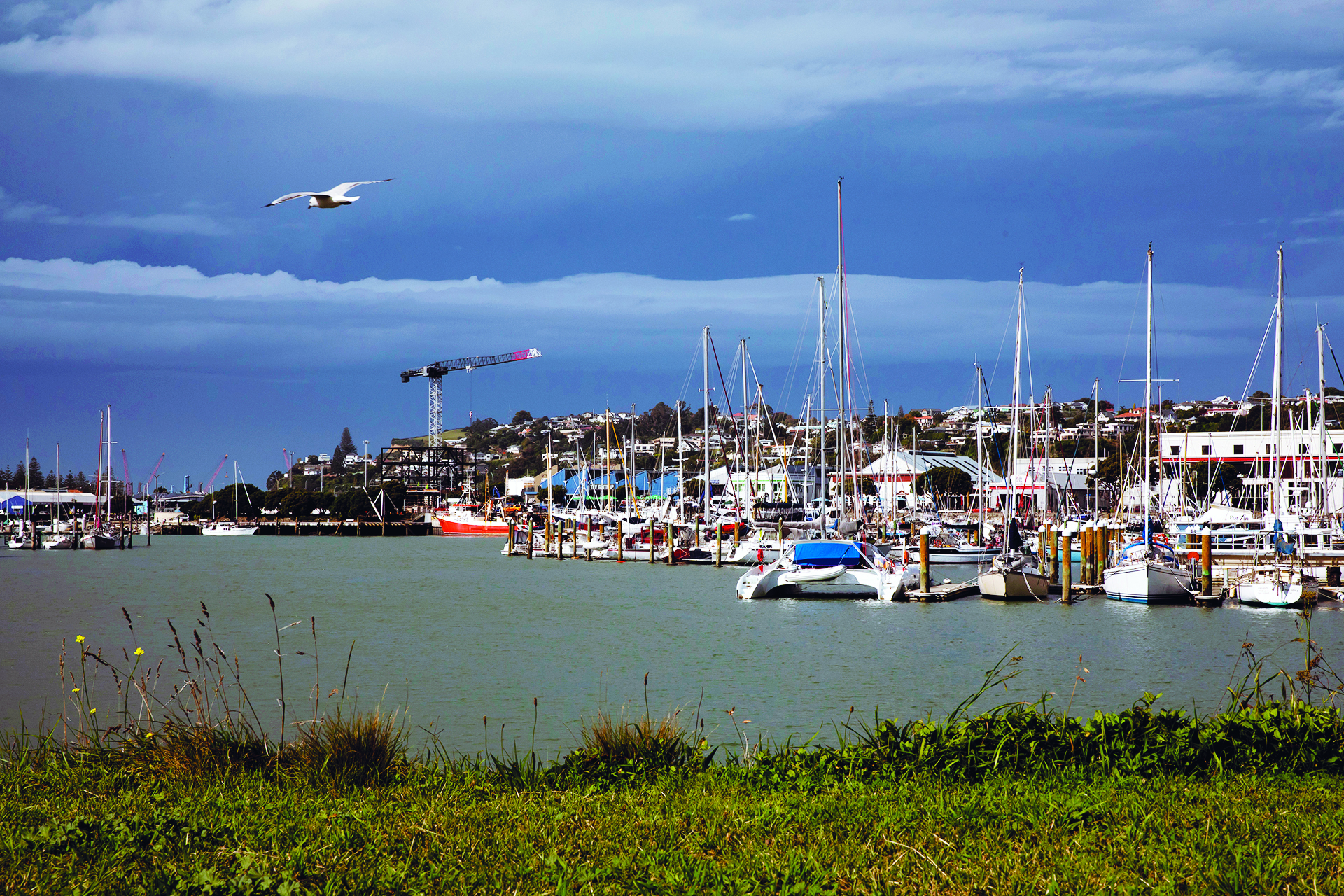
It’s certainly a verifiable Kiwi malady – to invest inordinate time, emotion and resources on love affairs of this nature. And across an extraordinary range of boats – from classic runabouts, to old launches straight out of Agatha Christie movies, to racing yachts that once were – and all the rest.
Why do we do it? Simply because the rewards are inestimable. I can clearly recall days on the sparkling Hauraki Gulf, with Skyborne sliding along at respectable speed, not heeling at all, and thinking there is nothing better in the world than this. This immersion in the splendours of our natural world provides something way beyond the counting of its cost. The endless offerings of sea-sky-wind-clouds-birds-headlands offer more, way more.
Skyborne has become known to readers of Boating NZ, as we have often chronicled Up the Creek adventures from the boat as a vehicle and base for intriguing story-telling.
With a draft of less than 1m, and the ability to raise the rudders and sit on the sand, Skyborne has given us adventures aplenty – and in sometimes unexpected places. I recall finding the most low-key marina in all of Aotearoa, in the estuary off beautiful Kennedy Bay on the outside of the Coromandel.
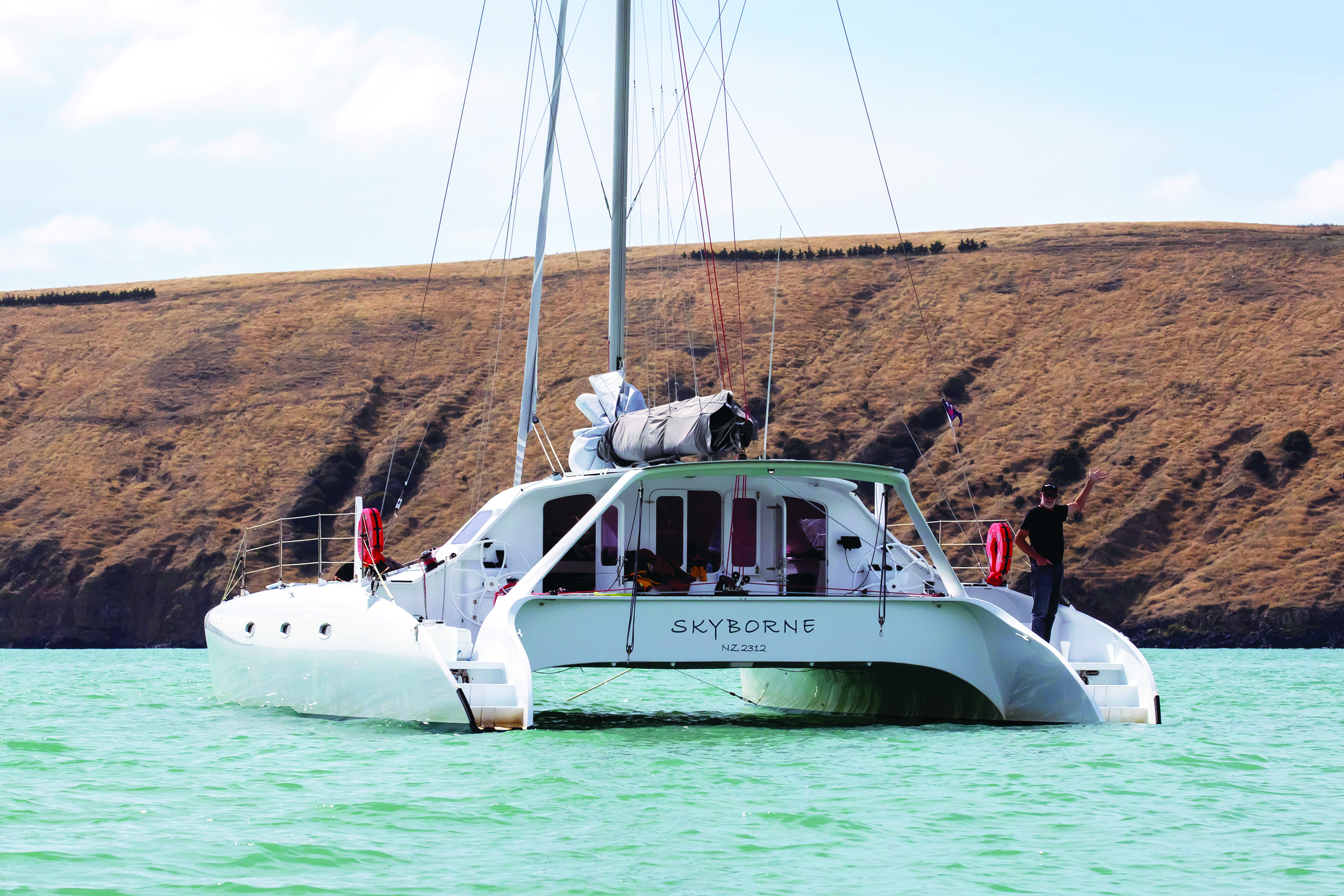
Also a trip around the North Island and down to Akaroa via the Marlborough Sounds two summers ago, where Lesley and I found delightful hidden waterways aplenty, and eccentric characters in equal measure.
The trip started with a beat into 25-30 knots going south from Cape Reinga beyond Pandora Banks, and included squalls of 50 knots in the Marlborough Sounds, and 40 knots in an exhilarating overnight passage from Tory Channel to Lyttelton. The characters met included the bloke in Havelock with 200 British Seagull outboards in his shed; the 80-year-old paragliding champ and seadog in Waikawa; boatbuilders and ships’ wreckers at Whakatahuri; the locals at d’Urville Island with tales of a rich history; the dedicated folk working on restoring antique boats at the museum at Okains Bay; the sailing dolphins tours operator at Akaroa; the inspiring disabled sailors from Napier who crossed the Cook Strait in dinghies; a goat-hunting sea-kayaker in Nelson.
So, while getting through our annual maintenance on the hard at Whangarei, I’ve been doing much thinking. About boats, about good boats, and what they can teach us.
“Skyborne comes from the drawing board of Jeff Schionning…”
There’s an intimacy that grows around you and the boat. Knowing every curve and cranny. In these circumstances, you’re in and part of the boat.
That intimacy stretches to knowing exactly the boat’s capabilities. I silently chuckle at a monohull sailor friend who tenses up, braces into a crouch, white knuckles on the wheel, when Skyborne surges to 15 knots on a reach. For Lesley and I this is unremarkably normal.
We’ve learned much about the boat in the time we have been associated with Skyborne. And along the way have helped further prove the seaworthiness of well-designed, fast light modern cruising catamarans.
I know exactly how much sail she can carry in what winds and sea states. Including in an extreme Tasman storm – winds peaked at 70 knots, over very confused seas. I wrote about the Coppins sea anchor and the boat that saved our lives.
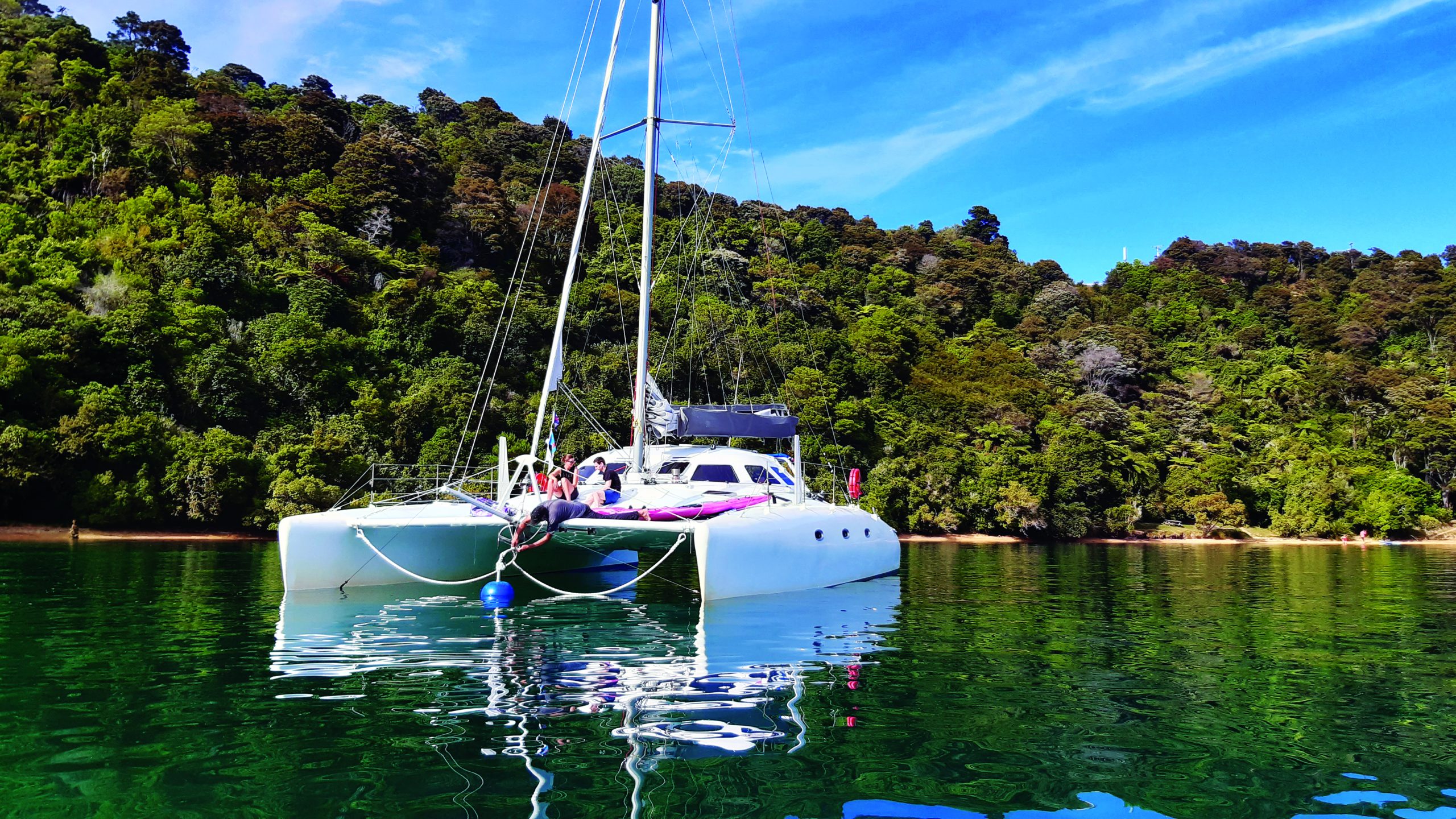
I recall other memorable sails: A fast reach from Mahurangi to Man o’ War Bay in less than two hours. Lesley snoozing, me relishing steering in a fast reach with main and blade jib, averaging nearly 20 knots.
A beat back from the Bay of Islands, coming up behind a modern production European 50-foot monohull, slowing to 9 knots to pinch above them, then taking off so we couldn’t see them even with binoculars a few hours later.
Unexpectedly having to thread the Colville Channel, beating into 40 knots. Two deep reefs, the self-tacking blade jib eased a bit to power through the steep waves. Twelve knots and pointing high, but easing the speed down a bit when a steep set of waves came along.
Ghosting in four knots of breeze with a boat speed of twice the wind speed.
Skyborne comes from the drawing board of Jeff Schionning, one of Australia’s pre-eminent catamaran designers. She’s a Line Honours design, which was effectively the prototype for the well-known Waterline Series.
Like some other purposeful Schionning designs, Skyborne is 12m long and a healthy 7.5m wide. This is a form follows function deal – it’s an efficient beam for the boat. On our circumnavigation of the North Island, via Cape Reinga, Marlborough Sounds, Tory Channel, Wairarapa Coast, we had a ceramic vase with an orchid in it sitting on the saloon table. Not stuck down. And it stayed there.
In the same way a motorbike can accelerate out of danger (an option not available to many heavier vehicles), so a cat like Skyborne has speed as a safety factor. In some instances, you can outrun the weather. And in that beat through the Colville Channel, we were out of there in an hour or so. Other sailboats of similar size would have taken five or six hours.
Another passage on the wind, exiting the Tory Channel, wind against tide. Bumpy. Windy. Very. We set course for Cape Palliser, and passed it in a few hours. A keelboat near us battled all day, and diverted to Wellington. We know, because that boat arrived in Napier a week later on the back of a truck, while we were waiting.
So here I am on the hard readying Skyborne for new owners we’re confident we’ll find. And I’m also thinking about the essential nature of all this.
This closeness to boats is a long-standing thing. For when you consider the great diaspora of humankind, you inevitably recall the big jumps that happened, all happened across water. The great civilisations of discovery and the eras that defined them – the Polynesians, the Phoenicians, the Greeks, the Arabs, the Vikings, the Portuguese, the Dutch, the French, the British – they all depended on seaworthy boats. And all those boats needed first